

The audiovisual industry is filled with brilliant people. We have engineers who can solve problems no one else sees, technicians who can rescue a live event under impossible conditions, designers who can translate complex requirements into elegant systems, and sales professionals who help us understand how to move ideas from possibility to reality.
What we do not always have is a clear plan for turning those talented people into strong leaders themselves. The Peter Principle is pretty much the norm. Do well in your role and get promoted… as it should be. But then, you’re often left to figure out that new role without investment in the skills necessary to be successful. Someone earns a new title, and is suddenly responsible for people, budgets, strategy, conflict and organizational outcomes. We assume they will figure it out because they were successful in their previous role. What people don’t tell you as you step into management is that individual contributors are responsible for the “stuff” that needs to get done, while managers are responsible for the people doing it and accountable to the organization funding it.
That is not leadership development. It is leadership by chance.
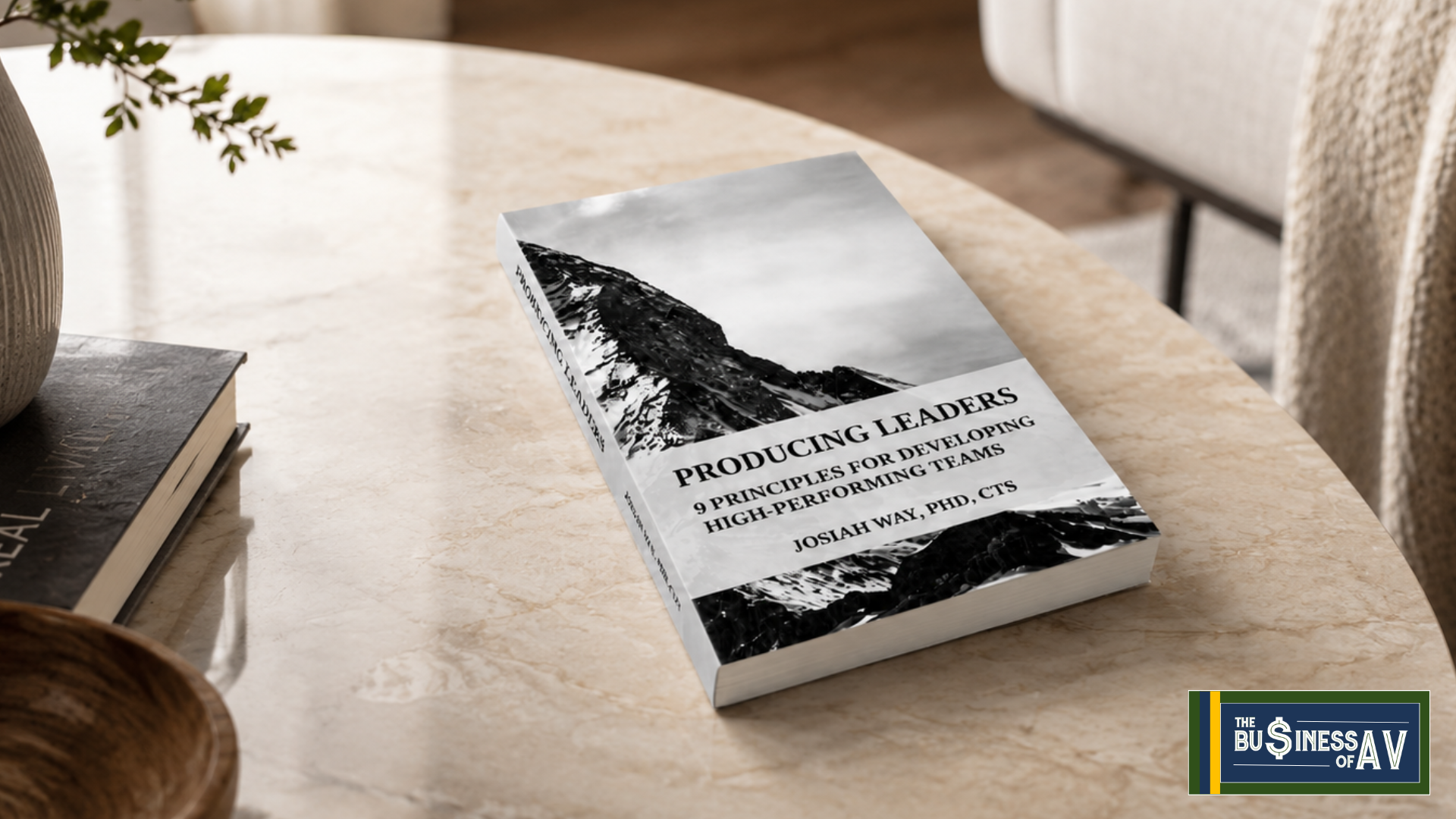
I have spent more than 30 years working across technology, higher education, media, entertainment and the arts. During that time, I have led teams, built organizations, made difficult decisions, succeeded publicly and failed privately. I have also had the privilege of mentoring people who went on to become leaders in their own right. That experience is what led me to write my forthcoming book: Producing Leaders: 9 Principles for Developing High-Performing Teams. The book is not built around theory for theory’s sake. It is built around the principles I have relied on when the stakes were real, the resources were limited and the people involved deserved better than generic leadership advice.
The first principle is that all of life is sales. Those who know me know that’s no surprise. Leadership is influence. Every time we ask someone to support a new direction, adopt a standard, approve a budget, take a risk or believe in a vision, we are selling ourselves. The best leaders do not manipulate people into agreement. They build trust, communicate value and create genuine buy-in.
That influence has to be connected to strategy with purpose. Leaders should be able to explain where the organization is going, why the direction matters and which values are not negotiable along the way. A strategy without purpose becomes activity. Purpose without strategy becomes aspiration.
And from there… Structure matters just as much. Organizational design is a puzzle, and every piece affects the others. Building an org isn’t about just hiring people, it’s an art form that requires a skill of it’s own. The right people can still fail in the wrong roles. Strong teams can underperform when accountability is unclear, decision-making is slow or responsibilities overlap. Leaders must design organizations for impact, not simply preserve structures because they are familiar.
Next, great leaders must also understand something that can be uncomfortable to say out loud… the business powers the mission. We are a business. We are accountable to that business. Whether the organization is a corporation, university, nonprofit or public institution, the work has to be sustainable for its benefit. Revenue, funding, margins, resources and measurable outcomes are not distractions from the mission. They are what allow the mission to continue. Leaders have a responsibility to make decisions that protect both the people and the organization employing them.
That does not mean leadership becomes cold or transactional. The strongest leaders I know are authentic. They are transparent when they can be, vulnerable when they should be and willing to admit when they do not have every answer. They also create what I call an empowerment cycle… Mentorship develops capability. Capability creates trust. Trust earns freedom. Freedom creates ownership. That is how people grow beyond simply following instructions.
But, as we all know, it’s not all just wine and roses. High-performing teams also actually need and require productive conflict. Avoiding hard conversations does not preserve culture. It weakens it. Healthy disagreement, handled with respect and clarity, often produces better decisions than artificial consensus. And parallel to that, leaders need to learn how to fail up. Failure should not automatically end a career, a project or an idea. Sometimes failure reveals that the path itself needs to change. The question is whether we learn, realign and move forward wiser than before.
Finally, leaders must know how to position value. I’m a shameless self-promoter. And I’ll say, if you won’t promote yourself, who will? Acting advocating is equally important to the overall culture and success. Good work matters, but invisible work is often misunderstood or overlooked. Leaders need to communicate impact, advocate for their teams and help people understand the value being created.
I wrote this book because leadership is too important to leave to chance. Our industry does not simply need more managers. It needs leaders who can build people, protect organizations and create the conditions for high performance. That is the work. And it is worth doing intentionally.
Listen to the accompanying Higher Ed AV Podcast for a deeper dive: https://higheredav.com/?p=12383