
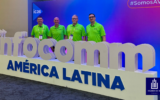

I came home from InfoComm América Latina 2026 thinking a lot about investment. Not investment in the traditional business sense of opening offices, expanding distribution, or calculating the size of a new market, but investment in people. After three days in Mexico City, that was the story I couldn’t get out of my head.
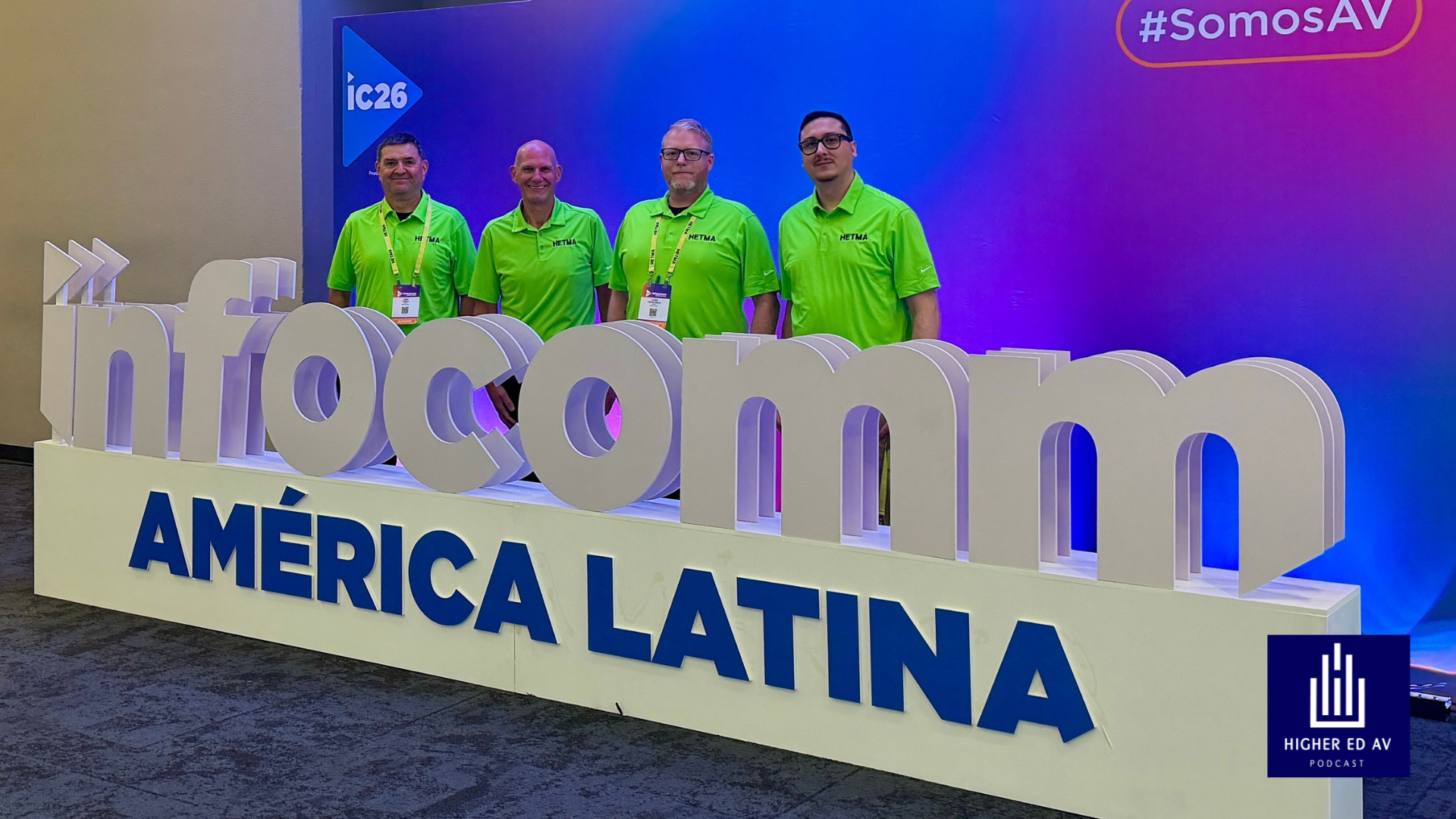
I went into the week not really knowing what to expect. This was only the second InfoComm América Latina, HETMA had never exhibited there before, and we intentionally kept things pretty simple. We had a small booth and a team of four, brought some swag, planned our Higher Education Summit, and figured we would spend the week introducing ourselves, meeting people, and learning more about the region. I’ll admit that I expected it to be a relatively easy show for us, and I was very wrong.
From the moment the floor opened on Wednesday, we were slammed. People kept coming to the booth asking who we were and what we did, and that part wasn’t unusual. HETMA gets that question at almost every show because we aren’t selling a product, and an end-user organization sitting on a trade show floor can sometimes be confusing at first. What was different was how quickly people understood the need once we explained what HETMA was about.
An integrator would hear about HETMA and immediately say, “I work with four universities that need this.” Someone else would walk a customer over and introduce them to us, while manufacturers, consultants, and higher education professionals kept doing the same thing throughout the week. By the end of the three days, we had 665 unique booth scans and had run out of almost everything we brought with us, including far more swag than I thought we could possibly give away.
The number was impressive, but it wasn’t really the important part. What mattered was why people kept coming back and why the conversations lasted as long as they did. There was a hunger for information and connection that was impossible to miss, and it became clearer with every conversation we had.
We talked about AV-over-IP, remote monitoring, support models, budgets, learning spaces, AI, and the same kinds of technology challenges we talk about every day in higher education in the United States. There were certainly differences in how those challenges played out, but the fundamental desire was the same. People wanted to know what their peers were doing, learn from someone who had already solved the problem they were facing, and have a community they could call when they didn’t know the answer.
That really hit me because those of us who have been fortunate enough to work within strong industry communities sometimes forget how valuable that access is. We can call someone at another university, ask a manufacturer a question directly, jump into a community conversation, or find somebody who has already deployed the technology we are considering. We attend conferences where people openly share what worked and, probably more importantly, what didn’t. That kind of access becomes normal to us, but it isn’t normal everywhere.
Several conversations throughout the week came back to the same idea. People told us that they often look to what is happening in the United States as a benchmark for technology and higher education, but the information doesn’t always make its way to them in the same way. Sometimes their access to new ideas or products depends heavily on the relationships they have with their integrator or manufacturer, and if those relationships aren’t strong, there can be a real gap.
That is where I think the business conversation starts to become interesting. We talk all the time about developing markets and expanding internationally, but most of those discussions eventually turn into conversations about selling products. How many potential customers are there, how many projects exist, who are the channel partners, and what does distribution look like? Those questions obviously matter, but if we want a market to grow, we also have to invest in the knowledge that allows people to confidently make decisions inside that market.
I saw that firsthand during the education portions of the show. InfoComm América Latina put a real emphasis on summit-style education, and you could actually see the traffic patterns on the show floor change as people moved in and out of those programs. People were there to see products, but they were also clearly there to learn, and that appetite for education was one of the most noticeable parts of the week.
Our Higher Education Summit on Friday made that even more obvious. John from Alamo Colleges, Rodrigo from UCLA, and Chris from The Ohio State University each talked about their campuses, the technologies they are using, how their organizations have evolved, and some of the challenges they face supporting learning environments. We then brought Andres from AVI-SPL into the conversation and opened it up to everyone in the room, which was where the session really started to become valuable.
I didn’t want us to fly into Mexico City from the United States, sit on a stage, and tell everyone, “Here is how you should do higher education AV.” That would have completely missed the point, so instead we kept turning the conversation back to the room. We asked whether they were experiencing the same challenges, what those challenges looked like at their institutions, what got in the way, and where they saw opportunities to move forward.
The discussion went everywhere. Budgets came up, of course, because apparently there is no country where higher education technology professionals believe they have enough money. We talked about remote monitoring, AV-over-IP, staffing, support, and the way institutions make decisions. There were plenty of similarities to what we experience in the U.S., but there were also differences that we needed to hear and understand rather than assume we already knew.
Eventually we broke into table discussions, and that may have been my favorite part of the entire week. The formal program ended, but the conversations didn’t, and people kept comparing experiences and sharing ideas. At some point I literally packed up our materials and headed back down to the booth while people were still sitting there talking, and they stayed another half hour or more. When people are still having the conversation after you have technically ended the event, you know there is a real need.
Another thing became increasingly clear to me throughout the week: we have to be careful when we use terms like “Latin America” as though we are talking about one market. We aren’t. Mexico is different from Colombia, Colombia is different from Brazil, and Brazil is different from Mexico. There are cultural differences, business differences, language differences, geographic differences, and differences in the way public and private institutions operate.
That probably sounds obvious when you say it out loud, but industries have a bad habit of grouping regions together when we develop strategies. We talk about LATAM, EMEA, APAC, and other giant geographic areas because it makes the spreadsheet easier. The people living and working inside those regions don’t experience them as a spreadsheet, and that is something every company thinking about international growth needs to remember.
Localization, then, has to be more than translating marketing materials into Spanish or Portuguese. It means listening, finding the local leaders who already understand their communities, and recognizing that the model that works in Los Angeles, Dallas, New York, or London might not be the right model somewhere else. Even if the technology is identical, the business environment surrounding it may not be.
We started having conversations during the week about HETMA potentially doing more in Mexico, Brazil, Colombia, and elsewhere throughout the region. People asked us to come down and help create more opportunities for higher education technology professionals to connect. What I kept telling them was that we don’t want to come in and dictate what that community should look like. We can provide resources, platforms, templates, connections, and experience, but the leadership needs to come from the people who actually live and work there if the model is going to be sustainable.
One of the unexpected lessons of the week also came from our happy hours. People sometimes joke about HETMA having a bar at the booth, but there is a reason we do it, and it has never really been about the beer. The beer simply gives people an excuse to stop, and once they stop, conversations happen.
An integrator ends up talking to an end user, a manufacturer meets someone they wouldn’t normally see at their booth, and a university technology manager hears another person describing a problem they have already solved. The formality disappears and suddenly people are simply talking to one another. That is where relationships start, and those relationships often become far more valuable than whatever first brought someone to the booth.
By Thursday and Friday, people weren’t coming to our booth because they had just discovered us. They were coming back because they knew other people would be there. Some would grab a drink and hang out, while others would bring somebody new over and introduce them. The booth started to feel less like an exhibit and more like a meeting place, which is exactly what we had hoped it could become.
Then two different exhibitors asked us where our booth was going to be next year because they wanted to book space near us. That was the moment I knew something had changed. We had gone from being the organization people didn’t quite understand on Wednesday morning to becoming part of the community infrastructure of the show by Friday afternoon.
So, yes, we booked our booth for next year before we left. We are going bigger, with plans for an island booth, more programming, another education summit, and more room for exactly the kinds of conversations we watched happen this year. What excites me most, though, isn’t the square footage. It is what can happen during the next year as those relationships continue to grow.
AVIXA deserves a tremendous amount of credit for what they are building with InfoComm América Latina. It would have been easy to launch a regional trade show, fill a hall with exhibitors, sell some booths, and call that enough. Instead, there was a clear investment in education and in creating an experience that made sense for the people who were there, and you could feel how much that mattered.
We had people thank us simply for showing up, and that caught me off guard at first. My initial reaction was that we should be thanking them because we were the guests and they were welcoming us into their community. Eventually, though, I understood what they were really saying. They appreciated being seen, being included, and having people make the effort to come to them rather than always expecting them to come somewhere else.
There is an important lesson in that for the business of AV. If we believe there is opportunity in a region, then our investment cannot begin and end with putting products into the channel. We have to help develop the ecosystem around those products by supporting education, trusted relationships, local leaders, and communities where people can openly exchange ideas and learn from one another.
When those things exist, people become more confident. They take bigger swings, try new technologies, make better purchasing decisions, and develop stronger partnerships. The industry grows with them, which means that investing in community is not separate from business growth. In many cases, it is what makes business growth possible.
That is ultimately what I brought home from Mexico City. There are talented people all over the world doing incredible work who want access to the same conversations many of us already enjoy. They want to learn, contribute, and share what they have figured out, and sometimes what they need most isn’t another company arriving to tell them what to buy.
Sometimes they need people who are willing to invest in bringing the right people together and then stay long enough to help those relationships grow. The market is already there, and the real question for the rest of us is what we are willing to do to become part of it.
Check out the Higher Ed AV Podcast recap episode: https://higheredav.com/376-infocomm-amrica-latina-recap-higher-ed-av-podcast-with-joe-way/