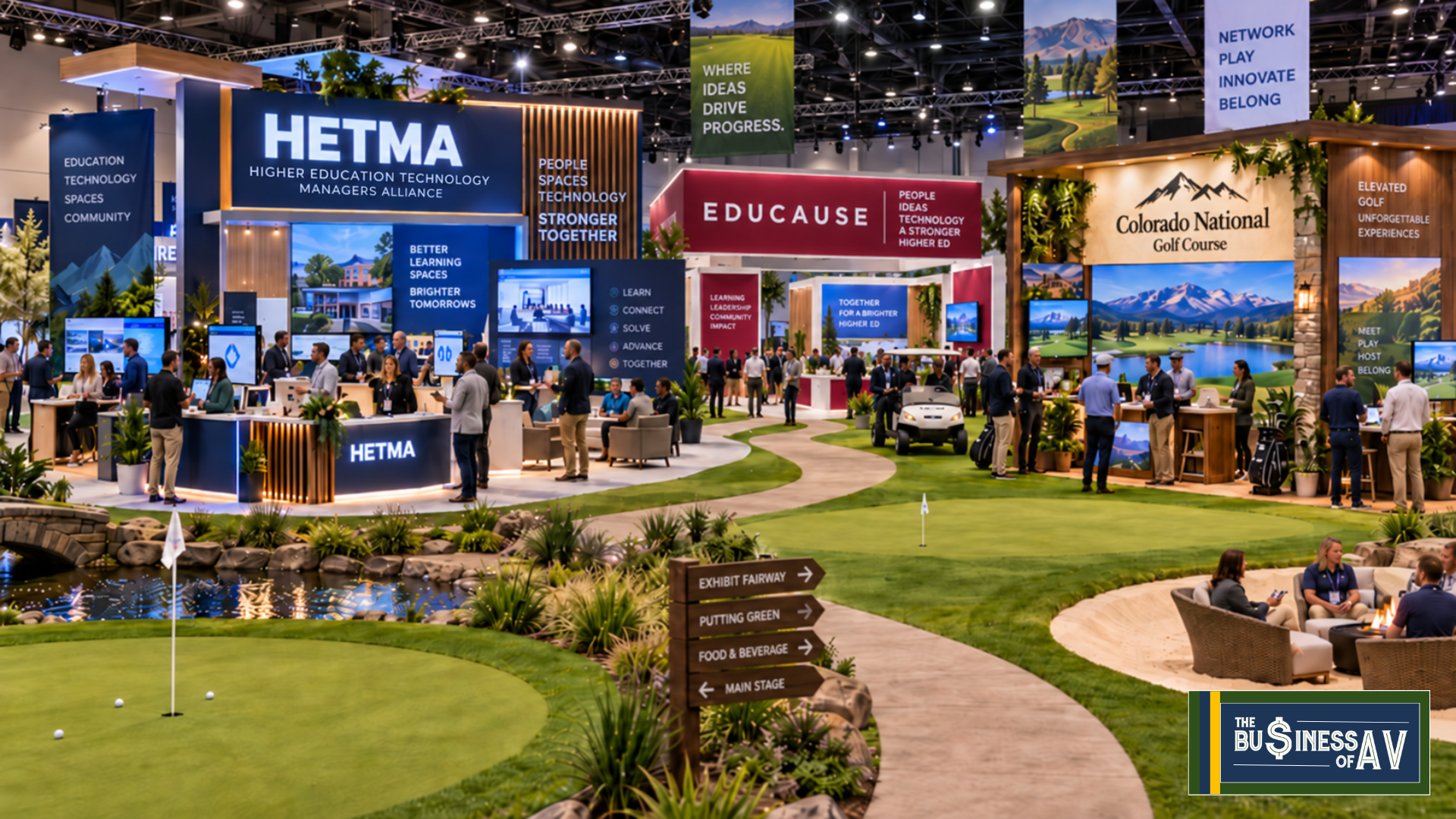


There is something about a golf tournament that lowers the temperature and encourages fellowship among peers. Titles matter less, company logos on shirt chests demonstrate support rather than sales attempts, and the normal pressure to pitch or perform fades for a few hours. What is left is genuine conversation and listening, friendly competition, and the realization that most of us are not nearly as good at golf as we think we are.
That was exactly the spirit behind the HETMA Golf Classic this year. The purpose was simple enough… bring people together, have some fun, and raise money for the HETMA Prism Scholarship. The scholarship remains one of the things I am most proud of in my entire career because of what it creates… opportunity, opens doors, and bringing new voices into an industry that gets better every time our community becomes broader through new perspectives and relationships. By that measure alone, the day was a success. But as the round unfolded, it became clear that something else was happening at the same time. What started as a fundraiser was quietly becoming something more important… it was becoming a purposely carved-out moment for people across all channels to connect at a human level.
And by the time we moved from the golf course to the EDUCAUSE show floor, it felt less like we were leaving one event and starting another, and more like both the same and new relationships were simply continuing to grow… just at a different address.
That was the part that stayed with me most. We talk all the time about the higher ed vertical, but I’m not so sure the word “vertical” is even the right word anymore. A vertical sounds neat and clearly defined, yet the work we are doing across higher ed is anything but neat and defined. AV, IT, networking, instructional design, facilities coordination, cybersecurity concerns, enterprise systems, media management, digital signage, channel partnerships, training and certification, and engaging membership organizations are no longer isolated aspects of our careers. They overlap every day and in every action we take… the lines between them continue to blur. And that’s a good thing. Modern campus needs are not organized around the boundaries our industry traditionally created for us, and our teams are being forced to operate according to the new reality.
The people who gathered at some point this last week, at either the Golf Classic or EDUCAUSE, represented nearly every part of that ecosystem we are forced to navigate in order to be successful. There were AV technology professionals, manufacturers, integrators, consultants, “partner pavilion” connections, senior executives, industry service providers, event providers, and people who work across several of those categories at once. I’m sure I’m missing many.
Sure, some of these who gather compete with one another, some sell to one another, and some will partner on one project while competing on the next. Yet none of that seemed particularly important for that week. And to be honest, it was refreshing. For once, everyone was working toward the same things… raise money for a worthy cause, build relationships, have fun, support the community, and of course plant some no-pressure sales seeds. Specifically on the golf course, somewhere between the bad drives, long putts, raffle tickets, conversations, and inevitable scorecard creativity carved out through mulligan packages, many of the labels just disappeared.
That mattered even more when EDUCAUSE began because trade shows can be strange environments. The Golf Classic is one thing, because we curate the experience for the attendees, while at a trade show, we are the attendees (while ironically also curating the experience for their attendees as well). At trade shows it’s nearly impossible to expect meaningful relationships to develop inside short and highly transactional booth visits. While we rush between booths, attend educational presentations, schedule meetings in thirty-minute increments, jump on a floor tour, and try to fit complicated conversations into whatever time remains before the next appointment, shows can often become one big blur. Yet, that wasn’t the case this year for those who took part in the curated HETMA experience.
“Golfucause” week changed the normal dynamic before EDUCAUSE ever started. People arrived at the show already knowing each other a little better, and conversations had context behind them. Someone who might otherwise have been just another name on a calendar was now a person you had spent hours laughing with, competing with, or trying to save par alongside. That changes the way we listen and the way we talk. It changes how comfortable we are asking questions, and it makes it easier to admit that we do not have every answer. In an industry that is getting more complex by the day through rapid change and innovation (*cough*, AI, *cough*), that kind of open honesty may be one of the most valuable things we can create.
The higher ed technological landscape is becoming too complicated for any one group to solve alone. AV cannot do it alone, IT cannot do it alone, and neither can manufacturers, integrators, consultants, facilities teams, instructional designers, or campus leadership. The systems we are building now cross too many boundaries and depend on too many layers for anyone to pretend that one discipline owns or can solve the entire problem. That means the relationships between those groups have become just as important as the technology connecting their systems. I saw that throughout EDUCAUSE, where AV professionals were participating in conversations about cloud platforms and artificial intelligence while IT leaders were spending more time thinking about what happens inside physical spaces. I also saw manufacturers listening to campus challenges before jumping to a product pitch, which may sound small but is exactly the kind of shift this industry needs. True dialogue was the theme of the week.
The business of AV has always been about more than equipment, even if our industry focuses on products and SKUs as the default. Yet, it is popular to talk about being a “relationship” industry and not a “technology” industry, to be honest, very few actually act upon that. And that’s understandable because it is the “stuff” that we charged to manage on a daily basis. But it’s the relationships that form the foundation of the product management success. Companies and institutions that understand that are the ones that seem best prepared for where our market is going.
Almost every meaningful project today requires an ecosystem, whether we want to call it that or not. Manufacturers need integrators who can deploy their technology well, integrators need manufacturers who understand the realities of the client environment, and consultants need accurate information from both. Campus teams need all of them to understand institutional priorities, budgets, governance, security, accessibility, and the human reality of supporting systems after everyone else leaves. That may be the bigger lesson I took away from “Golfucause” this year. The value was not simply that people attended the same event or happened to play the same course… the value was that people from across the entire higher education community began behaving more like they were part of the same thing. Even while EDUCAUSE had “neighborhoods” separated by service types, the lines were fluid with crossover being the norm rather than the exception.
We have spent years talking about convergence as though it were primarily a technical shift. AV moved onto the network, cloud platforms entered the room, data became part of the conversation, and AI is now accelerating nearly every part of the technology stack. The physical classroom, enterprise network, collaboration platform, and management layer are becoming increasingly connected whether our organizations are structured for it or not. The technology itself has largely converged already… it’s the people and organizations that are still playing catch up. Legacy thinking is the blockade, but times like “Golfucause” week demonstrate that we are all attempting to solve the same problems, just from different places.
Most importantly, the impact of this means that all of us have to become more comfortable working with people whose incentives, responsibilities, and perspectives may be different from our own. It means recognizing that the best outcomes will come when people know how to work across different perspectives, and find ways for those to align for a common purpose. That is where gathering together for one another like what happened at “Golfucause” week matter. An “event” gives us somewhere to go, while a “gathering” gives us a reason to connect. An event is built around schedules, sessions, booths, and agendas, while gathering is measured by the relationships that continue after the formal program ends.
“Golfucause” became that kind of gathering this year. It began with a simple idea of playing golf and raising money for a cause we believe in, but it created a space where nearly every part of our vertical could come together without immediately defining who was the customer, vendor, competitor, or partner. EDUCAUSE then gave those relationships somewhere to go next within the context of our daily work. That is why the week felt different to me. The golf was not separate from the conference, fundraising was not separate from the business conversations, and the relationships were not separate from the strategy. Each part fed the next, and the result was a stronger sense that higher ed is at its best when the people who serve it put the first things first.
I have to thing that that is what growth looks like for our industry in the long run. It is not simply bigger events, larger booths, more product development, or just more technology, but stronger relationships between the people responsible for making all of it work for the benefit we are called to serve. Golfucause 2026 started on the greens, but ended as a gathering. For me, that was the real success of the week. A day that began by raising money ended up becoming a week where all aspects of our vertical (and industry) could gather, connect, and move forward together. That is the kind of growth worth building on.
Check out all the #EDUCAUSE26 podcast coverage here: https://higheredav.com/?p=13374.