

I have taken a fair amount of criticism over the years for specifying amplifiers that some people believe are too large for the loudspeakers connected to them. It usually starts when someone compares two numbers on a submittal. The loudspeaker may have a continuous rating of 300 watts, while I have specified an amplifier capable of delivering 500 or 600 watts. That difference gets circled, highlighted, and occasionally presented as proof that I am about to start blowing up speakers across campus.
After having this argument more times than I can count, I understand the reaction. The warning that “too much power will blow a speaker” has been passed around the audio industry for decades, and there is some truth behind it. Connect an enormous amplifier to a small loudspeaker, remove every form of protection, and let someone drive the system however they want, and something will eventually fail. I am not advocating for that.
What I am doing is building enough headroom into the system so the amplifier can handle moments that are louder than normal without falling apart.
Headroom Is Not the Enemy
The power rating printed on a loudspeaker does not perfectly describe everything that will happen to it in an actual room. Speech and music are constantly changing. A faculty member may speak at a fairly consistent level for most of a lecture, then lean into the microphone or raise their voice to emphasize a point. A video might have quiet dialogue followed by a much louder transition. At an event, someone will inevitably ask for “just a little more volume” after the room fills with people.
Those brief increases are where amplifier headroom earns its place in the design. The system does not need maximum power every second, but the amplifier needs enough reserve capacity to reproduce those peaks cleanly when they arrive.
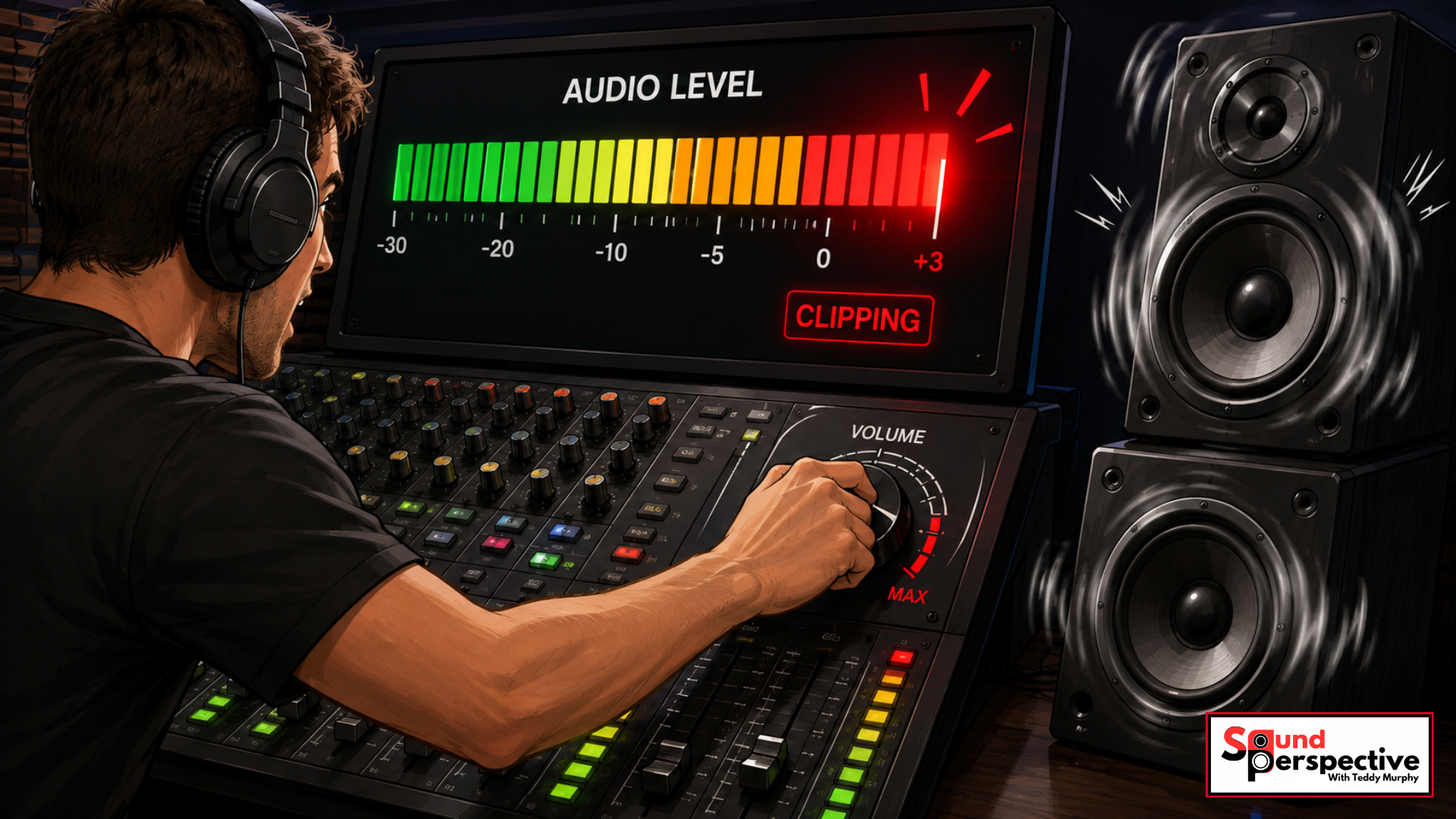
When the amplifier is too small, it may work perfectly well right up until it does not. During commissioning, the room sounds acceptable. The microphone is clear, the music plays, and everyone moves on to the next item on the checklist. Once the space is occupied and someone starts pushing for more level, the amplifier reaches the limit of the voltage it can produce. The incoming waveform continues to rise, but the amplifier cannot follow it, so its peaks are flattened.
That is amplifier clipping, and it is where the “smaller is safer” argument begins to break down.
Imagine a smooth sine wave with rounded peaks. Light clipping shaves off those peaks. Push the amplifier harder and the waveform becomes flatter, eventually taking on more of the characteristics of a square wave. I would be careful about saying that every clipped signal becomes a perfect square wave, because real audio is more complicated than a diagram in a textbook, but the comparison is useful for understanding what is happening.
A square wave contains strong harmonic content above the original frequency. As clipping becomes more severe, the amplifier creates additional high-frequency energy that was not part of the clean signal. In a multiway loudspeaker, the crossover directs much of that energy toward the high-frequency driver. The tweeter is not normally expected to handle the same share of power as the low-frequency driver, so this extra energy can create heat and cause damage surprisingly quickly.
This is one of the more frustrating parts of the amplifier conversation. A person can choose a smaller amplifier because it appears safer, push it into clipping whenever the room needs more output, and end up creating exactly the failure they were trying to prevent.
My preference is to give the amplifier some breathing room and control the system properly. I do not want it running with its foot against the floor every time we host an event or play a video with a wide dynamic range. I want the required power to be available, while the DSP, limiters, and gain structure keep that power within the safe operating range of the loudspeaker.
Depending on the loudspeaker and application, an amplifier rated at roughly one and a half to two times the loudspeaker’s continuous rating may be appropriate. I hesitate to present that as a rule because loudspeaker ratings are not always measured or published in the same way. Impedance matters. Program material matters. The expected sound pressure level matters. The manufacturer’s recommended amplifier range and limiter settings matter more than a shortcut someone remembers from years ago.
We also have to remember how quickly wattage increases when we begin talking about decibels. Adding 3 dB of amplifier headroom requires approximately twice the available power. Reaching 6 dB requires approximately four times the power. That extra capacity is not intended to be delivered to the loudspeaker continuously. It is there for the short peaks that would otherwise force the amplifier into clipping.
Clipping Happens Before the Amplifier, Too
There is another version of this problem that occurs before the signal ever reaches the power amplifier. Digital clipping tends to get mixed into this conversation, even though it occurs at a different point in the signal chain.
In a digital system, 0 decibels relative to full scale (dBFS) is the ceiling. Once the signal reaches that level, there is no additional space above it. If a microphone receiver, console, DSP, computer, or recorder attempts to push the signal beyond that ceiling, the waveform is cut off. The resulting distortion is created inside the digital signal path, and no amount of amplifier headroom can undo it later.
I have seen people turn down a DSP input and assume they fixed the clipping because the meter is no longer red. If the wireless receiver clipped before the signal reached the DSP, all they have done is turn down an already damaged signal. The same applies when a console clips its output before feeding another device. Every gain stage has to be checked in order because a clean-looking meter at the end of the chain tells us very little about what happened upstream.
This is also why amplifier selection cannot be separated from gain structure and commissioning. A larger amplifier without limiter protection can be dangerous. A perfectly sized amplifier receiving clipped audio from the DSP will faithfully make that distorted signal louder. A smaller amplifier driven beyond its capability will add its own distortion. None of these problems can be solved by looking at a single wattage number on a specification sheet.
When someone questions one of my amplifier selections, I am happy to have that conversation. We should be able to explain why an amplifier was chosen, the load it will see, how much output the room requires, and how the loudspeakers will be protected. Those are fair design questions.
What becomes tiring is the assumption that a larger amplifier must automatically be a poor choice. I am not choosing it because I want to see how much punishment a loudspeaker can take. I am choosing it because classrooms and campus events do not operate at one perfectly steady level, and I would rather manage clean power than fight distortion from an amplifier that never had enough capacity in the first place.
So yes, I will probably continue getting comments about my amplifier specifications. I can live with that. I would much rather explain the extra headroom during a design review than explain a rack full of clip lights after the room is full and the event has already started.