When we discuss amplifier power, the conversation usually begins with watts. How many watts does the amplifier produce? How many watts can the loudspeaker handle? Is a 500-watt amplifier enough, or should we move up to 1,000 watts?
Those numbers matter, but they do not tell the whole story. I have seen loudspeakers connected to fairly large amplifiers that still struggled to provide the level needed in a room. I have also worked with very efficient loudspeakers that produced plenty of usable volume with much less amplifier power. The difference often comes down to two things that are easy to overlook: speaker sensitivity and the distance between the loudspeaker and the listener.
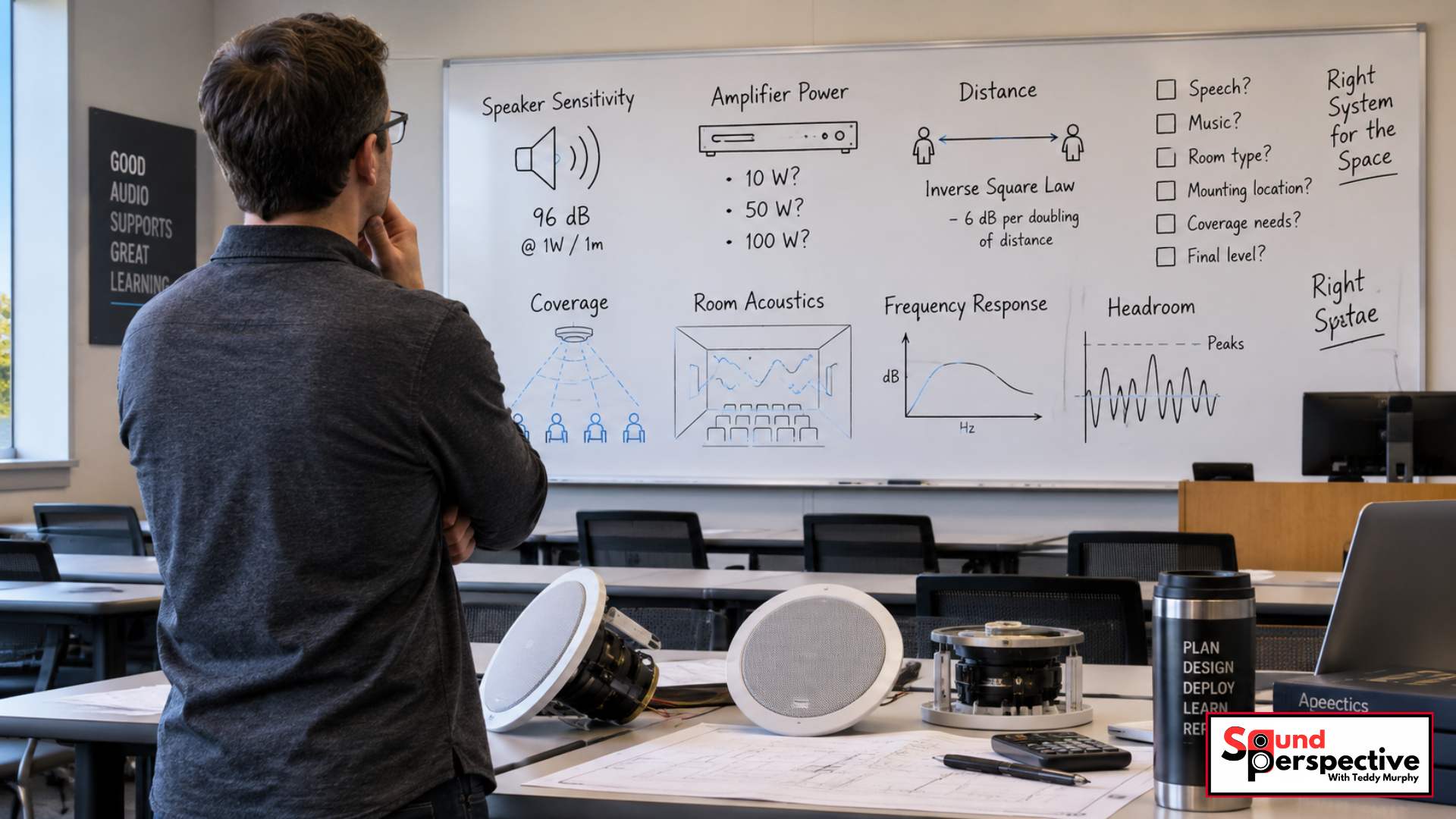
Speaker sensitivity is simply a measurement of how effectively a loudspeaker converts amplifier power into acoustic output. It is commonly measured by providing one watt of power and measuring the sound pressure level from one meter away. A loudspeaker rated at 96 dB sensitivity will produce approximately 96 dB at that distance with one watt. A speaker rated at 90 dB will produce approximately 90 dB under the same test conditions.
Six decibels may not look like a major difference on a specification sheet, but making up that difference with amplifier power requires approximately four times as much power.
That is where a speaker selection can quietly affect the rest of the system. If I select a speaker with lower sensitivity, I may need a much larger amplifier to reach the same sound pressure level. The amplifier may cost more, generate more heat, require more electrical power, and use more rack space. There may be perfectly valid reasons to choose that speaker, but I need to understand the tradeoff before I complete the design.
Amplifier power also does not translate directly into the kind of increase many people expect. Doubling the amplifier power only gives us about a 3 dB increase in level. Moving from 100 watts to 200 watts does not make the system twice as loud. Moving from 200 watts to 400 watts adds approximately another 3 dB.
This is one reason chasing wattage can become expensive very quickly. If the loudspeaker is not efficient enough for the application, buying a bigger amplifier may help, but it may not be the best way to solve the problem. Sometimes the better decision is a different loudspeaker, another loudspeaker placed closer to the audience, or a design with better control over where the sound is going.
Why distance matters
Distance is the other part of this discussion, and it is where the inverse square law applies. The name makes it sound far more complicated than it needs to be. In simple terms, sound gets weaker as we move farther away from the source. In an ideal free field, every time the distance from the loudspeaker doubles, the sound pressure level drops by approximately 6 dB.
If we measure 96 dB at one meter, we would expect roughly 90 dB at two meters, 84 dB at four meters, and 78 dB at eight meters. Real rooms have reflections from walls, floors, and ceilings, so the numbers may not follow that pattern perfectly. The principle still matters. A person sitting near the loudspeaker may hear a very different level than someone in the last row.
I have encountered rooms where the response to poor coverage was simply to turn the system up. That may improve the level in the back of the room, but it can make the front uncomfortably loud. It may also increase the risk of feedback and push the amplifier closer to clipping. The system becomes louder without becoming better.
This is why loudspeaker placement is every bit as important as amplifier size. Two properly placed loudspeakers may provide more consistent coverage than one loudspeaker trying to cover the entire room. In larger spaces, delayed loudspeakers can bring the sound closer to listeners in the rear rather than forcing the front system to do all the work. Ceiling loudspeakers use the same basic idea by reducing the distance between the loudspeaker and the listener throughout the room.
Directivity matters here too. A loudspeaker does not distribute every frequency evenly in every direction. Its coverage pattern helps determine how much sound reaches the audience and how much ends up on walls, ceilings, or other reflective surfaces. A loudspeaker with the correct coverage pattern can often use its available power more effectively because more of its acoustic energy is directed where people are actually sitting.
Putting it into practice
For a basic design, I start by considering the level required at the farthest listener. From there, I look at distance, loudspeaker sensitivity, coverage, and the amount of amplifier power needed to reach that level while preserving adequate headroom. I also have to consider what the system will reproduce. Speech reinforcement in a classroom does not have the same demands as a performance system, a gymnasium, or a space playing music with strong low-frequency content.
Suppose I am considering a speaker with a sensitivity of 96 dB at one watt and one meter. If the farthest listener is approximately eight meters away, the simplified inverse square calculation leaves me with about 78 dB at that location from one watt. Increasing the power to ten watts adds approximately 10 dB, bringing the calculated level to around 88 dB. One hundred watts would add another 10 dB.
That example is intentionally simple. Loudspeaker impedance, power compression, frequency response, room acoustics, directivity, mounting position, and the actual program material will all affect the finished result. Manufacturer prediction software and acoustic modeling are much better tools for final system design. Still, the basic math helps explain why a speaker rated for hundreds of watts may not provide the coverage someone expects.
It also shows why sensitivity should never be read by itself. A sensitivity number may be averaged over a particular frequency range, measured under conditions that do not match the installation, or presented differently by another manufacturer. Maximum sound pressure level, continuous power handling, frequency response, coverage, and distortion all belong in the conversation. A high sensitivity rating does not automatically make one loudspeaker better than another.
There is also a practical limit to solving everything with more power. Loudspeakers heat up as power increases, and some of that electrical energy becomes heat instead of sound. This is called power compression. As the voice coil gets hotter, the loudspeaker may become less efficient. On paper, doubling the power should provide another 3 dB. Under sustained real-world operation, the increase may be smaller.
My goal is not to find the amplifier with the largest number printed on the specification sheet. It is to create a system where the loudspeaker, amplifier, room, and listening distance work together. I want enough output for the farthest listener, reasonably consistent coverage for everyone else, and enough amplifier headroom to reproduce short peaks cleanly.
Watts are only one part of that decision. Speaker sensitivity tells us how much useful acoustic output we receive from those watts, while the inverse square law reminds us how quickly that output can fall as the audience gets farther away. Once those two ideas become part of the design process, amplifier and loudspeaker choices start making much more sense.