

When I started in higher ed AV, I was the one AV guy inside an IT department. Technically part of the team. Practically on my own. We shared an office. We did not share a frame of reference. That gap bothered me enough that I went back to school. I earned my degree in Information Technology with a focus in Cybersecurity, not because I wanted to leave AV, but because I could not do AV well anymore without speaking IT’s language. I needed to understand how they evaluated risk, how they thought about networks, and why they made the decisions they made. If I was going to advocate for AV on shared infrastructure, I had to stop sounding like a guest in the conversation. That decision changed how I work. But it also showed me how wide the gap really is.
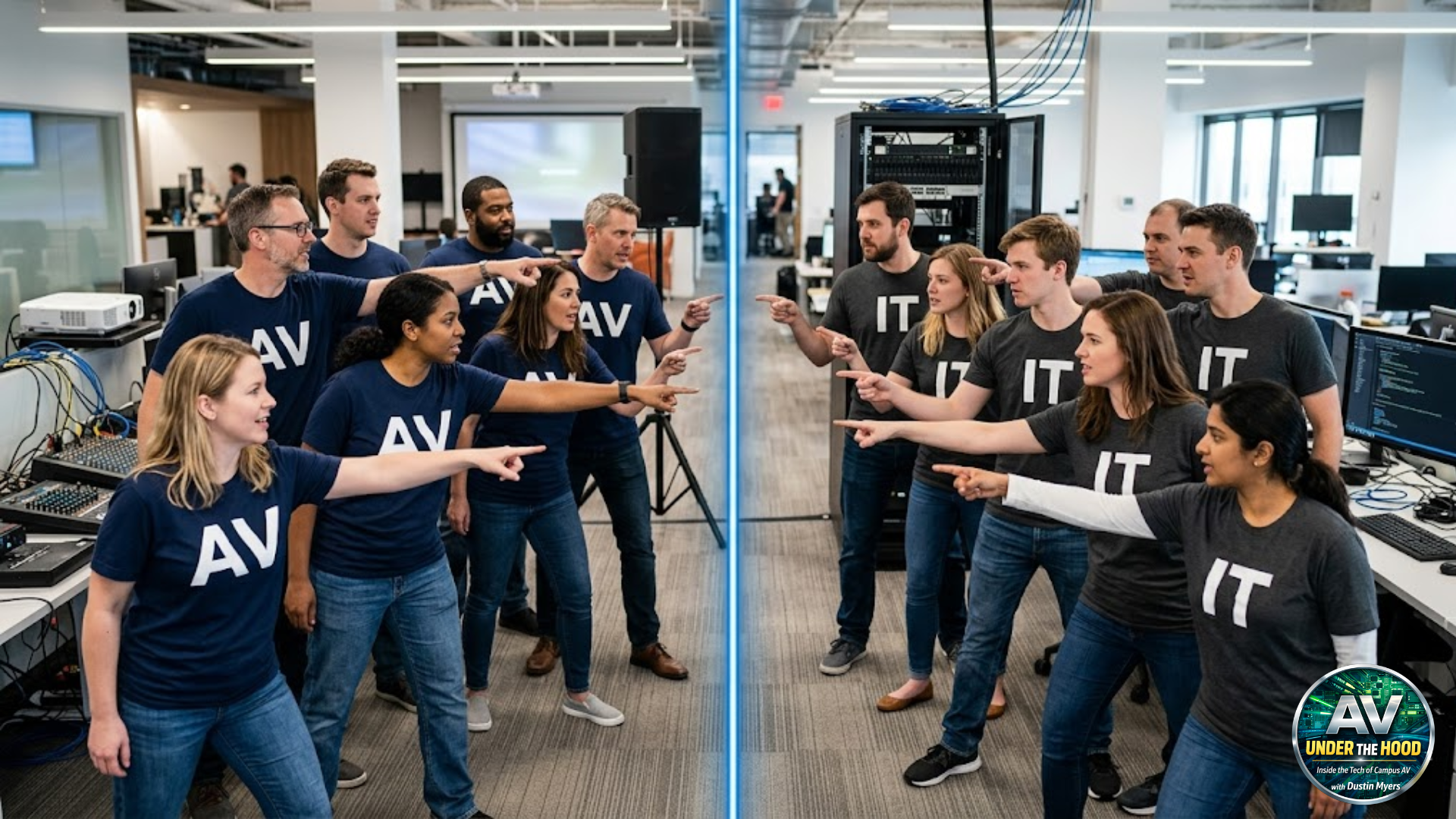
For decades, higher education treated AV and IT as related but separate. AV handled the room. IT handled the network. Those boundaries held when AV systems were self-contained. A room had its own switcher, its own display path, its own control logic. If something broke, troubleshooting stayed inside the room.
That world is gone. Classrooms now run on the network. AV moved onto IT’s network and inherited every dependency, policy, and constraint that comes with it. But AV still gets evaluated the way it always has. Faculty do not care what layer the failure lives on. If the room does not work when class starts, that is an AV problem in the eyes of everyone standing in it.
IT sees things differently. A campus network serves thousands of users and hundreds of applications. The networking team thinks in terms of traffic management, security posture, policy enforcement, and scale. Those priorities are necessary. But they produce a different definition of what “working” means.
I heard this story during a presentation last year. A team at another institution had a building where their AVoIP rooms were dropping video intermittently. Everything on the AV side looked clean. When they finally got the network team involved, it turned out QoS policies on the AV VLAN were never configured to prioritize video traffic. During peak hours, when the rest of the building was hammering the network, AV streams were treated as best-effort and got starved out. The AV gear was fine. The network was technically up. But the room experience was broken.
When AV says reliable, it means the room works every time someone walks in. Audio is clear. Video appears when expected. When IT says reliable, the conversation centers on uptime metrics, redundancy, and service-level targets across the enterprise. A system can meet every one of those benchmarks and still frustrate the faculty member trying to teach.
Bandwidth means different things too. AV sees it as a requirement tied to a stream. IT sees it as dependent on uplinks, oversubscription, concurrent demand, and what happens when a design that worked in one room scales to a full building. I have experienced pilots perform flawlessly and then seen the same design collapse at scale because nobody tested what forty active rooms do to the same infrastructure.
Security adds more friction. AV needs devices reachable and manageable. IT needs to minimize attack surface and enforce access controls. Both positions are defensible. But when a firewall rule breaks a control path, the AV team finds out because a room stops working during class. Not because someone sent a warning.
Having that cybersecurity background changed how I navigate those moments. I can explain why a firewall rule matters and also explain what happens in the room when a port gets blocked. That translation ability should not be rare. In this industry, it still is.
James King has written about this in his work on IT in AV that AV now plays a direct role in how students and faculty connect and collaborate. That means AV teams are expected to understand VLANs, firewalls, multicast, and QoS in ways that were not part of the job ten years ago. The field adapted. The organizational structures did not.
Most institutions still run AV and IT through different reporting lines, different budgets, different timelines, and different definitions of success. AV is driven by semester deadlines and faculty expectations. IT is driven by standardization, security, and enterprise stability. Those differences determine how each team prioritizes work and responds when something breaks.
Telling them to communicate better does not fix a structural problem. AV teams have to get better at framing problems in terms IT can act on. Saying the room is glitchy does not open doors. Showing that failures correlate with specific network conditions does. Documentation and patterns are leverage.
IT teams have to recognize that a network passing health checks does not mean services are performing well. A room that drops audio for three seconds during a lecture is not a minor event just because the switch stayed up.
And leadership has to stop treating this as a personality conflict. It is a design problem. If the institution wants reliable learning environments, AV and IT have to be structured to plan together and share ownership of the outcome.
I went back to school because I got tired of not being heard. That should not be what it takes. The industry needs AV professionals who understand infrastructure and IT professionals who understand real-time experience. Not because everyone needs a second degree, but because the systems we build now require both perspectives.
The real issue is not that AV and IT speak different languages. It is that campuses depend on both teams to deliver the same experience, and nobody built the organization to support that.
Until that changes, AV will keep owning failures it does not control. IT will keep supporting systems it does not see. And the room will keep being the place where everyone finds out the hard way.