
A Different Path into AV
I switched to working in AV a little less than three years ago. Before that, I spent about a decade as a social worker, most recently in vocational rehabilitation with the State of Iowa. During that time, I became aware of Gallaudet University and found myself fascinated by it. On the surface, it might look like just another higher education institution. In reality, it is anything but.
What Makes Gallaudet Unique
Gallaudet is the only university in the world designed specifically for the Deaf community, and it operates bilingually in English and American Sign Language (ASL). While all hearing students must sign for admission, Deaf students are not required to arrive fluent in ASL. Instead, they are supported through a variety of communication options, including spoken language support, captioning on mobile displays, and one-on-one signing at closer proximity when visual acuity makes distance viewing difficult.
Teaching, Technology, and a Visual-First World
Instruction at Gallaudet relies heavily on visual communication, which shapes how technology is used. Zoom plays an important role when classes are recorded, with a focus on capturing visual content accurately. Microphones are not common permanent fixtures in many classrooms, though they can be brought in as needed. The greater challenge is ensuring that all communication is visually accessible.
Cameras are not installed everywhere, and there is currently no great solution for dynamically switching camera focus between an instructor and other active signers in the room. At many other universities, classrooms designed primarily for hearing students already struggle to move cameras between speakers, but imagine the challenge when speakers are not using their voices. This highlights a challenge that feels familiar to anyone working in AV: technology does not always align cleanly with human communication.
Assistive listening options do exist across campus, using a mix of distribution methods. While some older assistive listening technologies are still in use, the university is moving toward Auracast in the near future.
Rethinking the Role of Interpreters
Many people associate events that are inclusive of the Deaf community with the use of an ASL interpreter, but that relationship is almost flipped at Gallaudet. Faculty teach through signing as their primary method of communication. Interpreters are more commonly used when Deaf students, faculty, or staff are interacting with members of the hearing community.
When I met with members of Gallaudet’s AV/IT team, there were two interpreters on the call, switching back and forth. This was necessary because only one member of the team is hearing. Yes, that means only one member of the team can validate audio quality by sound in a room. That reality can require a mental adjustment for those of us used to validating AV systems primarily through sound.
At Gallaudet, everything is built around the visual experience. Speakers may be present in rooms, but they are not essential. Sight is the critical sense. Audio plays a supporting role rather than a defining one.
When Audiovisual Priorities Flip
In many AV discussions around teleconferencing, lecture capture, or classroom design, there is an assumption that video can suffer as long as the audio is clear. For the general hearing population, that tradeoff often feels acceptable. We attend meetings with cameras off, look down at notes, or let our eyes wander while listening to a presentation.
In an environment designed for the Deaf community, that assumption completely breaks down. Visual engagement is not optional. It is the core of communication. Audio pickup and quality become secondary features that could be completely absent.
DeafSpace and Design Intentionality
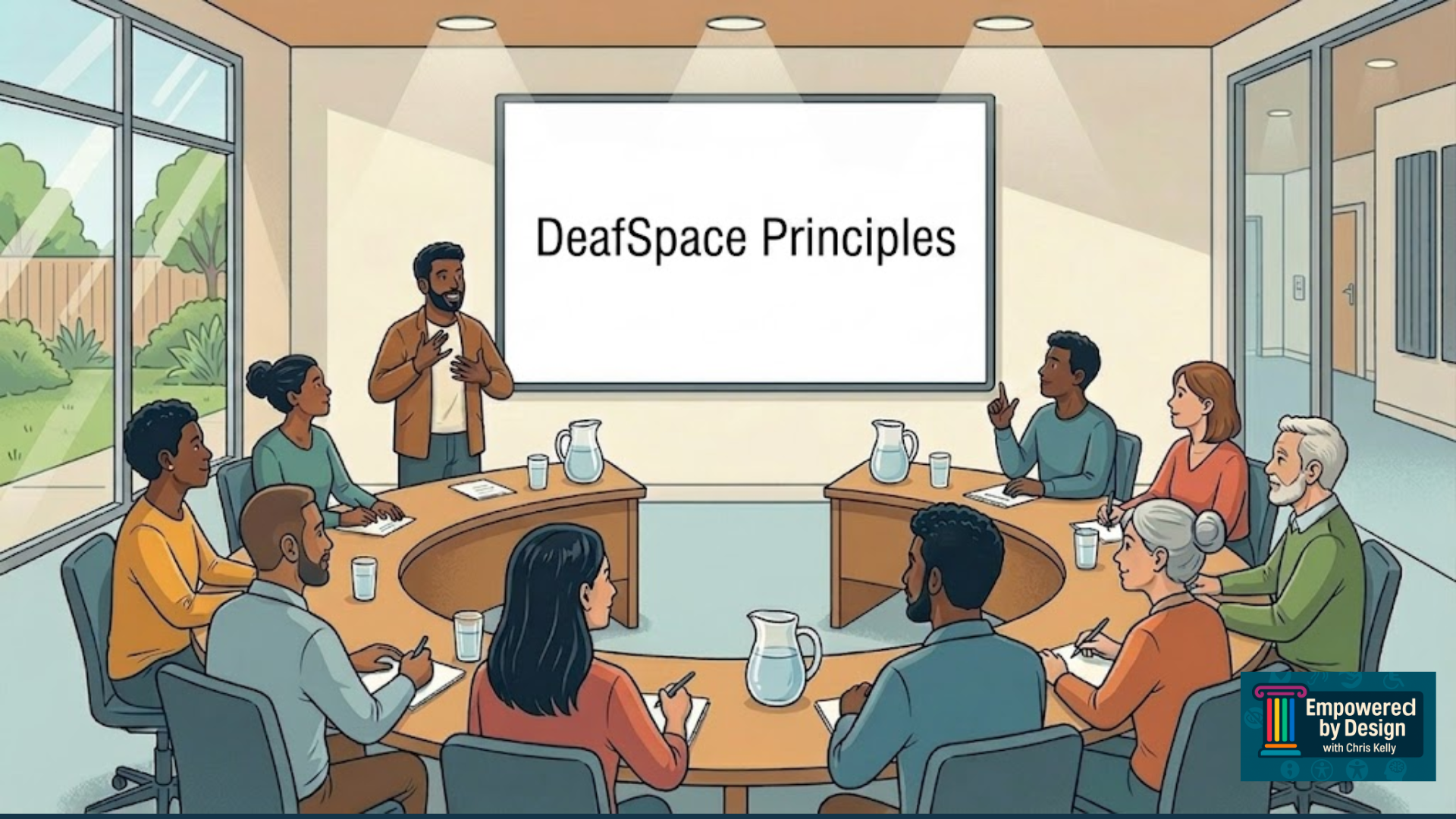
This led me to learn about DeafSpace, a design philosophy developed at Gallaudet that emphasizes visual accessibility and ease of communication. The university offers excellent resources outlining these principles, and there are meaningful lessons here for anyone involved in designing learning spaces.
Traditional classrooms often rely on rows or pods that prioritize visibility of the instructor but limit peer-to-peer communication. DeafSpace design encourages C-shaped or curved room layouts, allowing everyone to see one another clearly and follow signed interactions from all participants.
Watching ASL is an active and sustained visual task. Eye fatigue can happen even in the best environments. Lighting, therefore, must be intentional. Reducing glare, controlling shadows, managing natural light, and avoiding inconsistent backlighting all matter.
Surface color choices are also important. Flat, muted colors reduce reflections and visual distraction, a point reinforced by architectural color guidance from Sherwin-Williams here.
Another consideration is physical spacing. Members of the Deaf community often use more personal space than their hearing peers. This allows for a comfortable signing range and better visibility of others’ signing spaces. Height and placement of furniture also matter. Signing above a laptop or high surface is uncomfortable and can hinder communication.
What This Means for Higher Ed AV
So, what can a typical higher education AV manager take from all of this? Unfortunately, many institutions still treat accessibility reactively, often driven by accommodation requests rather than proactive design. Shrinking budgets make this even more challenging. That said, there are a few important takeaways worth sharing.
First, this is a useful mindset shift. AV does not always need to center equally on audio and video. It can be just as valid, and sometimes more effective, when visual communication takes priority. Thinking beyond traditional assumptions can help us design spaces that better support a wider range of users.
Second, small, incremental changes matter. Paying attention to paint colors, lighting, furniture design, spacing, and sightlines can make classrooms more inclusive without large capital investments.
Finally, accessibility improvements do not usually come from massive, one-time spending. They are built over time through consistent, thoughtful choices. Talk with your campus accessibility office. Ask where students and faculty are struggling. There may be low-cost changes you can make in your next budget cycle that have a meaningful impact. You do not know until you ask.