
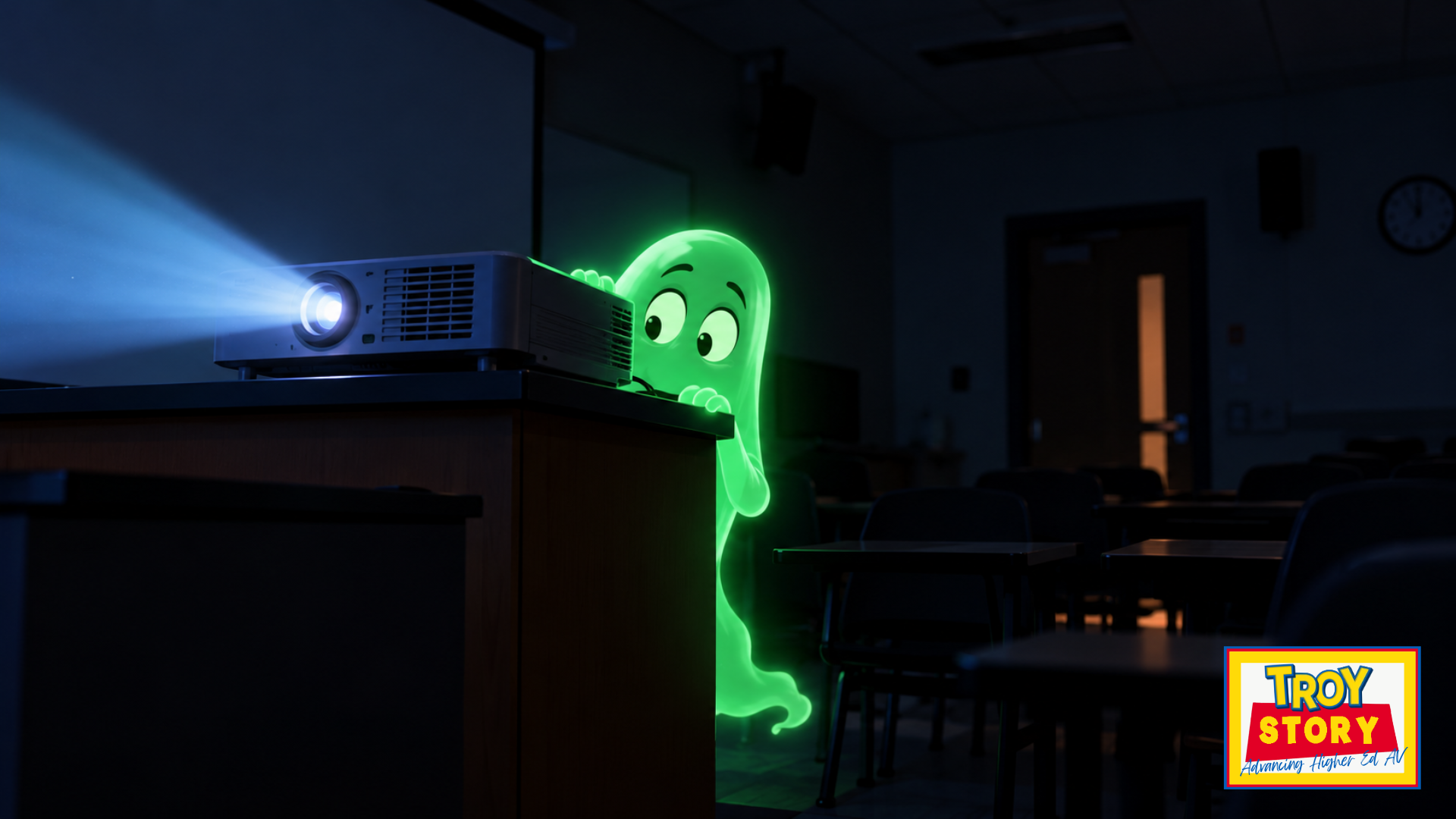


Every higher ed AV team knows the feeling. A call comes in from a classroom. The sound has stopped working, the projector won’t display an image, or something is making a noise that nobody can quite describe.
You head over, walk into the room, and everything works.
The instructor looks at you. You look at the system. Somewhere, a classroom ghost laughs.
I’ve spent enough time supporting classroom technology to know that my presence apparently fixes things. I would love to list that as a certification. Unfortunately, “walked into the room” doesn’t count toward my CTS renewal.
It also doesn’t tell us what went wrong. That’s the part that can get lost in the joke. We’ve all said some version of “it knew I was coming.” Sometimes the instructor says it first. Everyone laughs, the class gets moving again, and we head back to whatever we were doing before the phone rang.
But the person teaching that class still experienced a problem. They lost time, interrupted their lesson, and called for help in front of a room full of students. Finding a working system when we arrive doesn’t erase any of that. And if it happens again next Tuesday, our mysterious healing powers probably aren’t going to seem quite as charming.
When the Equipment Needs a Walk
Sometimes, the equipment even manages to fool the technicians. At a previous university, when I worked on the night crew, we would encounter equipment that simply would not cooperate. We would test it, troubleshoot it, and confirm that, yes, this thing was broken. Eventually, we would swap it out to get the classroom working and bring the suspect equipment back to the office.
The next morning, the day crew would deliver the news: “It works fine.”
Of course it does. It got its walk.
That became our explanation. The equipment got bored sitting in the same classroom and occasionally wanted to get out. Apparently, a trip back to the office was all it needed to reconsider its behavior.
After enough of these outings, we instituted a three-strikes policy. Every time a piece of equipment failed in a classroom but tested fine back in the office, we put a mark on the bottom with a yellow paint marker. Three marks meant we were pursuing an RMA. Something was wrong, whether or not it felt like demonstrating the problem on the workbench.
Those yellow marks gave us a history that a successful bench test couldn’t erase. Instead of starting the same argument every time a device came back, we could turn it over and count.
It was a simple way to deal with one of the hardest parts of AV support: a problem that won’t stay around long enough to be diagnosed. A failed piece of equipment at least gives us something concrete to investigate. A system that behaves perfectly during every test can leave us questioning everything, including whether we’ve somehow offended it.
Troubleshooting the Unexplained
We start looking for patterns. Does it happen at a particular time? With one laptop? After the system has been running for several hours? What happened immediately before the failure?
This is where listening matters. The instructor may not use the same terminology we do, but they were there when it happened. A detail that sounds minor might be the thing that helps us understand it.
“The screen went black” gives us somewhere to start. “The screen went black when I started the video, but I could still see my desktop afterward” gives us considerably more.
Getting those details requires a conversation in which people feel comfortable telling us what happened. If our response makes someone feel foolish for calling, we may have fixed nothing and made the next problem harder to investigate.
Keeping Track of the Ghosts
We also owe the next technician something better than a ticket that says “working upon arrival.” What was reported? What did we check? What did we try? Did the instructor describe something that might help connect this incident to the next one?
Otherwise, every call becomes the first sighting of the same ghost. Nobody knows the room has a history because that history lives in scattered conversations and somebody’s memory. Our yellow paint marker was a basic way of making sure that history stayed with the equipment. Useful ticket notes serve the same purpose across an entire classroom system.
There’s still room to enjoy the strange side of this work. Anyone who has spent enough time in classrooms has a story about equipment behaving in ways that seem almost personal. We trade those stories because other AV people understand the particular frustration of spending an afternoon testing a system that will wait until you leave to fail again.
With Halloween approaching, I’m willing to give the classroom ghosts a little credit. Their timing is excellent.
But when the next call comes in, we still have to take it seriously, ask good questions, and leave useful notes. The person who called needs to know we believe them, even if the evidence has vanished by the time we reach the podium.
And if the equipment just needs another walk, bring a yellow paint marker.