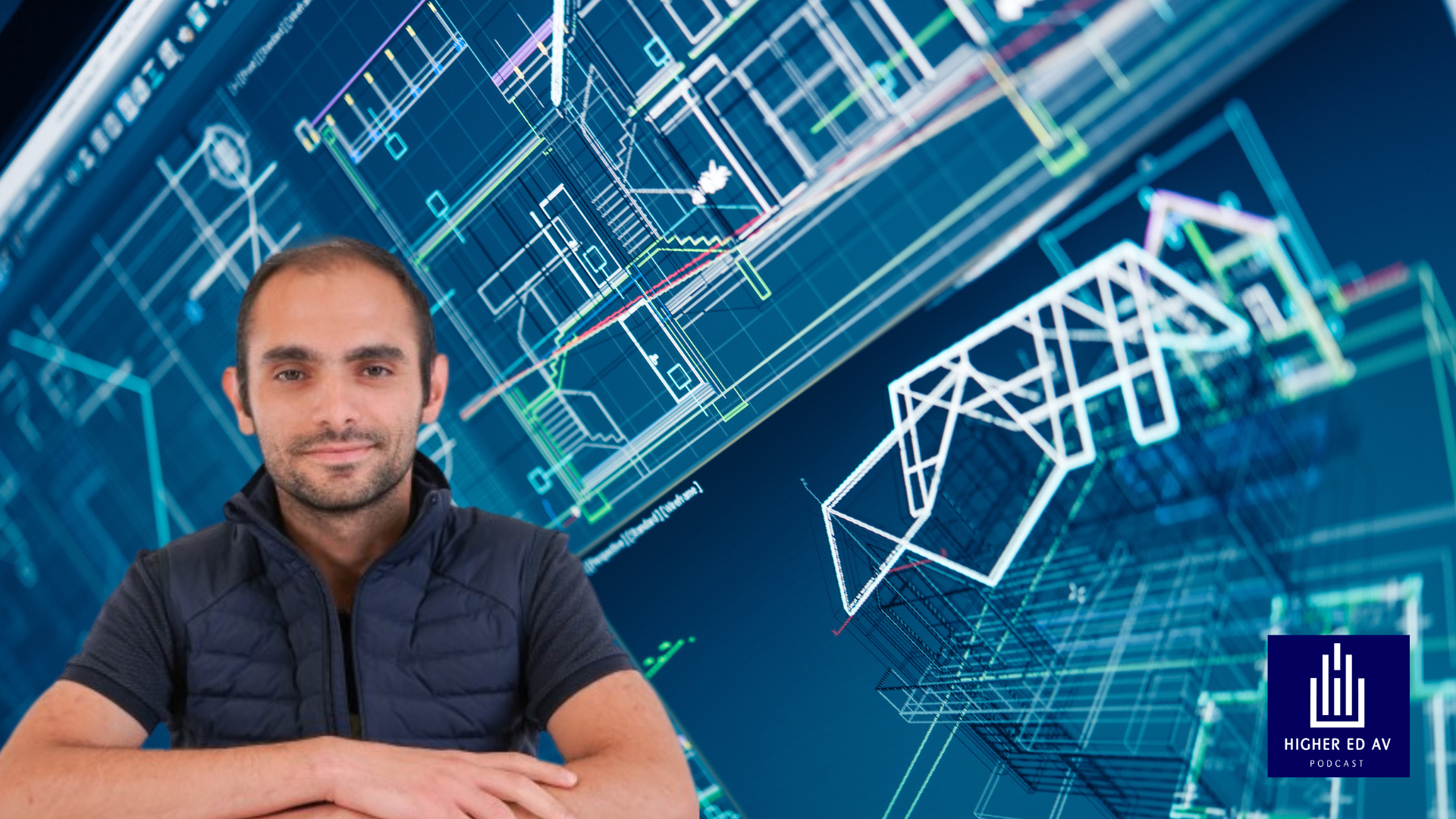







What happens when an architecture student gets dropped into the middle of an AV/IT organization that is looking to modernize spaces two decades forward? In this episode of the Higher Ed AV Podcast, Joe Way sits down with UCLA Master of Architecture student Taha Jamshidi to talk about the increasingly important intersection between architecture, technology, and the spaces where people learn. Taha shares how his work with UCLA Digital Spaces has given him a behind-the-scenes look at everything required to create a modern classroom, from BIM modeling and construction documentation to renderings, infrastructure planning, accessibility, and the technology that ultimately makes the space work.
The conversation dives deep into the work that happens long before anyone hangs a display or installs a camera. Taha explains how the team documents existing spaces, builds digital twins in Revit, develops floor plans, elevations, sections, reflected ceiling plans, and highly realistic visualizations before a project ever reaches construction. That early planning becomes the foundation for everything that follows. For Taha, working alongside AV engineers and technology professionals has also changed the way he thinks as an architect. Technology can no longer be something added to a building after the design is complete. Power, network infrastructure, cameras, audio, displays, accessibility, and the user experience all have to be considered as part of the architecture itself.
Taha also shares one of his favorite projects: designing and 3D printing a custom mounting solution for UCLA’s classroom credenza system that accommodates Catchbox charging equipment without sacrificing ventilation, strength, usability, or aesthetics. What sounds like a small problem becomes a perfect example of the innovation mindset behind great AV. Rather than waiting for a manufacturer to create something, the team identified a problem, modeled a solution, fabricated it, tested it, refined it, and ultimately deployed something that looks like it belonged in the original product. Taha connects that same problem-solving approach to his architecture experience, including an internship in Tokyo with renowned architect Shigeru Ban.
The episode also celebrates Taha receiving an AVIXA Foundation scholarship and explores how his growing AV knowledge is influencing the kind of architect he hopes to become. From projection mapping and digital signage to experiential environments and AI-enabled learning spaces, Taha sees technology as an essential part of the human experience inside a building. The conversation ultimately becomes about more than classrooms or AV systems. It is about collaboration, patience, iteration, and appreciating the enormous amount of unseen work required to create something that feels effortless when people finally use it. For AV professionals, architects, students, and anyone designing the next generation of learning spaces, Taha offers a valuable reminder: the best experiences are created when architecture and technology are designed together from the very beginning.
Connect with Taha Jamshidi:
LinkedIn: https://www.linkedin.com/in/jamshidi-taha/