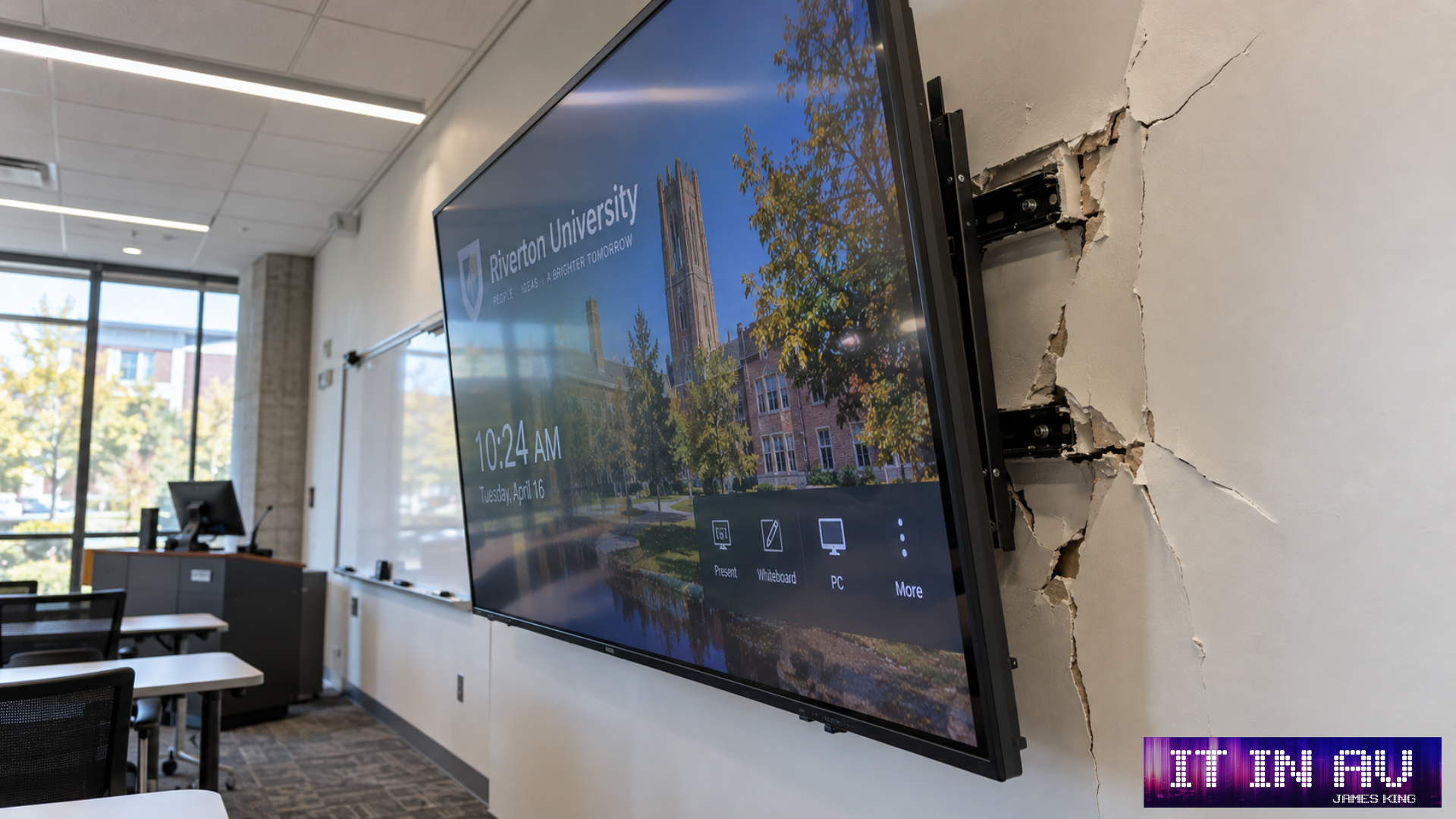

On Wednesday, Oct. 7, 2026, my wife sent me a news video about a tragic incident involving a large smart display that fell and killed a 6-year-old child at a school. I will not go into the specific details of that case or assign blame, but I want to address a dangerous, growing trend in our industry.
As budgets shrink, personnel are let go, and project timelines are compressed, there is a constant push to do more with less. This pressure can cause teams to overlook critical details or force nonexperts to make decisions outside their expertise.
Our AV gear is mounted on walls, tucked under tables, and hung from ceilings. Yet how many AV technicians are true experts in structural integrity? When equipment is improperly installed, the consequences can be catastrophic.
As Joe Way put it:
“One of the things we rarely talk about in AV, though we should, is that we can take all precautions to do wall backing, etc., to ensure that the wall, strut, etc., meets the weight and hanging requirements, but that doesn’t mean that the ACTUAL wall or ceiling was ever intended to bear the additional stress. In many cases, interior areas can have hard dividing walls without relying on the greater structure other than supporting its own weight.
“A great example of that is office buildings—that’s why it’s so easy to reconfigure and move walls around. They only have to bear their own structural integrity plus a certain percentage delta…. Then we AV people come ‘add backing’ and add 1,000 extra pounds and are shocked when it collapses.
“Maybe the structure itself wasn’t intended for that use, even if we do our jobs right. This is why we need to be working with the actual building engineers and structural team, not just relying on the last-known as-built drawings.”
What can we do? We must stand our ground. If something does not feel right, speak up. You may not be a structural engineer, but if you have been around enough construction projects, you know when something is off. Even when leadership pushes for value engineering that threatens safety, we must be the voice of reason.
Will standing our ground prevent every tragedy? No. Even with the best plans, the top experts, and properly engineered structures, accidents can still happen. However, speaking up can significantly reduce the risks. That means we cannot simply give in or cut corners.
During the planning phase, we need to clearly communicate to the general contractor where our equipment will be installed, how much it weighs, and how it must be safely secured. During installation, we should verify that proper hardware is used and local codes are followed. When installing equipment in older buildings, our facilities team must be involved from day one and provided with the same detailed structural information as a general contractor on a new build. Ultimately, both the construction and AV teams must share responsibility for creating safe spaces.