

As I sit here in a classroom replacing equipment this summer, I find myself becoming increasingly annoyed with myself. A few years ago, when this room was originally upgraded, I remember looking at a handful of things that weren’t exactly the way I wanted them and telling myself, “We’ll come back and fix it later.” The problem is that later never happened.
At the time, there were perfectly reasonable explanations. The semester was approaching, and other projects were waiting. The room was working, and there was a massive list of projects calling my name. Nothing was broken, so it was easy to convince myself that a few loose ends could wait until the next break.
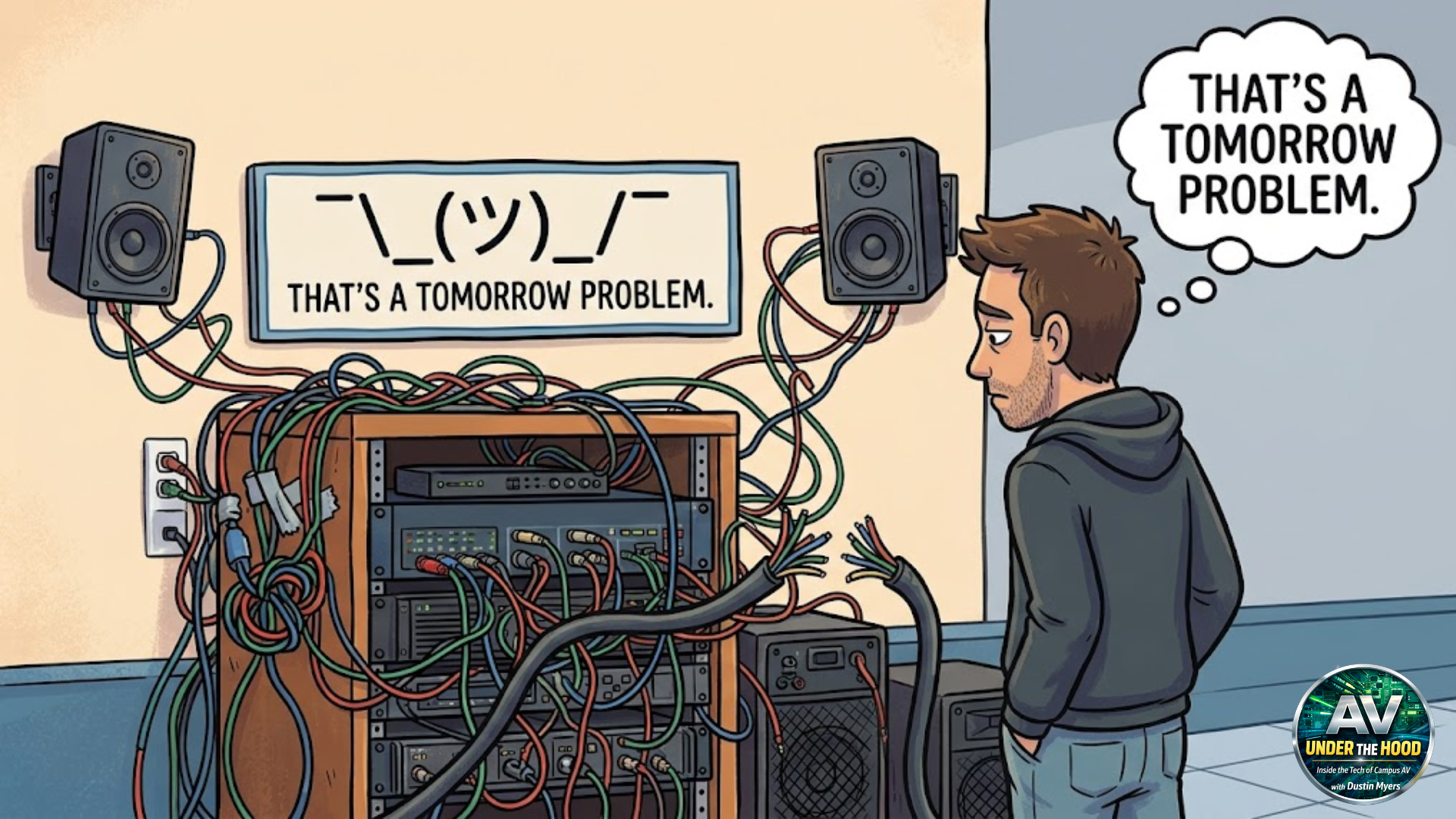
Then the next break came and went. Now I’m standing in the same room years later, tracing cables and trying to remember why I made the decisions I did. That’s the thing about shortcuts. Most of them don’t feel like shortcuts when you make them. They feel like reasonable decisions. You’re trying to get a room ready for classes, so cleaning up cable runs and documenting everything gets pushed to the back burner. Now it’s years later, and when you’re the one opening the rack back up, you realize how many of those temporary decisions became permanent.
I don’t know many AV professionals who intentionally cut corners. What I do know are a lot of AV professionals who have looked at a project schedule or an approaching semester and made the calculation that something could wait until later. The problem is that “later” never comes.
The part that always gets me is that I can usually remember exactly why it happened once I stop and think about it. There is always a reason, but whatever the reason was, it made sense at the time. That’s what makes these situations so interesting to look back on years later. The decision itself usually wasn’t a mistake.
When you’re in the middle of a project, every decision feels obvious because you’re living it every day. You know why a workaround was put in place. You know which items were supposed to be revisited later. Fast forward a few years, and all that’s left is the result. The reasons that led you there have long since faded into the background.
Maybe that’s why summer projects always feel a little nostalgic. It’s like opening a time capsule and getting a glimpse into the past. Sometimes I look at something and think, “That was actually a pretty good solution.” Other times, I find myself staring at a rack wondering what kind of idiot would have done it that way, before realizing the idiot was me.
I have learned that nothing is more permanent than a temporary solution that works well enough to be ignored. Most of those decisions were not lazy; they were made under a deadline. That is how temporary decisions become permanent ones. By the time you come back years later, you’re not looking at one shortcut. You’re looking at layers of them, each left behind by a version of yourself who assumed there would be time to fix it properly later. Apparently, every past Dustin thought future Dustin would have plenty of time. Boy, was I wrong.
If there’s a lesson in any of this, it’s that future you is eventually going to inherit every decision you make today. Speaking from experience, future you would really appreciate a few more notes, a little better documentation, and maybe one less thing left on the “we’ll come back and fix it later” list.