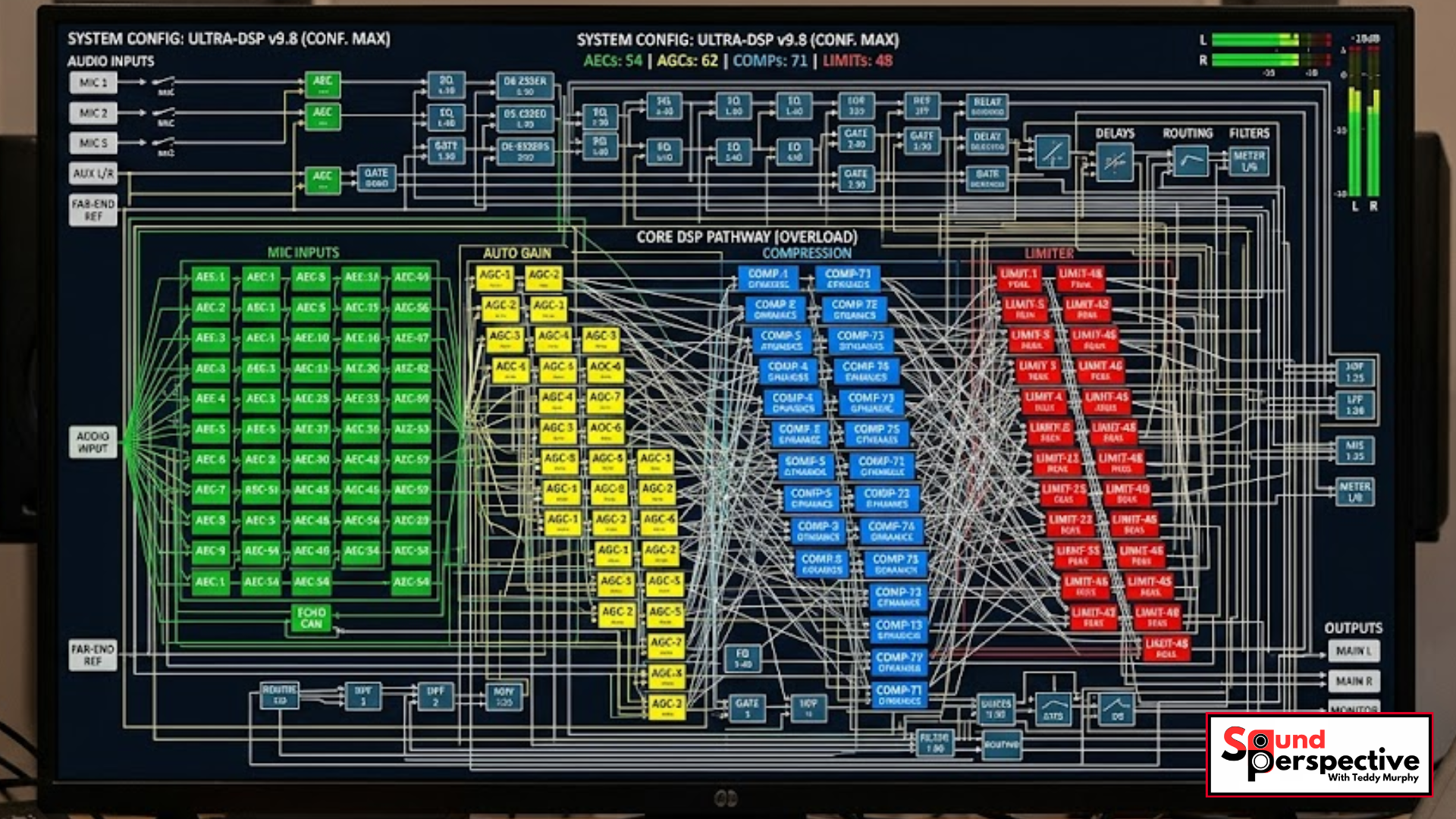


Somewhere along the way, parts of the AV industry convinced themselves that a good DSP file is one with every possible processing block crammed into it. Automatic gain control (AGC) on every input. Feedback suppression everywhere. Noise reduction on top of compression on top of automixing on top of dynamic EQ.
Thirty-seven filters scattered throughout the design like someone was getting paid by the block.
And then everyone stands around wondering why the room sounds like a bad conference call from 2009.
Modern DSP platforms are incredibly powerful tools, but too many programmers treat them like a buffet instead of an engineering platform. Just because a DSP has a feature does not mean you are required to enable it.
A DSP is not a trophy case for every plugin you know exists. One of the fastest ways to identify an inexperienced DSP programmer is by opening a file and realizing they used every processing block available without any clear reason why.
Bad DSP programming often feels less like system tuning and more like panic. One of the biggest offenders by far is automatic gain control.
There are absolutely environments where AGC has value. In soft-spoken conferencing environments or rooms with inconsistent microphone distance, it can help smooth out level changes. Used lightly and intentionally, it can improve usability.
But what I continue to see in higher ed is AGC deployed like someone discovered it for the first time five minutes before commissioning.
If your room sounds like the HVAC system is trying to keynote the meeting every time the presenter stops talking, congratulations, your AGC is probably working overtime.
AGC does not understand context. It does not know what speech is supposed to sound like. It only sees level. So when the room gets quiet, the DSP starts dragging every bit of background noise into the foreground like it suddenly became important.
Air conditioning. Laptop fans. Paper shuffling. Chairs squeaking. Typing. Distant hallway conversations.
All of it becomes part of the “experience.”
Then programmers stack compression on top of the AGC because now the audio sounds unstable. Then they add noise reduction because the AGC made the room noise unbearable. Then they add more gain because the noise reduction made the audio feel unnatural. At some point, the DSP stops processing audio and starts fighting itself in real time. And somehow this became acceptable.
The same thing happens with automatic feedback suppression. Feedback suppression is supposed to be a safety net, not your entire tuning strategy. If your DSP has carved twenty notches into the frequency response because you could not be bothered to properly tune the room, that is not system optimization. That is surrender.
Feedback suppression cannot fix bad loudspeaker placement. It cannot fix poor microphone positioning. It cannot overcome physics. All it can do is start ripping chunks out of your frequency response until the room sounds like someone threw a blanket over the loudspeakers. Yes, the feedback stopped. So did the intelligibility.
One or two surgical filters in a difficult environment can make sense. Aggressive automatic suppression throughout an entire system usually means the actual problem was never solved.
What makes this even more frustrating is that many of these rooms would sound dramatically better with less processing, not more.
A properly designed room with good gain structure, proper loudspeaker coverage, sensible microphone placement, and decent acoustics often requires surprisingly little DSP intervention. The cleaner the source audio is, the less work the DSP has to do.
But that requires understanding audio fundamentals, and unfortunately, some people would rather drag another plugin block into the signal chain instead.
There is also this strange misconception that more processing equals more professional.
It does not.
Sometimes the most experienced DSP programmers are the ones whose files look almost boring. Clean signal flow. Intentional processing. Minimal unnecessary manipulation. Every block has a purpose.
Meanwhile, the disaster files usually look like someone lost a fight with the component library.
Good DSP programming is not about proving you know what the tools do. It is about understanding when they should not be used.
Every processing block introduces consequences. Too much compression removes dynamics. Too much AGC raises the noise floor. Too much feedback suppression destroys tonal balance. Too much processing overall creates fatiguing, unnatural audio that nobody enjoys listening to.
And the worst part is that users may not understand why the system sounds bad, but they absolutely know that it does. We need to stop normalizing overprocessed audio in higher ed AV. We need to stop pretending that enabling every DSP feature is the same thing as system optimization.
Because at the end of the day, the goal is not to build the most complicated DSP file possible. The goal is to make the room sound good.
And sometimes the best DSP decision you can make is to delete half the garbage from the design and starting over.