






NEXXT and HETMA: Creating Space for the AI Questions Higher Ed AV Needs to Ask
Some InfoComm conversations are not about a booth stop. They are about giving the community a place to think, build, and test what comes next.
That is the work NEXXT is doing.
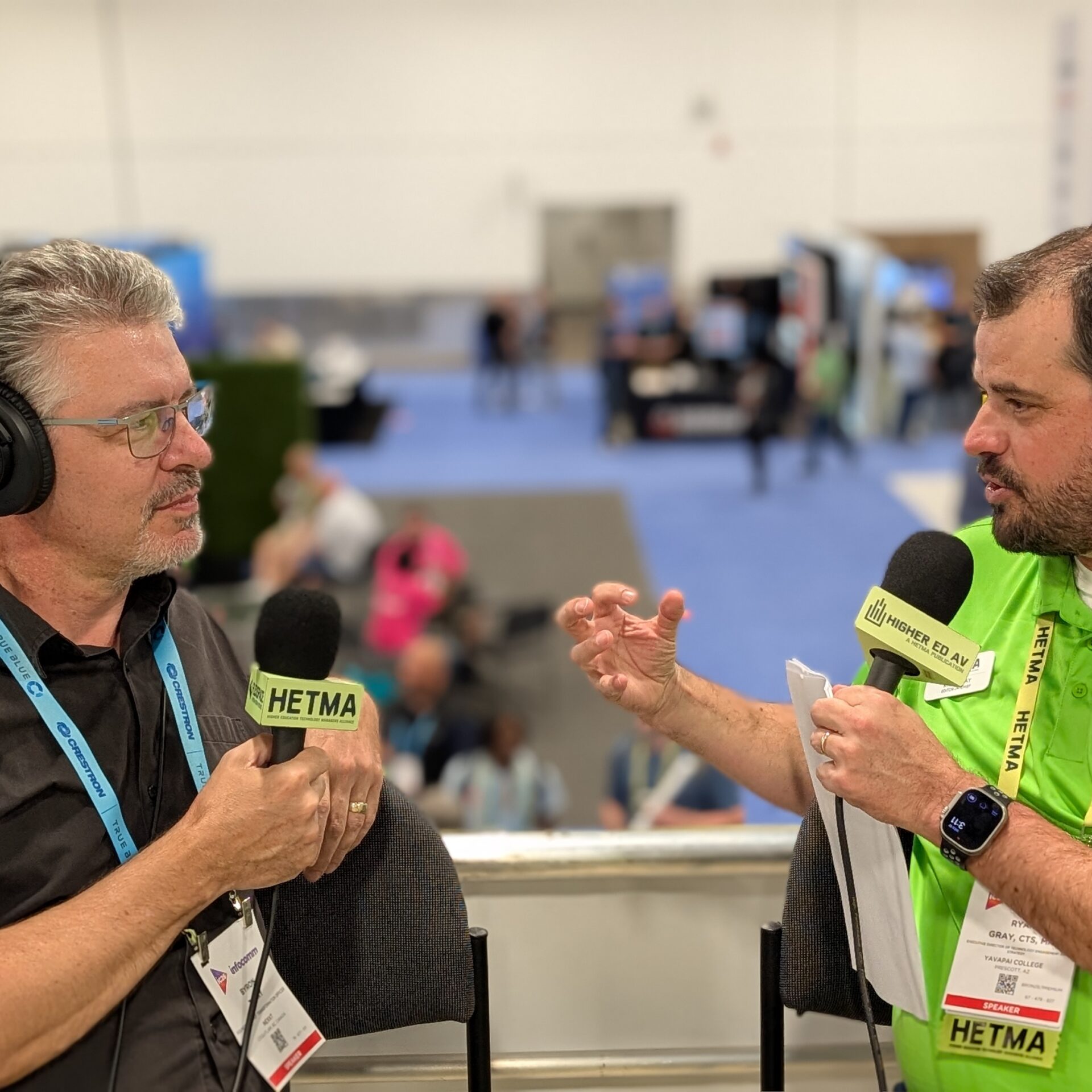
In the HETMA booth conversation, Byron Tarry, Founder & Chief Transformation Officer of NEXXT, talked about the organization’s partnership with HETMA, The SPRINT at InfoComm 2026, and the need to create practical spaces where AV and IT professionals can engage with AI without pretending anyone has the whole thing figured out.
For higher ed AV/IT teams, that matters because AI is not just another product category on the show floor. It is touching support workflows, teaching models, collaboration spaces, service desks, analytics, room design, media production, and institutional planning. The hard part is not only learning the tools. It is finding the space to ask better questions with people who understand the work.
Byron put the starting point clearly:
“there are no experts”
That is a useful frame for this moment. It gives AV/IT teams permission to stop waiting for someone else to hand down the final answer. The work is still forming. The people closest to the rooms, users, support tickets, faculty workflows, and student experience need to be part of the conversation.
From AI Talk to Practical Action
One of the strongest parts of Byron’s message was the need to move from inspiration into action. A lot of AI conversation can stay too abstract. People leave a session energized, but not always equipped to do anything differently when they get home.
Byron named that gap directly.
“without any tangible action to go and pursue,” the result can become “fear and inactivity”
That line fits higher ed well. Campus teams do not need another vague prompt to “do AI.” They need ways to test ideas, understand what is practical, and bring the right people into the room.
That is where NEXXT’s work around sprint-style collaboration matters. The goal is not to solve every institutional AI question in one session. The goal is to give people a way to work through uncertainty together, identify a real challenge, build a practical concept, and leave with a method they can adapt back on campus.
The Front Lines Belong in the Room
The higher-ed connection becomes clearer when Byron talks about who should participate. This is not only a leadership retreat topic. It is not only for the corner office or the boardroom.
“people are the engine to this change”
That is the part HETMA members should hear. The technicians, instructional technologists, classroom support teams, AV engineers, media teams, and digital learning staff often understand the friction better than anyone else. They know which workflows waste time. They know where faculty struggle. They know which rooms create support drag. They know where a small automation, better data path, or new tool could actually matter.
Byron also pointed to the importance of bringing in the front lines because they may be the closest to the everyday problems and the most ready to experiment. That is a strong fit for higher ed, where practical innovation often starts with the people keeping the rooms running.
The SPRINT at InfoComm
At InfoComm 2026, NEXXT partnered with AVIXA on The SPRINT: Practical Innovation in Action. The format brought people together around a challenge, then asked them to build something tangible: a prototype, service concept, business model, workflow, automation blueprint, or other proof-of-concept artifact.
That is the kind of format higher ed can learn from. The real value is not only what gets built during the session. It is learning a repeatable method for bringing different perspectives together, testing ideas quickly, and leaving with something concrete enough to bring back to a team.
Byron described that as part of the goal: giving people a skill set around innovation they can take back into their own organizations.
That is where NEXXT’s work connects well with HETMA. Higher ed AV/IT does not need AI as a magic layer on top of old processes. It needs ways to evaluate where AI might remove friction, support learning, improve service, improve access, or change how teams spend their time.
Why Higher Ed Belongs in the NEXXT Conversation
Near the end of the conversation, Byron tied the HETMA partnership to the value of experimentation inside the education community.
“there’s an element of R&D and experimentation and so on that lives in the education community”
That is a strong reason for higher ed AV/IT teams to engage with NEXXT. Campuses are not just places where technology gets deployed. They are places where people test new models for teaching, support, collaboration, access, and knowledge creation. That gives higher ed something important to contribute to the broader AV and workplace technology conversation.
NEXXT’s work gives the community a place to do that with structure: events, thought leadership, a digital community, podcasts, consulting, and partner programming. For HETMA members, that makes the partnership worth watching because it creates another path for higher ed AV voices to be included in conversations that are already shaping the next phase of the industry.
The Higher Ed Takeaway
NEXXT is not a booth stop. It is a partner creating space for the conversations higher ed AV/IT teams need to be in.
The work is about AI, but not as hype. It is about future-focused thinking, practical experimentation, organizational culture, front-line participation, and repeatable innovation methods. For HETMA members, that makes NEXXT worth following not only for what it says about AI, but for the way it creates rooms where people can test ideas together.
The next step for higher ed is not waiting until AI feels settled. It is getting the right people into the room now, asking better questions, and building small, practical ways to learn what works.
Check out NEXXT’s events, community, and thought leadership at nexxtnow.com, and watch for future NEXXT and HETMA opportunities to bring higher ed AV voices into the transformation conversation.