
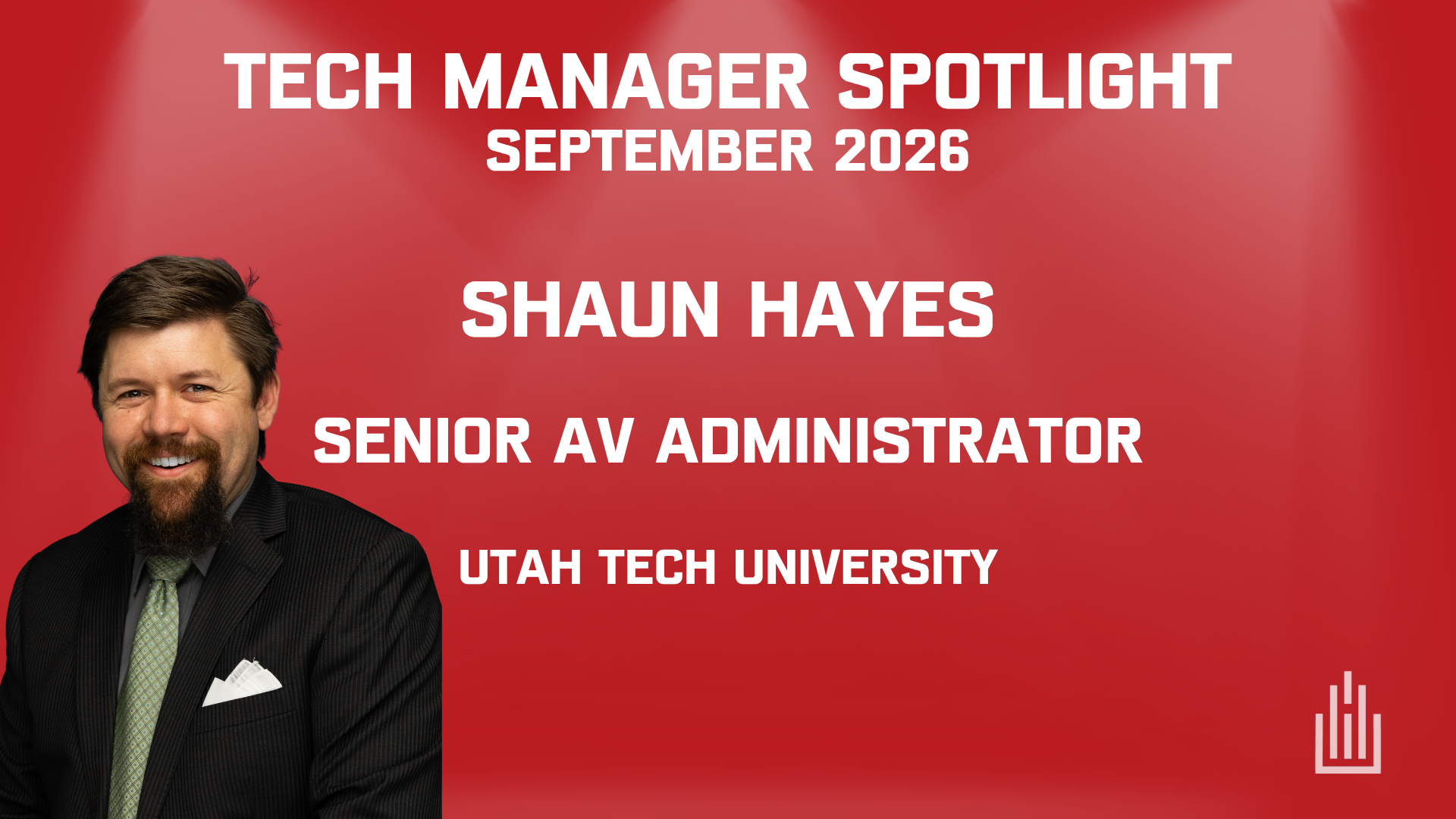


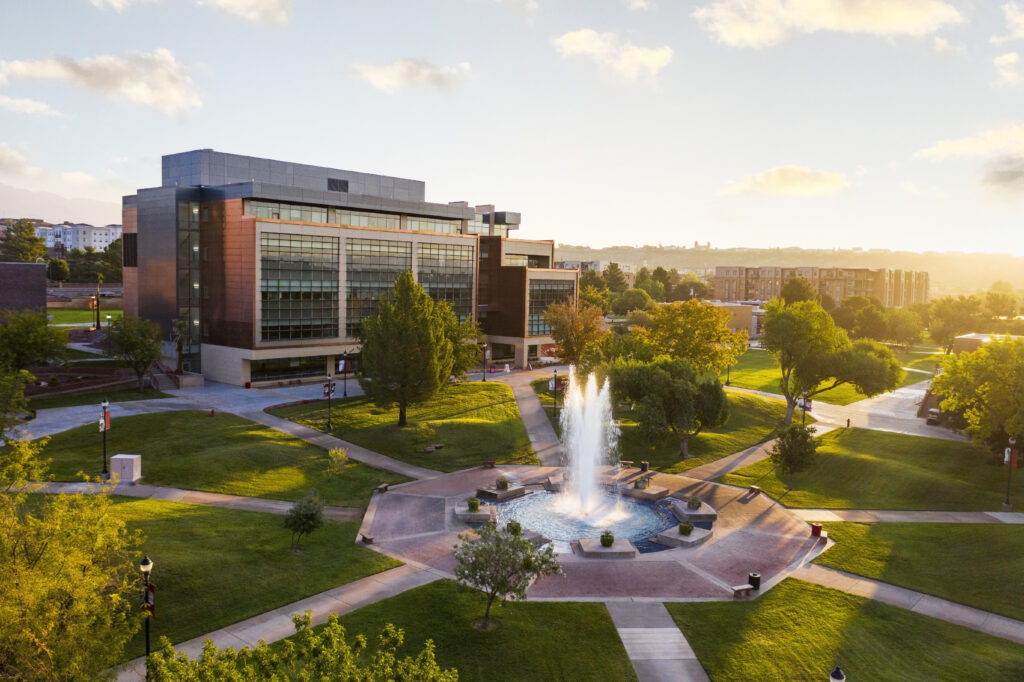
For this edition of Tech Manager Spotlight, we spoke with Shaun, Senior AV Administrator at Utah Tech University in St. George, Utah. Serving a student population of approximately 13,000 across two campuses, Utah Tech relies on audiovisual technology to support teaching, learning, and campus operations in more than 300 spaces. Shaun oversees that technology environment from end to end, managing the design, programming, installation, maintenance, and long-term planning of the integrated systems that faculty and students depend on every day.
With roughly 20 years of experience in the AV industry, including the last decade in higher education, Shaun brings a broad perspective shaped by work in live sound, corporate event technology, and campus AV operations. His background includes degrees in Audio Engineering and Recording Arts, Music, and Business Administration, as well as industry certifications, including AVIXA Certified Technology Specialist (CTS), Extron, and HDBaseT credentials. That combination of technical expertise and operational experience has helped him build large-scale classroom technology programs and guide major institutional technology initiatives.
Throughout our conversation, Shaun repeatedly returned to the importance of preparation, documentation, and people. He describes his leadership style as hands-on and supportive, drawing on experience gained at every level of the profession. Rather than focusing solely on technology, he emphasizes giving team members the tools, training, and clarity they need to succeed, while maintaining a strong focus on morale and professional growth.
That same philosophy shapes how he approaches collaboration and improvement at Utah Tech. By establishing clear technology standards and system documentation, maintaining strong relationships with campus stakeholders and leadership, and encouraging team members to contribute new ideas, Shaun has helped develop a proactive approach to remote monitoring and preventive maintenance. The result is a technology environment designed not just to solve problems when they occur, but to identify and address them before they impact the classroom.
Have you always worked in AV? What did the path look like for you to get to where you are now?
AV has been the through-line of my whole career, though it’s taken me through a few different worlds to get here. I started as the head AV engineer for the music department at Adams State University, then ran audio for a solar-powered mountain concert venue with the Rio Grande Scenic Railroad. From there, I moved into corporate event technology with PSAV in Denver, where I worked my way up from event technology specialist to assistant director of event technology. That’s where I really learned the business and leadership side. I made the jump into higher ed AV at Arapahoe Community College and then came to Utah Tech in 2020. It’s been a steady progression from live sound to corporate events to building and running campus AV programs.
What is your morning routine?
Honestly, pretty basic. I come in, get some coffee going, and start working through email and our system dashboards to see if anything needs to be addressed before classes begin. It’s a quiet window before the building fills up, and getting through it means the rest of the day starts on my terms.
What does an average weekday look like for you?
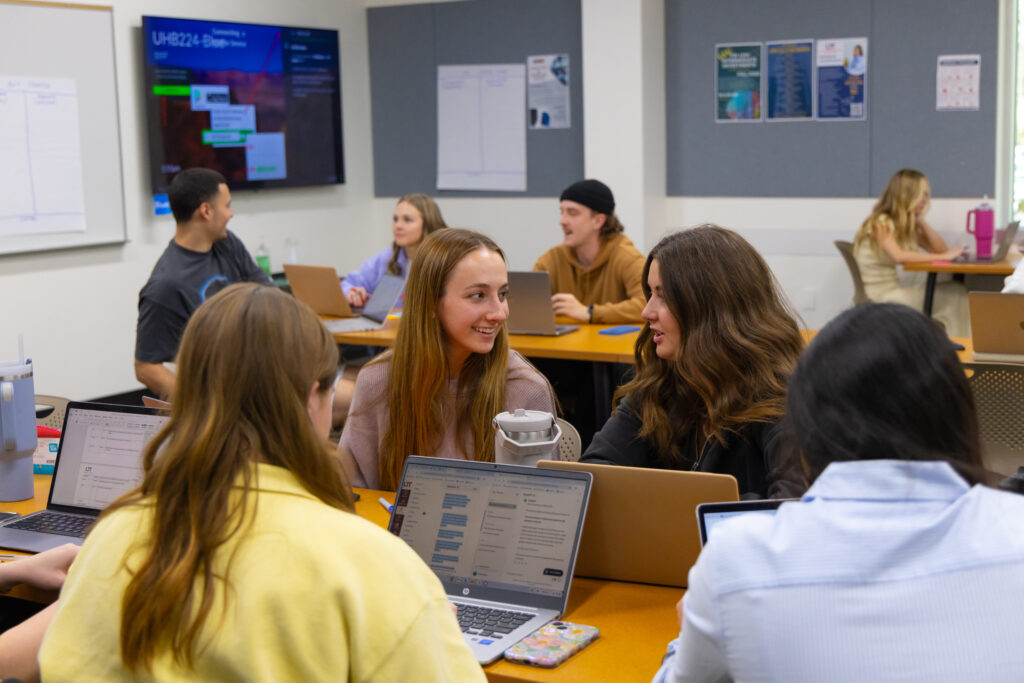
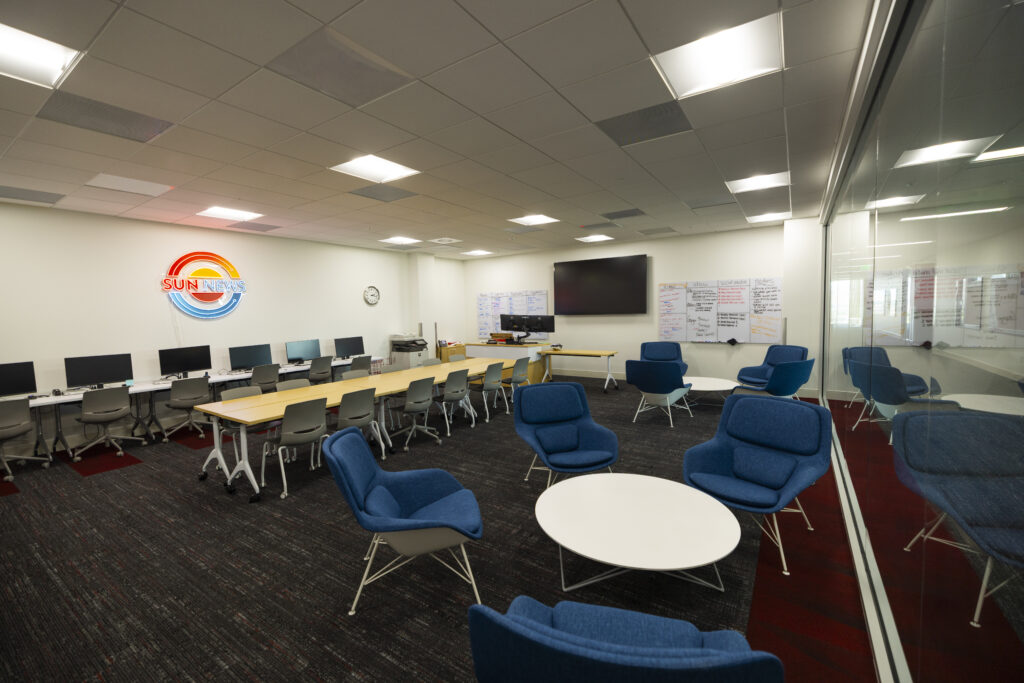
No two days are identical, but most weekdays are a mix of proactive and reactive work. I start by checking our centralized AV command center, which monitors classroom systems campuswide, so I can catch and resolve issues before they affect a class. From there, it’s a blend of project work, including designing and specifying new spaces and coordinating with vendors and integrators, supporting my team of student employees and one full-time staff member, and staying on top of budgets and procurement. I always try to protect some time for the longer-term planning that keeps our systems reliable.
What does your busiest day look like? What are the challenges your role faces, and how do you overcome those?
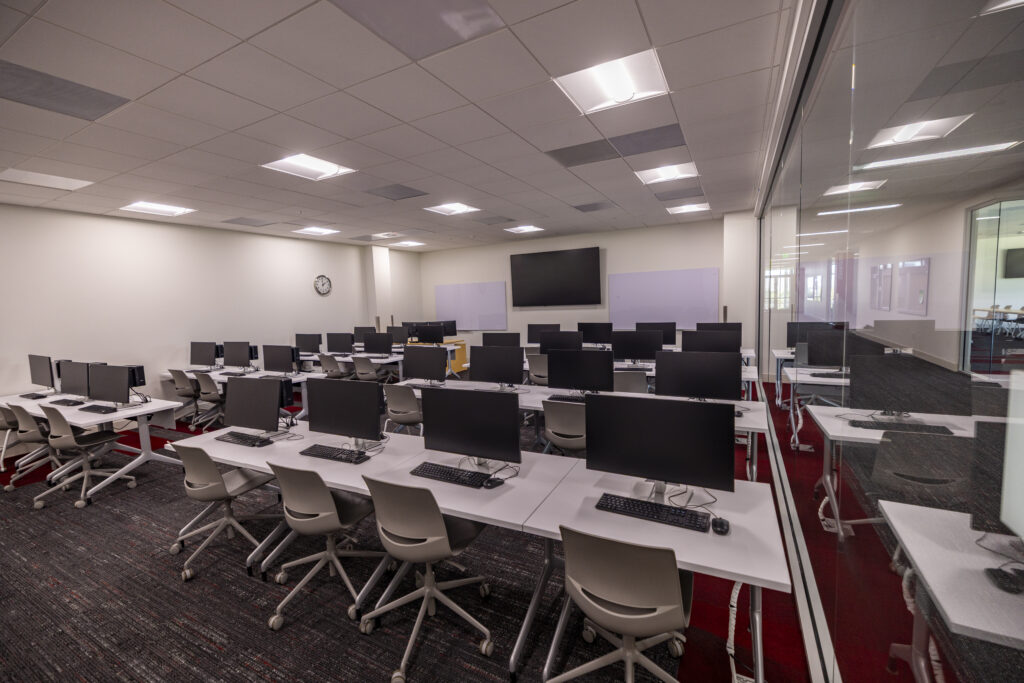
My busiest days usually fall right before a semester starts or in the middle of a large installation, when construction timelines, vendor deliveries, and a hard “first day of class” deadline all collide. The biggest challenge in this role is that AV is mission-critical. When a classroom system goes down, teaching stops, but budgets and staffing are always finite. I overcome that mainly through preventive maintenance and remote monitoring, solid documentation and technology standards, and strong relationships with vendors and campus stakeholders so problems get solved quickly.
Tell us about a project you are currently working on now?
Right now I’m collaborating with our CIO to build out long-term equipment replenishment cycles, essentially making sure the technology we’ve installed stays current and funded on a predictable schedule rather than reactively. I’m also continuing to expand our centralized AV command center so we can monitor classroom systems campuswide and drive preventive maintenance that resolves issues before a class is affected.
What do you enjoy doing on weekends? How do you spend your time outside of work?
Mostly hands-on projects: 3D printing, woodworking, and restoring antique stationary engines. I like anything where I get to build or fix something myself.
I recently picked up an older pop-up camper and have been restoring it. Between the restoration itself and getting out to camp with it, that’s become my favorite way to unwind.
What inspired you to get involved with HETMA, AVIXA, and other higher-ed orgs?
I’ve always believed AV professionals do their best work when they’re connected to a broader community. AVIXA has been central to that for me. Earning my CTS pushed me to formalize and validate skills I’d built over years in the field, and it keeps me connected to where the industry is heading. I’m also a member of HETMA, the Higher Education Technology Managers Alliance, and get to its events when I can. It’s one of the best ways to trade notes with people managing AV at other campuses and see how they’re solving similar challenges. In higher ed, especially, these organizations let us share what’s working across campuses instead of each of us solving the same problems alone.
Where do you see your career trajectory going in the next five years? Where do you envision yourself?
I want to keep growing the strategic side of this work. Over the next five years, I see myself continuing to move from managing AV systems toward shaping AV strategy at the institutional level, the kind of long-term planning, standards, and funding-cycle work I’m doing now with our CIO. Ideally, that means a broader leadership role where I can help set technology direction across the university, not just deliver it room by room.
What is your life motto and how do you apply it to your daily routine?
I always say, “Luck favors the prepared.” The results my team and I have achieved aren’t luck. They come from hard work, a lot of planning, and trying to spot problems before they become problems.
Comparing your career path over time, what are some of the moments, accomplishments, or projects that you’re most proud of?
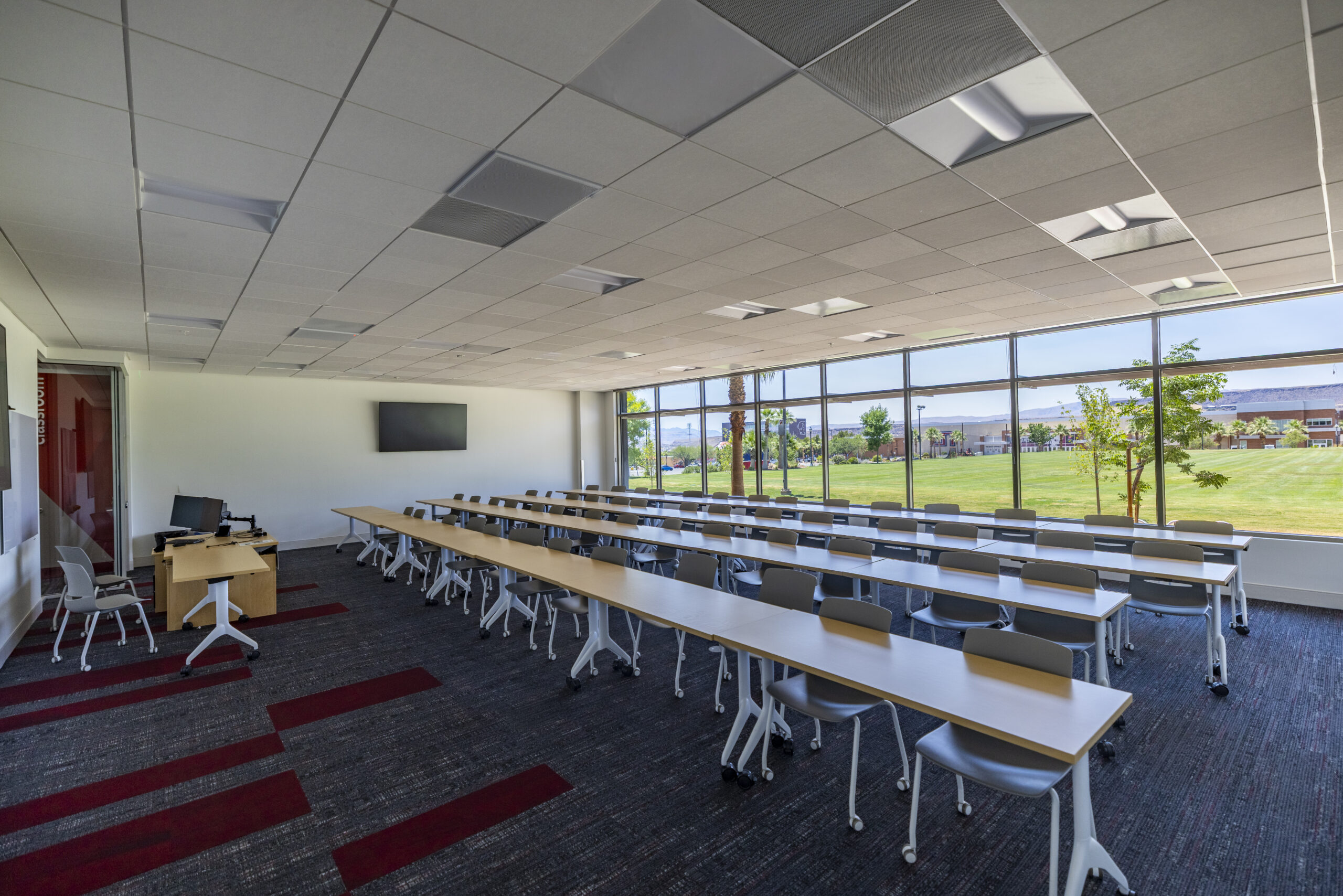
The one I’m proudest of is the 100% replacement of AV technology in more than 170 classrooms at Utah Tech, delivered in 18 months. I scoped, scheduled, and budgeted the entire project and secured the one-time federal funding that made it possible. Earlier, at Arapahoe Community College, I delivered a $2.5 million classroom technology upgrade that had been scoped for three to five years in just 18 months, at roughly 30% cost savings. I’m also proud of building AV command centers and writing technology standards where none had existed before, and I was twice recognized by the ACC president for service to the college.
How do you see the role of AV evolving in higher education?
AV and IT have essentially merged. Today’s classroom systems are networked, monitored, and managed a lot like any other enterprise technology, and that trend is only accelerating. I think we’ll keep moving toward standardized, centrally monitored environments where issues are caught and fixed before anyone notices, and toward spaces that flex easily between in-person, hybrid, and remote teaching. The pandemic permanently raised expectations for video conferencing and teaching technology in every room, and I don’t see that going backward.
What’s a lesson you’ve learned the hard way in your career?
Learning to recognize when you have to take your career trajectory “by the horns” and move yourself forward rather than waiting for something to happen on its own. Nobody is going to hand you the next step.
What advice would you give to someone just starting out in AV or higher ed tech?
Say yes to the hard jobs and learn every layer you can: audio, video, control, networking, and the business side. My own path from live sound to corporate events to higher ed worked because I never stopped adding skills, and each one made the next opportunity possible. Get certified, but don’t stop there; the field moves fast, so stay curious. Learn to talk to non-technical people about technology. Being able to translate between engineers, faculty, and administrators is as valuable as any technical skill.
What’s something people often misunderstand about your work?
People tend to think AV is just “plugging in projectors” or fixing the remote that won’t cooperate. In reality, modern campus AV involves design, programming, networking, project management, budgeting, and preventive maintenance across hundreds of mission-critical spaces. When it’s done well, it’s invisible. The class just works, and that invisibility is exactly what makes it easy to underestimate how much engineering and planning goes into it.
Connect with Shaun on LinkedIn.