
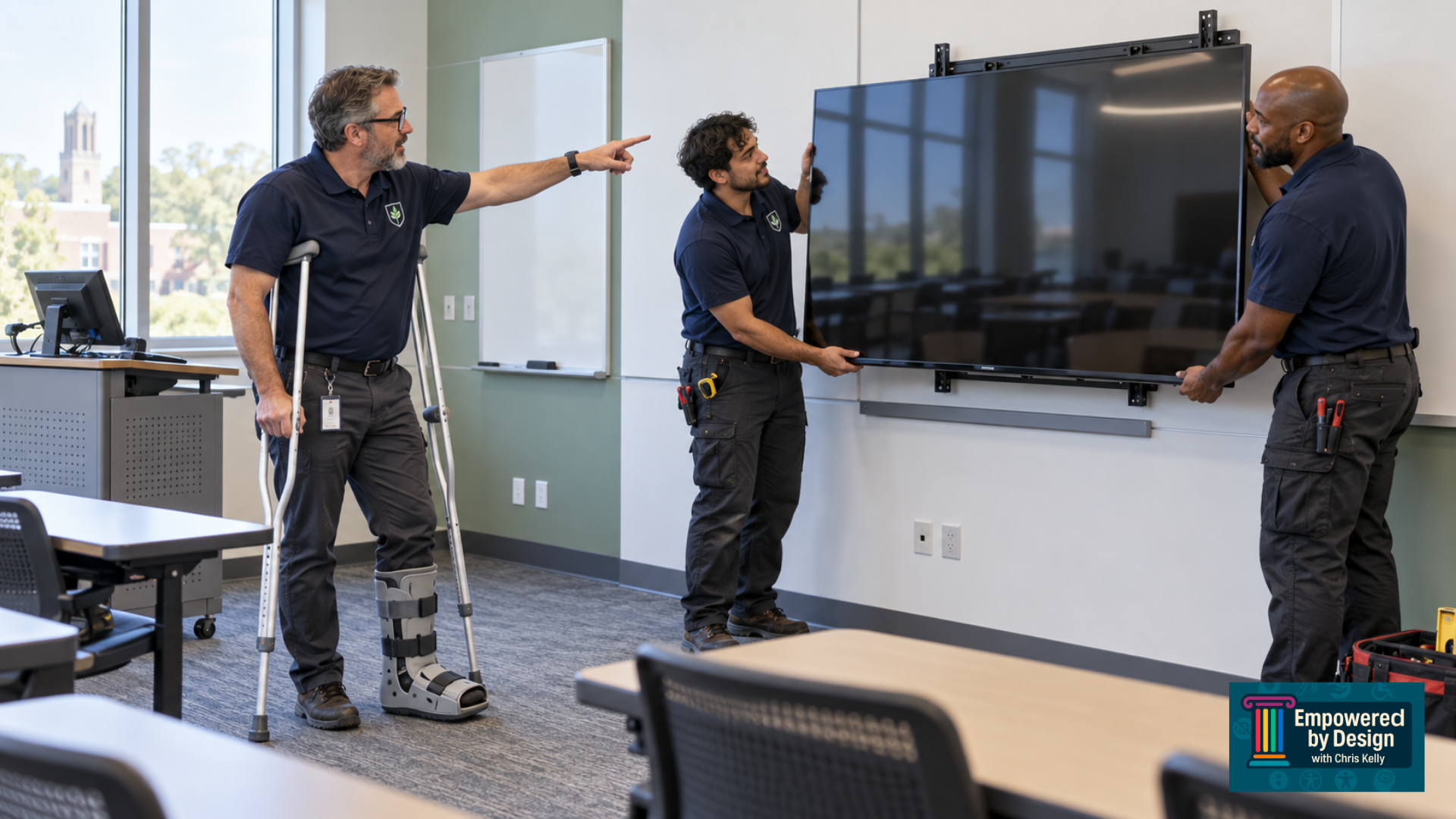


Four weeks ago, I wouldn’t have thought much about walking across campus, climbing a ladder, or standing at a lectern to troubleshoot something. I had work planned and timeframes figured out, with little reason to question whether I could physically do any of it. Then I hurt my calf while changing position in bed.
I recently attended the HETMA Golf Classic and EDUCAUSE 2026 in Denver. Around 2 a.m. before my late-morning flight home, I was gently rotating my foot when I heard a pop and felt a tearing sensation in my calf. Immediate pain, tingling, and tightness followed. The pain kept me awake for more than an hour before exhaustion took over.
The next morning, I couldn’t bear weight on that leg. I used the wall and whatever supports I could find to hop around. By late morning, I could put enough weight on it to limp in significant pain. Nearly three weeks later, as I write this, I am still limping some and experiencing varying amounts of pain.
People who know me know I tend to be active. I climb mountains, go to the gym, take the stairs, and generally move through life at a fast pace. Suddenly, things I would normally do without thinking required planning, postponing, or asking someone else to help.
Even driving using cruise control has been painful. Sitting at work has meant trying different positions to get comfortable. At an event my wife was involved in, I would normally have helped move things and looked for ways to volunteer. Instead, I spent much of the evening sitting to limit the pain.
This has given me my own experience with what I hope is a temporary disability. It doesn’t speak to anyone else’s experience, but it has made me look more closely at my assumptions about my own abilities and how much of my work depends on them staying the same.
The Same Classrooms, Different Needs
Going into classrooms, I started noticing something I hadn’t given much thought to before: there often wasn’t a chair near the lectern. Before starting work, I needed to find somewhere to sit or something to lean against to take weight off my leg.
The room hadn’t changed, but what I needed from it had. That raised a question I should have been asking already: If I needed to sit while working at that lectern, how well would it support a faculty member who needed to teach from a seated position?
Getting to the room became part of the problem, too. Some tasks were across campus, where I couldn’t count on parking nearby. For one task, I came in early just to get a closer parking spot. The work hadn’t become more complicated, but reaching it had.
There were also things I was the only person available or prepared to handle. I found myself climbing behind displays, using ladders, and walking between buildings while in pain because something needed doing. I can’t say how that affected my recovery, but I was asking myself to do things I wasn’t ready to do comfortably.
That is uncomfortable to admit in an article about accessibility. I could recognize the barriers and still decide I should work around them myself. When my abilities changed, my first response was often to keep trying to meet the original plan.
Planning Around One Person’s Abilities
For many things I do, I am used to being all I need. That independence is convenient until a task requires a walk I can’t comfortably make or a position I can’t maintain. A schedule built around me doing everything has little flexibility when I can’t.
That gives us something to consider beyond classroom design. How much of our support model depends on a particular person being able to do a task? If that person is injured, sick, or unavailable, can someone else take over? Have we shared enough information, or does the work wait until that person can push through it?
Another staff member isn’t always available. Many of us have small teams, and some are effectively the entire AV department. Those constraints make it important to be honest about what can get done, what needs to wait, and when we need help.
The same consideration applies to classroom users. A faculty member might need to teach while seated for a few weeks or throughout their career. A student’s ability to move between buildings or participate in class may change during the semester. Our spaces need to accommodate those changes.
A chair near the lectern is a starting point, but can someone reach the controls from it? Can they see and use what they need? Is there room to position themselves comfortably? A place to sit helps only if the person can still do the work they came to do.
Knowing Better and Making Room for It
My calf injury is new, but changes in my ability to work are not. I get migraines preceded by an aura phase that severely affects my vision. I see flashing lights and moving shapes and struggle to see well enough to function. Then come the pain and sensitivity.
Because I know the aura is temporary, I have tended to keep working through it. I have treated the pain as something to push through, too. Writing that makes me question why I dismiss my need to stop or recover simply because I expect the symptoms to pass.
I would want someone else to tell me if they couldn’t see well enough to work or were in too much pain. Yet I don’t consistently extend that consideration to myself. If I want people to feel comfortable asking for support, I need to consider what my behavior suggests is expected.
My experience in social work and interest in diversity, equity, inclusion, and accessibility have made me familiar with these conversations. What I have been thinking about lately is how easily I treat a period when disability isn’t affecting my daily life as something permanent. I make plans around what I can do now, rarely considering how quickly that could change.
The effects can also come and go. My migraines affect my ability to work, even though those limitations aren’t present every day. My calf injury has required different adjustments. Both make me question why I plan as though my current abilities will always be available. Expecting a limitation to pass doesn’t make the need for support any less real while it is happening.
I am still figuring out how to adjust my pace and ask for help. I want to carry that questioning into how I evaluate rooms, plan tasks, and share responsibility. Can someone work while seated? Does another person have what they need to take over? Can we adjust a deadline when someone’s needs change?
I expect I will eventually stop looking for a chair every time I enter a classroom. I would like to make sure that, by then, I haven’t stopped considering the person who still needs one.