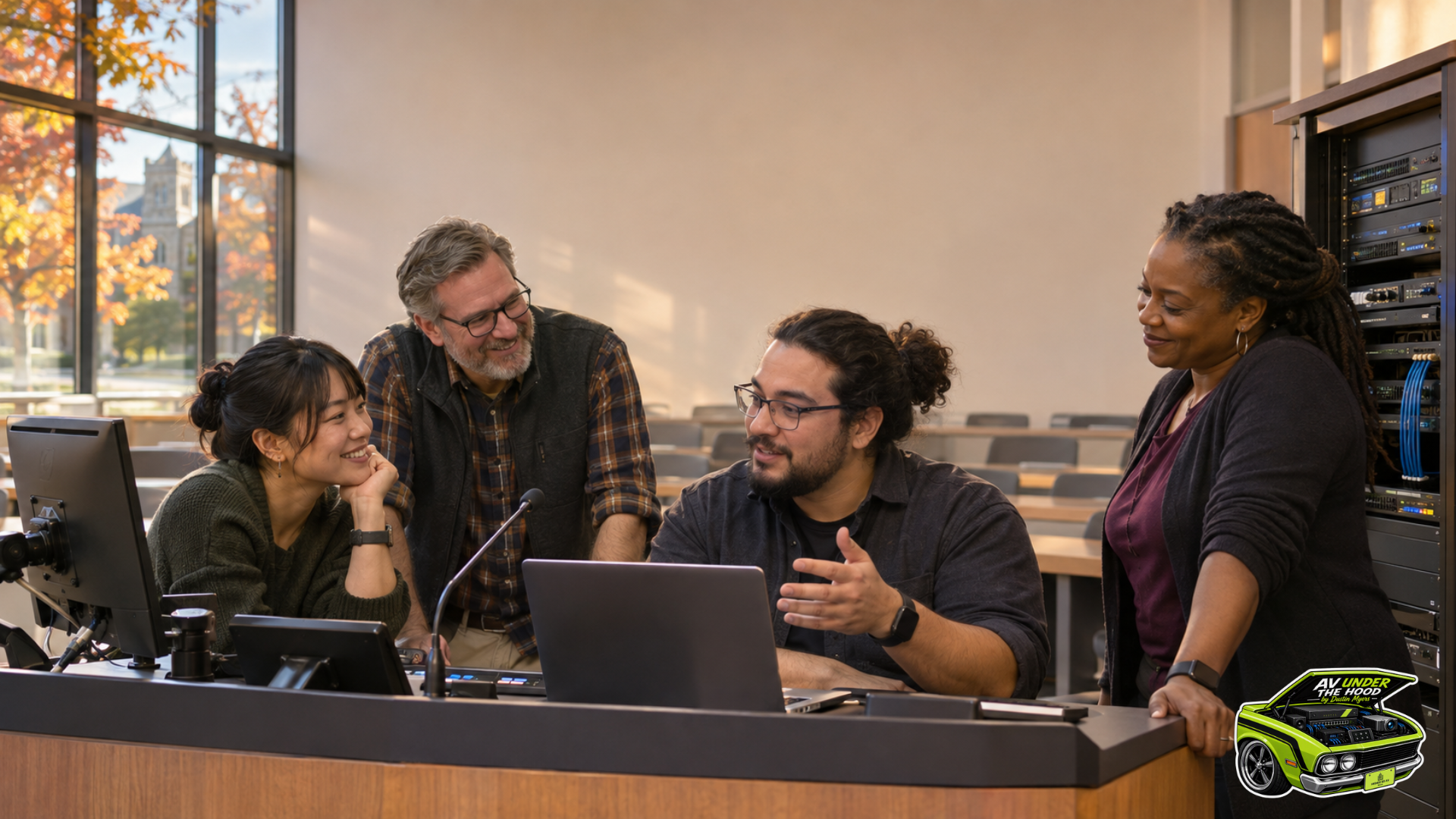
With this article publishing the day before Thanksgiving, I've been thinking about the people who have influenced the way I approach AV and the work I do every day. Some of them are people I work alongside, while others are people I see at conferences, hear from during HETMA calls, or reach out to when I need another perspective. There are also people I've never met who have shared an experience, written an article, or asked a question that made me stop and reconsider something I had simply accepted as normal.
We spend a lot of time in this industry talking about equipment. We compare displays, microphones, cameras, and network technologies. We look at specifications, evaluate new products, and debate whether a particular solution makes sense for our campuses. Those conversations are important, but the longer I work in higher ed AV, the more I realize how much of what makes this industry worthwhile has very little to do with the equipment itself. It comes down to the people who design it, install it, support it, and help make it better.
The people behind reliable AV
A lot of that work happens where most people will never see it. It's the person who catches a pathway problem before the wall closes, or the facilities employee who knows what's hiding inside an older building and helps us figure out how to work around it. It's the network engineer who catches a configuration issue before deployment or the technician who keeps chasing an intermittent problem until they understand what's actually causing it.
When AV works the way it's supposed to, nobody says much about it. That can make the work behind it easy to overlook. Reliable AV doesn't just happen. It takes planning, coordination, testing, and people who care enough to get the details right. Nobody applauds because the EDID was managed correctly, the Dante clock stayed stable, or the cable labels matched the drawings. Honestly, I'd be a little concerned if they did. The goal is for the technology to support the experience without becoming the experience.
Some of the people who have influenced me most are the ones willing to answer the phone when I have a problem that crosses into their area of expertise. They're willing to look at an issue without immediately deciding it belongs to someone else. They share what they know, explain the parts I may not understand, and help work through the problem instead of just pointing out whose responsibility it might be. I've learned a lot from those conversations, and I've tried to carry that same approach into the way I work with others.
The technicians doing the daily work deserve a lot of recognition, too. They're the ones arriving early, staying late, supporting events, checking classrooms, replacing batteries, tracing cables, and fixing problems before anyone else realizes something was wrong. It's easy to judge a support team by the few issues that become visible, but much harder to recognize the hundreds of classrooms, meetings, classes, and events that worked because someone had already taken care of the details.
A community willing to share
Beyond my own campus, the HETMA community has become an important part of how I continue to learn. Some of the best ideas I've brought back to my institution have come from conversations with people who were willing to share what worked, what didn't, and what they would do differently next time. We may work at institutions with completely different budgets, staffing levels, buildings, and organizational structures, but many of the challenges we face are remarkably similar.
Sometimes a conversation with someone at another institution can save hours of troubleshooting or give us a different way to approach a project. Other times, it's simply helpful to hear that someone else is dealing with the same challenges. It reminds us that we're not the only ones trying to figure things out, and that there is a community of people willing to help.
A lot of the ideas behind this column have come from those conversations. Someone raises a question during a HETMA call, shares a lesson from a project, or describes something that worked on their campus. Sometimes I can use that information right away. Other times, it stays with me until I run into a similar situation months later. That willingness to share knowledge and be open about both successes and failures is one of the things I appreciate most about this community.
That community didn't just happen. The HETMA Board of Directors puts considerable time and effort into creating opportunities for higher education AV professionals to connect, learn from one another, and have a stronger voice in the industry. Much of that work happens behind the scenes, just like the work we do on our campuses. Most members may only see the events and resources that come out of it, but there's a lot of effort involved in making those things possible.
Higher Ed AV Media provides another place for those conversations to happen. The editors and contributors have created a space where people can share technical knowledge, question established practices, and talk honestly about what it's like to work in higher education. They've also given me an opportunity to take experiences from my own campus, including some frustrating and uncomfortable ones, and turn them into conversations that might help someone else.
An article may have my name on it, but getting it published is never a one-person effort. There are people reviewing the work, asking questions, pointing out things that aren't clear, and constantly reminding me my article is due. Once again, a lot of that effort happens behind the scenes, and readers may never know who helped shape what they're reading.
Appreciation through the challenges
I also don't want appreciation to be confused with pretending everything goes smoothly. We all have projects that get frustrating, mistakes that need correcting, and conversations we'd probably rather not have. Some of the most valuable working relationships come from being able to acknowledge when something went wrong, work through it, and do things differently the next time. I can be frustrated with a situation and still appreciate the people who help get it resolved. Those two things aren't mutually exclusive.
As Thanksgiving approaches, I keep coming back to how much of this profession depends on people being willing to share what they know and help one another. The equipment gets the attention, the systems are what people see, and the finished room is what gets used. But none of that happens without the people putting in the time, sharing their experience, answering questions, solving problems, and making things better for the next person.
The best part of AV isn't the equipment, the systems, or even the projects we get to work on. It's the people we get to work with along the way.