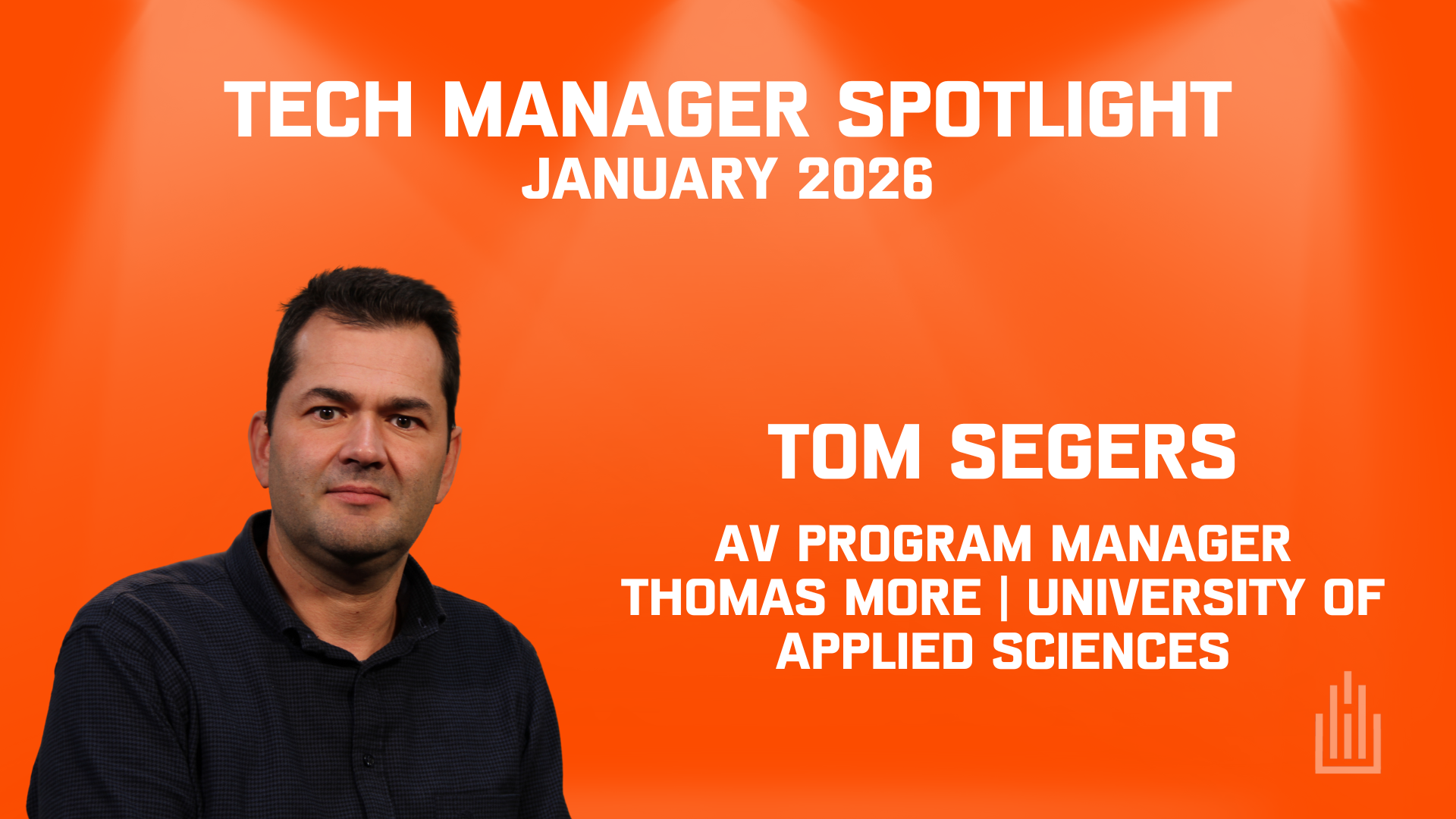

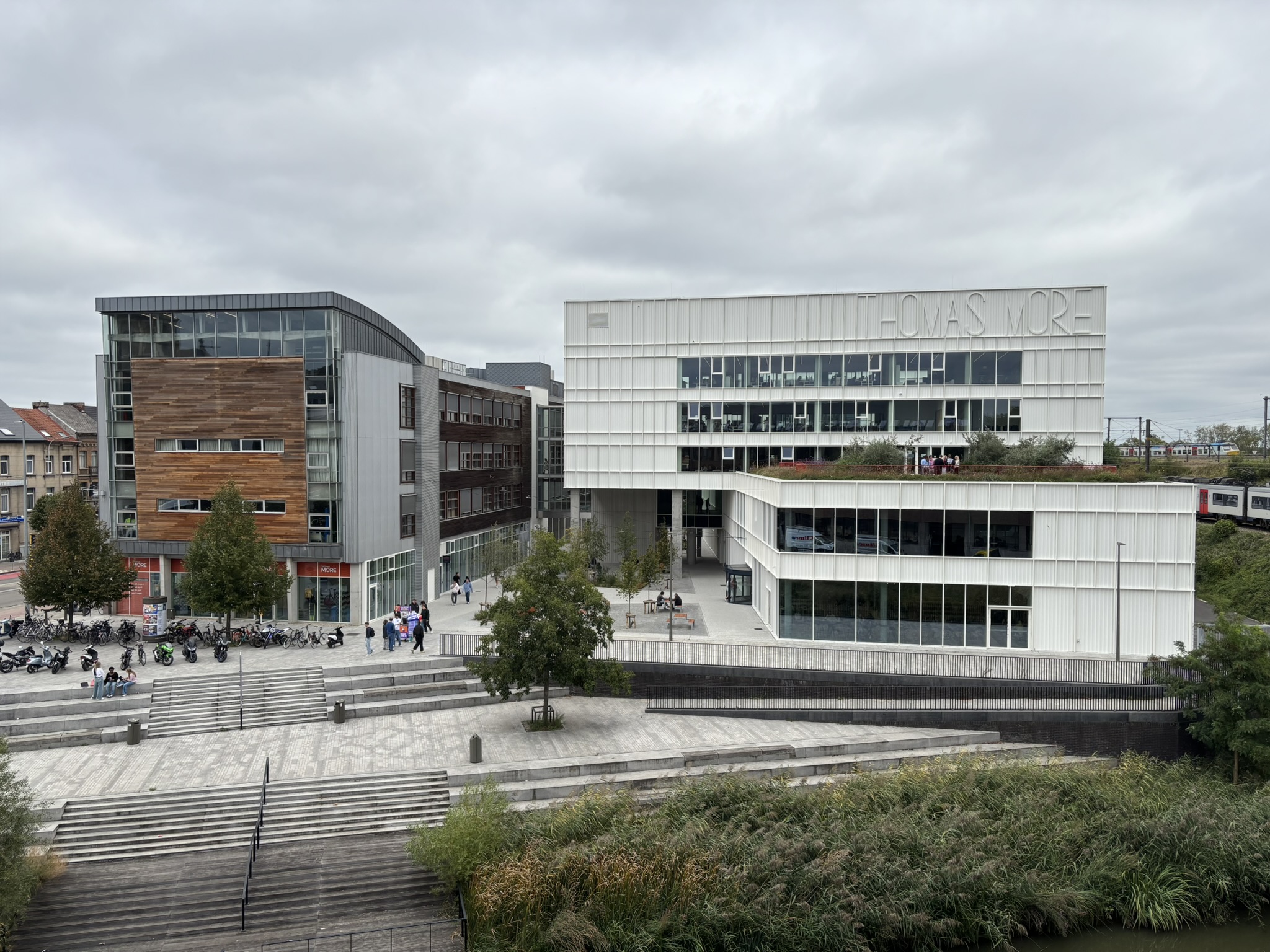
This month, Higher Ed AV Media shines the spotlight on Tom Segers, whose leadership at Thomas More University of Applied Sciences in Belgium exemplifies trust, service, and innovation in higher education technology. Tom’s approach is distinctly trust-driven and service-oriented—he empowers his team to take initiative, manage their own schedules, and make decisions within their expertise. Rather than micromanaging, Tom focuses on supporting, guiding, and removing obstacles, fostering a culture where autonomy and alignment go hand in hand.
Collaboration and innovation are at the heart of Tom’s department. He believes that real progress starts with spending meaningful time together, whether at conferences or during informal conversations across departments. These connections build understanding and spark creativity, making true collaboration possible even when priorities differ.
Today, his team of three AV experts supports a broad ecosystem: about 360 classrooms, 20 auditoriums, 24 hybrid classrooms, and 60 hybrid meeting rooms. They also manage Kaltura as their CMS for roughly 22,000 users, a campus-wide Zoom license, and a digital signage network of around 120 screens. On top of that, he creates video and audio content for lecturers to use in blended learning. To give an impression of what this setup looks like in practice, here’s a short demonstration video: Demonstration of some classroom technology.
Tom Segers continues to set the standard for AV program management in higher education, blending technical expertise with a people-first philosophy that inspires both his team and the wider academic community.

1. Can you share how you first got started in AV? What did your path look like to get to where you are now?
My journey into AV and IT began in secondary school, where I studied Industrial Informatics and built a strong technical foundation working with machine code, BASIC, and Turbo Pascal. As a teenager, I was fascinated by audio cassettes and VHS tapes—how they worked, how you could record, edit, copy, and tinker with them. That curiosity never really left me, and the fact that it eventually became my profession still feels like a privilege.
At 18, I realized my initial study choice wasn’t the right fit, and in a single weekend, I transitioned from being a student to becoming an employee at the same institution. That was 30 years ago, and I started with a half-time position in AV support and the other half as an electrician. The following academic year, I enrolled in evening classes to earn a higher education Information Communication Technology (ICT) degree.
My AV career began in what now feels like a different era—managing around 100 overhead projectors and making VHS copies. Soon after, we started adding LCD projection panels to those overhead systems, marking the first step toward digital AV. When the first data projectors arrived, I fully moved into AV and have stayed in the field ever since.
Over the years, AV has evolved more and more toward ICT, making my IT background increasingly valuable. In the early days, we even programmed the lecture halls ourselves, and I personally wrote the first control system code—about 8,000 lines in total. Once finalized, these programs rarely needed adjustments, and with only 20 lecture halls, you quickly learned the process.
Eventually, we decided to outsource the creation and modification of code, but in a way that ensured we retained ownership and control. We still define the architecture, look, and feel, and we prioritize open standards such as Visca over IP, PJLink, Dante, and KNX.
Most of my colleagues in the industry don’t work this way; many rely solely on configuration software, and those who do code typically handle everything themselves. We’re an exception in that respect, but with a team of only three, setting priorities is essential.
My background in construction and electrical work has also been surprisingly valuable in AV. A solid understanding of electricity gives you an intuitive feel for how infrastructure should be built—cabling, power distribution, grounding, signal paths—all the fundamentals that AV relies on. Today, that knowledge mainly comes into play when we design the pathways from the lecturer’s desk to the projection or display system. At the moment, we typically work with hybrid HDMI cables or UTP-based solutions, but with large projects stretching across six-year cycles, you always have to think ahead. The technology we’ll be using by the end of such a project may be completely different, so that early structural thinking really matters.
Looking back, my path feels very logical—I started in hardcore IT, grew into AV as the technology shifted, and now I’m right at the intersection where AV and ICT have become essentially one field. I sometimes describe my job as being a kid in a playground: I get to explore the newest AV technologies, try them out, and figure out which ones truly add value in an educational setting. That sense of discovery and curiosity, which began in my teenage years opening up broken devices just to see how they worked, has never really gone away—and it’s what continues to drive me in my career today.
2. What does a typical day look like for you in your current role?
A typical day usually starts with catching up on emails and reviewing our support tickets. I make it a point to stay connected to the day-to-day work, so I regularly join my team in resolving tickets on-site. Every now and then I even help install a classroom myself — it keeps me grounded and reminds me of the practical side of what we do.
And of course, like most people these days, I can’t escape the steady stream of online meetings. They’ve become part of the daily rhythm, whether you like it or not.
3. What are some of the biggest challenges and rewards you experience in your position?
One of the biggest rewards in my role is that we can push educational technology incredibly far — the possibilities are huge. But the challenge is that not every lecturer has the time or capacity to keep up with that rapid evolution. We’re constantly weighing what truly adds value to the learning process versus what might become an extra burden. Finding that balance is an ongoing discussion within our team, and we want to ensure that educators can focus on teaching, not troubleshooting.
Another major challenge is our full BYOD policy. Anyone can walk in with their own device, which means our AV setups need to support a huge variety of hardware. USB-C, in particular, has been a blessing and a curse. Our standard connection is still HDMI, but when we add a USB-C input alongside it, many lecturers instinctively plug in everything available — and suddenly their laptop thinks it has three active displays, with all the confusion that comes with it. Managing that mix of flexibility, clarity, and compatibility is a daily puzzle.
4. What do you enjoy doing outside of work?
Outside of work, spending time with my family is what truly recharges me. They’re my biggest source of support, and coming home to them always gives me new energy.
My main outlet is table football — I actually play at a competitive level. It’s a great way to clear my head, stay sharp, and have some fun at the same time.
5. Can you tell me about a recent project you’re particularly proud of?
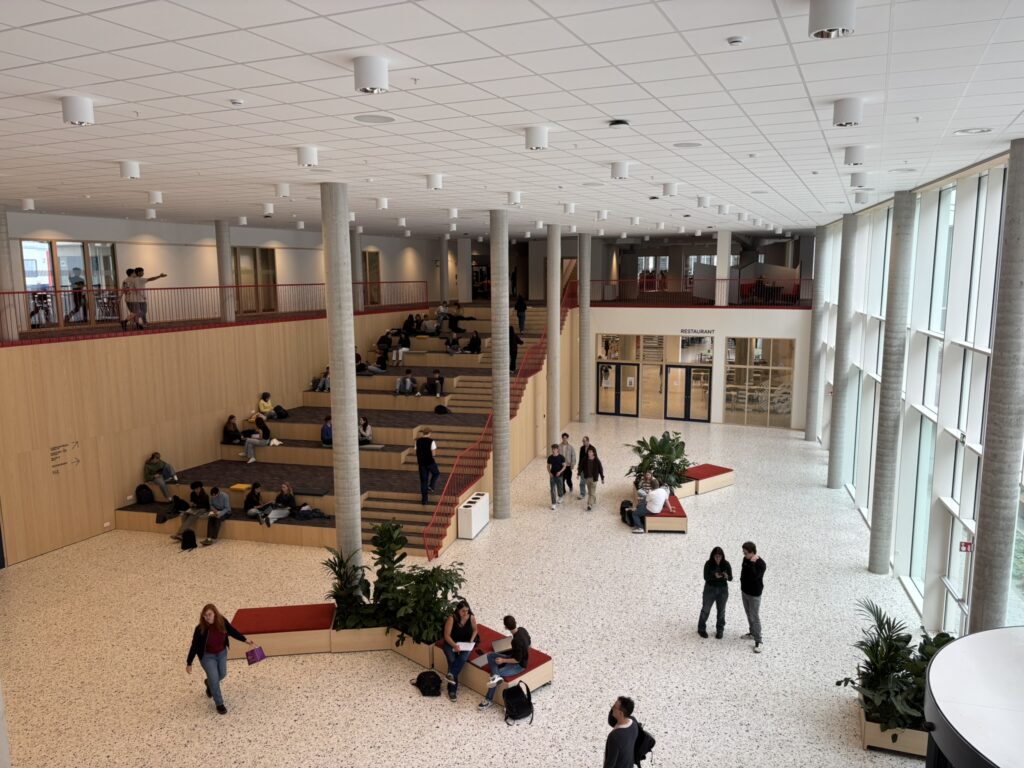
One of the projects I’m most proud of is the realization of our new campus building in Mechelen. It was made possible thanks to our Director, Mia De Wilde, who put a strong emphasis on designing for the “education of the future.” From the very beginning she focused on the idea that learning doesn’t only happen inside classrooms. It happens throughout the entire building — in inspiring zones that encourage meeting, collaboration, creativity, and even moments of relaxation.
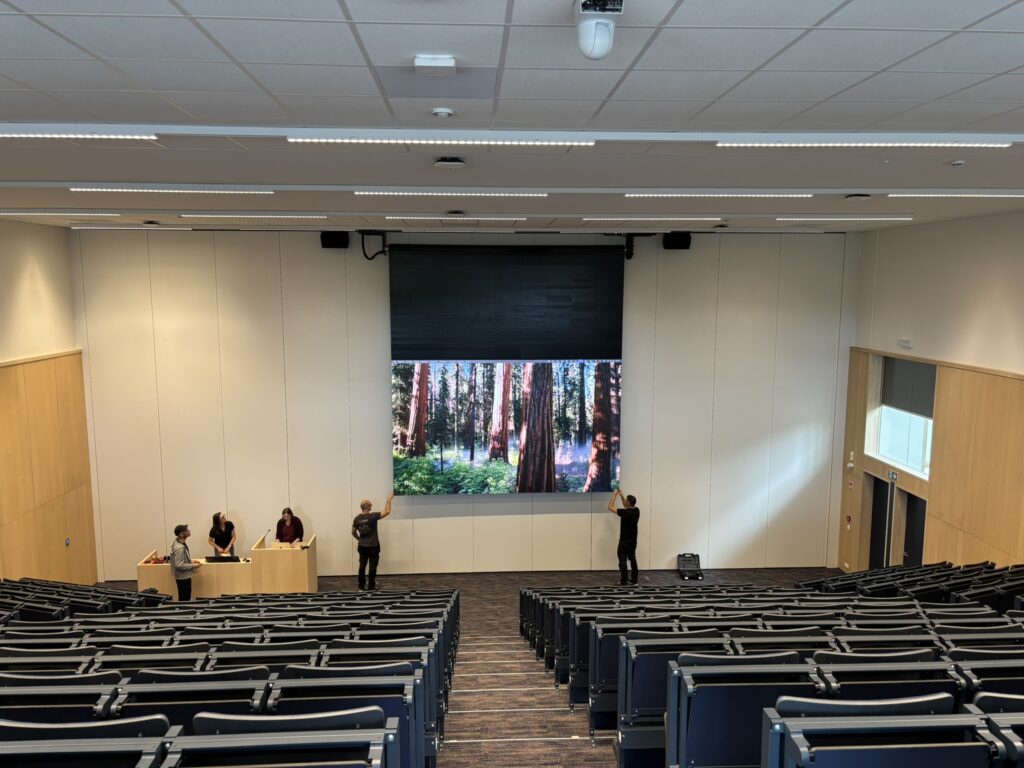
From an AV perspective, the highlight is without a doubt our retractable LED wall. It became the key to solving a major architectural challenge: creating a large auditorium that can also be split into two fully functional spaces. When the movable wall is closed, the LED display lowers automatically so that students sitting closest to it have a comfortable viewing angle. When the auditorium is used as one large space, the screen rises, ensuring that everyone has a clear view of the speaker. In that mode it also functions as a repeater display for students seated in the back. It’s a great example of how thoughtful architecture and smart AV design can work hand in hand to support modern learning.
6. What inspired you to get involved with HETMA?
Our involvement with HETMA actually began with Mia. She has been attending EDUCAUSE for several years and that’s where she first met Joe. When she came back and told us about the initiative, the timing couldn’t have been better. We had just started a Flemish AV group, but we were still figuring out how to communicate effectively and how to position ourselves.
I think everyone in higher education realizes that scaling our voice is essential if we want to have meaningful conversations with the industry. Many of the products we rely on today are still primarily designed for the corporate market. If we want to influence that landscape and see solutions that truly fit educational needs, we have to collaborate. HETMA provides exactly that platform.
On a personal level, it’s also a fantastic way to expand my network. We regularly visit other institutions to stay up to date, share knowledge, and learn how others approach similar challenges. After all, we’re all facing many of the same issues — so learning from each other has become absolutely crucial.
7. What are your short- and long-term goals, both professionally and personally?
Professionally, one of my key goals is to continue inspiring more lecturers to embrace the power of blended learning. A well-designed digital course enriched with knowledge clips offers so many possibilities. We saw this very clearly during the COVID crisis: the lecturers who had already invested in blended learning were far better prepared than those who had to start from scratch under pressure. And beyond convenience, the results speak for themselves — students perform better when high-quality digital materials support their learning.
In the long term, I want to keep helping our institution strengthen this approach and make it accessible to even more educators and students. Blended learning isn’t just a trend; it’s a meaningful shift in how we teach and learn.
8. Where do you see yourself making the biggest impact in the next 5–10 years?
To be honest, it’s hard to predict where I’ll make the biggest impact in the next 5 to 10 years. AV technology is evolving so quickly that the landscape can change completely in just a few months, let alone a decade. What I do know is that our AV team is incredibly flexible. We adapt fast, we learn continuously, and we’re not afraid to rethink our approach when the technology shifts.
So wherever the biggest needs emerge — whether that’s AI-driven support, next-generation learning spaces, or new hybrid models — that’s where I expect we’ll be focusing our energy and making a real difference.
9. What values or mottos guide your work and interactions with your team?
We actually have two unofficial mottos in our team. The first one is: “One day it’ll get quieter!” But it never does. It’s our way of acknowledging that AV support is a constant flow of activity — and that we’ve learned to thrive in that rhythm.
The second is: “No news is good news.” Most people only contact us when something isn’t working, so silence usually means everything is running smoothly. It keeps us grounded and reminds us why reliability is such an important part of what we do.
10. How do you see the role of AV evolving in higher education?
I believe we’re still in a growth phase when it comes to AV in higher education. Budgets are increasingly under pressure, and at the same time we’re seeing a shift back toward teaching larger groups. Hybrid teaching will definitely be part of the solution, as it allows institutions to remain flexible while still offering high-quality learning experiences.
From a technological perspective, I think we’re approaching a tipping point — especially in large lecture halls — where LED walls will replace traditional projectors. We’ve already completed our first installation, and I expect that trend to accelerate as LED becomes more cost-effective and delivers better performance. AI is another major force that will reshape our work. These days we rarely read full manuals when commissioning new equipment; instead, we ask highly targeted questions to AI, which saves an enormous amount of time. I’m currently setting up a test to develop an AI agent for first-line support, initially focused on technical troubleshooting. Later on, we’ll evaluate whether such a system could also help lecturers and students solve common issues on their own.
In short, AV is moving toward a future where smarter spaces, AI-driven support, and more flexible learning models become the new normal — and we’re right in the middle of that evolution.
11. What’s a lesson you’ve learned the hard way in your career?
One lesson I’ve learned the hard way is that in a large organization, you can never please everyone. No matter how well you design a solution, there will always be different needs, preferences, and expectations. So the key is to focus on the greatest common denominator — the approach that benefits the most people and aligns with the institution’s broader goals. It’s not always the perfect fit for every individual, but it’s the only way to create sustainable, scalable solutions.
12. What advice would you give to someone just starting out in AV or higher ed tech?
My first piece of advice is to build a strong foundation in IT — especially networking. AV is becoming more and more intertwined with ICT, and understanding how systems communicate is essential for almost every project we deliver.
Secondly, always think from the end user’s perspective. In AV, your goal is to make technology feel simple, intuitive, and approachable — even for someone with no technical background. That focus on usability is often what distinguishes an AV professional from a traditional IT specialist. If you can combine technical knowledge with empathy for the user, you’ll go a long way in higher ed tech.
13. What’s something people often misunderstand about your work?
One thing people often misunderstand about our work is that we sometimes have to say “no” to requests that seem perfectly logical from an individual point of view. But with 22,000 users, every decision has a much bigger impact. We always have to consider scalability, supportability, and long-term consequences. More and more, security, GDPR, and privacy also play a major role in those decisions. That can be difficult for people to understand, especially when the restrictions feel inconvenient. But ultimately, those boundaries exist to protect them — and to keep the entire institution safe.
Connect with Tom Segers:
LinkedIn: Tom’s LinkedIn