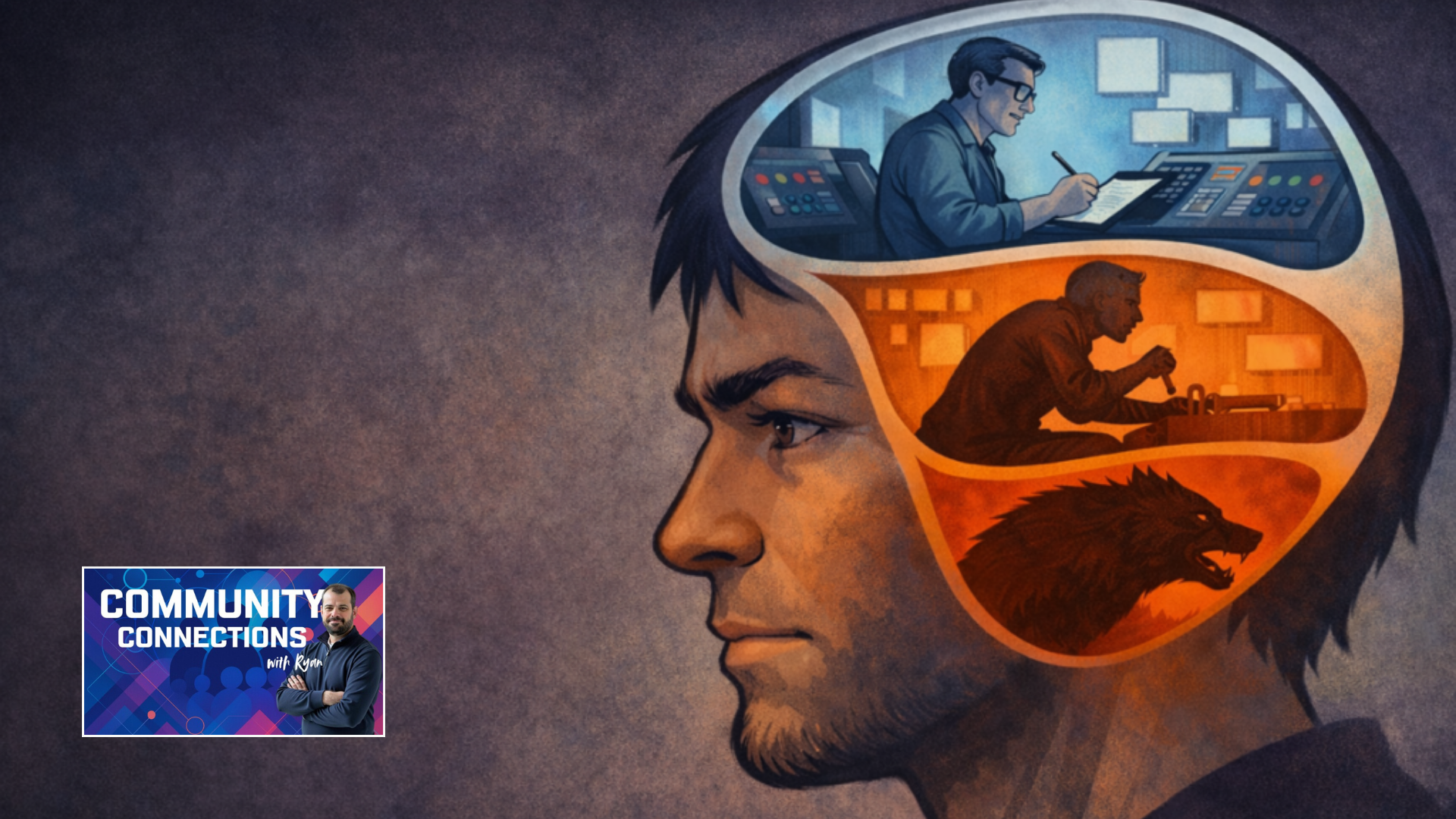


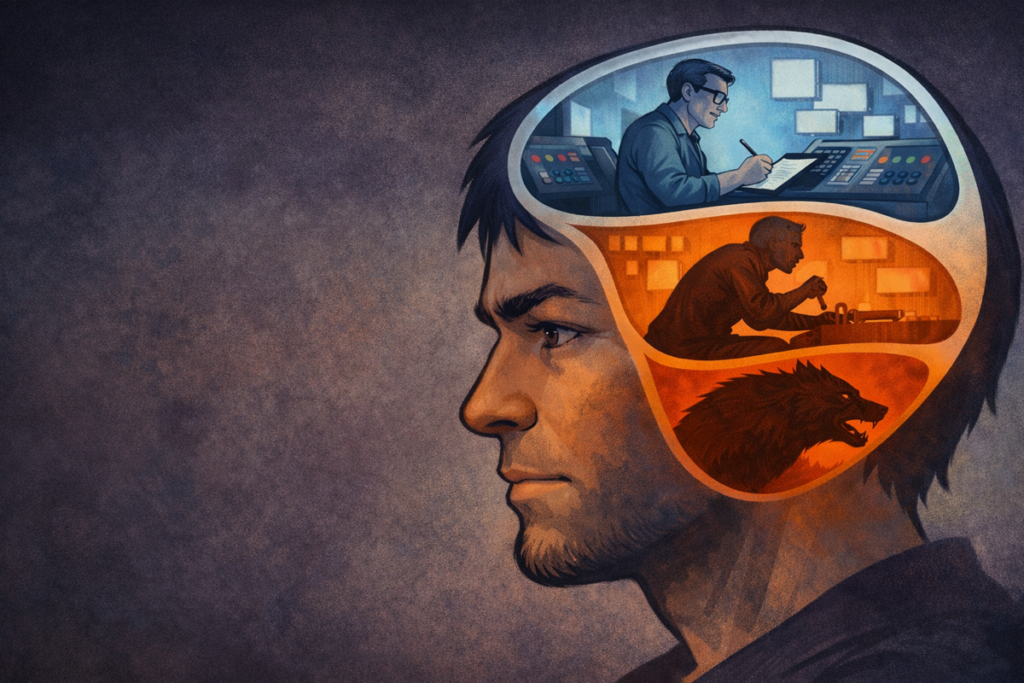
One way I have learned to think about my own mind, especially when I am trying to understand a reaction that feels bigger, faster, or stranger than I expected, is this: I am not just one clean, rational voice sitting at the controls. The part of me I can hear most clearly is the part that narrates, explains, justifies, and turns experience into language. That part feels like “me” because it is the part I can report on. But we all know thats not how it actually works.
I have often thought of the brain in rough layers, as a way of making sense of my own experience. There is the part of me that can talk. There is the part of me that can reason things throuhg. And then there are older, faster, less verbal forces in there too, pushing on fear, comfort, urgency, connection, reward, and threat long before I have assembled a polished explanation. That framework has been useful to me because it creates a gateway to self understanding. It also helps me extend myself a little more grace at times. Most of us are not calmly computing our way through every interaction. We are feeling, scanning, pattern matching, protecting, reaching, reacting, and then trying to explain ourselves in full sentences a beat later.
But just because that makes sense to me doesn’t mean that’s whats actually happening and just believing what feels good seems like the gateway to self delusion.
So let me take my own rough idea, sentence by sentence, and see what actually holds up.
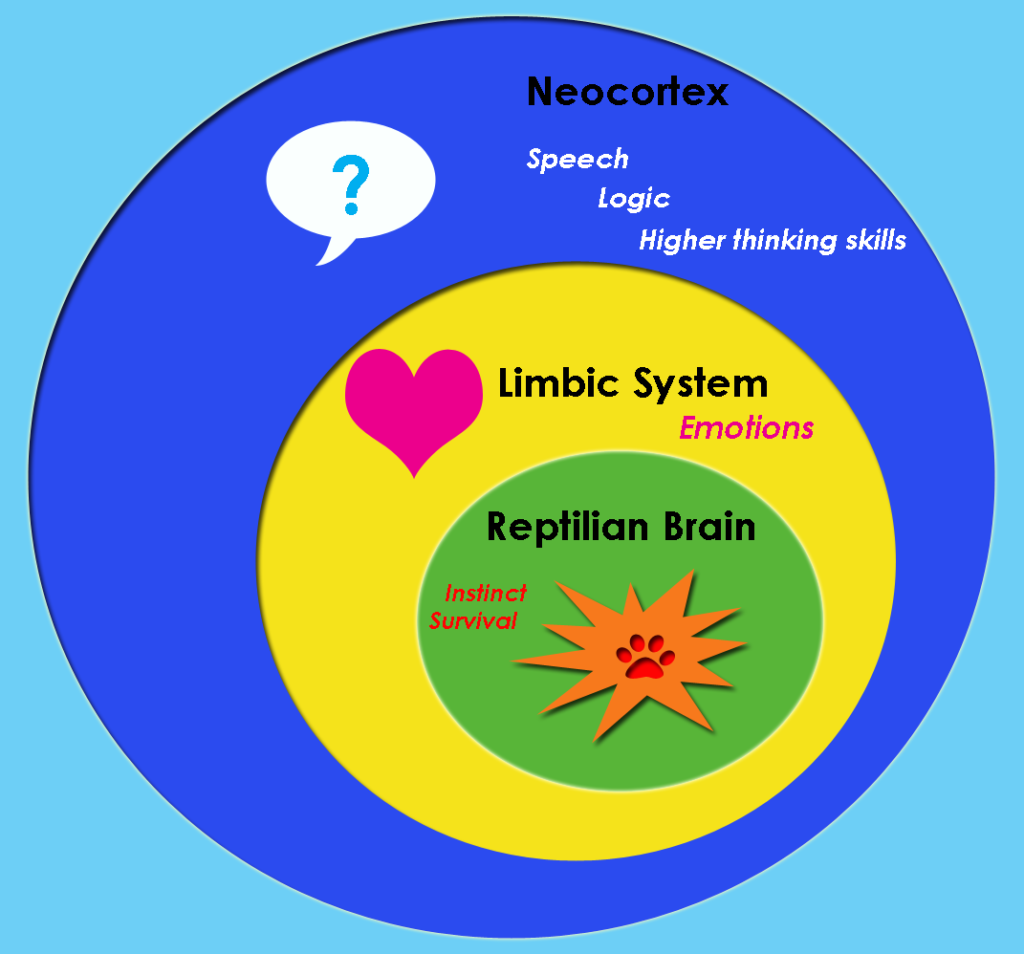
https://en.wikipedia.org/wiki/Triune_brain
When I say the human brain is not one brain but several brains, I am trying to describe an honest human feeling. I can want one thing and do another. I can know better and still react badly. I can tell myself a mature story about a situation while some other part of me is already halfway into defensiveness. As lived experience, that lands. As neuroscience, though, it is too tidy. The old model behind that kind of claim is Paul MacLean’s Triune Brain theory, the famous “reptile brain, mammal brain, human brain” framework. It has been hugely influential in pop psychology because it is memorable and intuitive. But modern neuroscience does not treat it as an accurate map of how the brain is organized or how evolution built it. The brain is not best understood as three separate creatures stacked on top of each other. It is one deeply interconnected organ made up of interacting systems and networks. Emotion and cognition are not living in separate apartments, occasionally texting each other from down the hall. They are tangled together from the start.
https://hopebraincenter.com/the-frontoparietal-network-your-brains-hidden-control-center-explained/
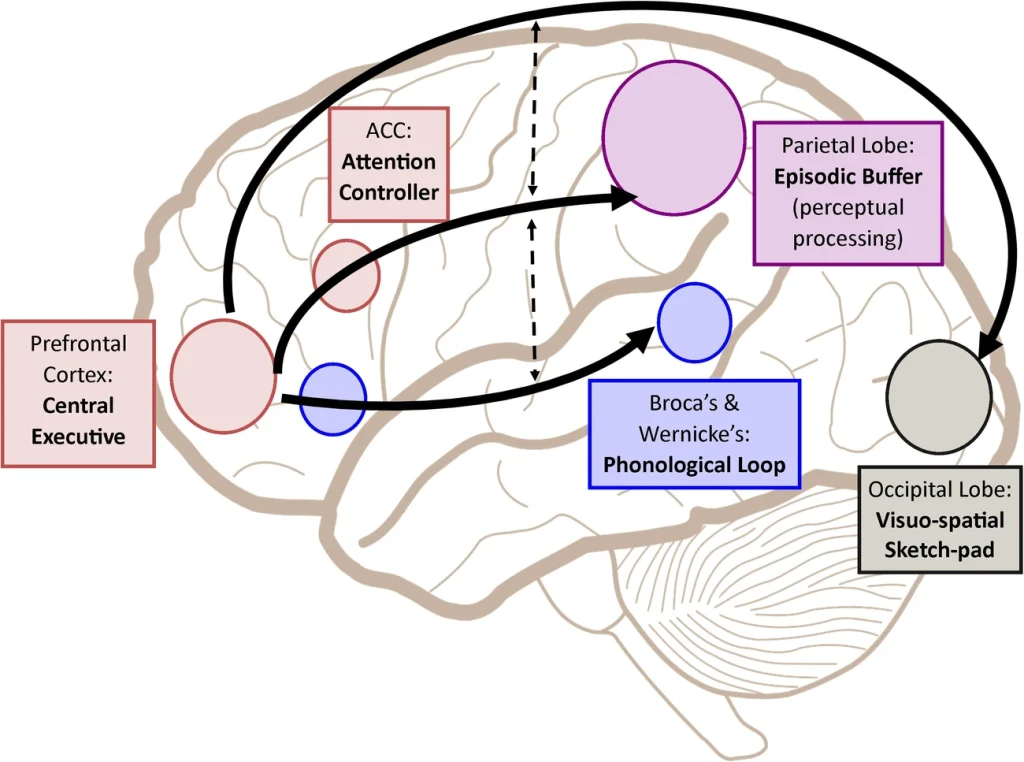
When I say we think of ourselves as the language centered executive function part because that is the only part we can put words to, I am getting at something real, but I am overshooting. The real part is this: verbal report is limited. We do not have direct language access to every process shaping attention, emotion, impulse, habit, or appraisal. A lot of mental life arrives in consciousness already partly processed. That part is fair. But executive function is not just “the language part,” and language is not the same thing as the self. What neuroscience usually points to here is the role of prefrontal networks, especially the frontoparietal control network, in things like goal maintenance, inhibition, task switching, and flexible control. That system is real, important, and much more distributed than the pop version suggests. It is not a little CEO in the skull. It is part of an ongoing negotiation among control, prioritization, memory, reward, and bodily state.
https://www.structural-learning.com/post/exploring-dual-process-theory
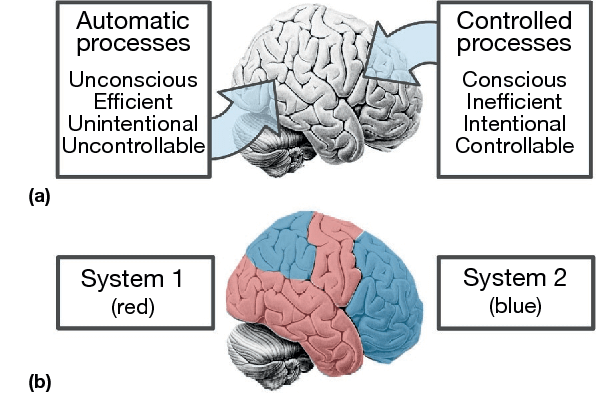
When I say the older parts of the brain are still in there driving most of what we feel and how we decide, again, I am sitting on top of a truth and then stretching it too far. The true part is that a great deal of human behavior is shaped by fast, automatic, and partly nonconscious processing. Threat detection, reward learning, emotional salience, habit, and action readiness do not wait around for a comittee meeting with the verbal self. That is one reason we can feel our body react before we have “figured out” what we think. But the phrase “older parts” can mislead people into imagining neatly preserved evolutionary layers, and the claim that those parts drive “most” decisions is broader than the science can cleanly support. A more useful frame comes from dual process theories, which distinguish between fast, intuitive processing and slower, more reflective processing. Even there, though, the best reading is not that we have two separate brains fighting for dominance. It is that human cognition includes multiple modes of processing, and both can matter depending on the situatoin.
When I say these forces often have power over us precisely because they are older than language, I think the better scientific phrase is not really “older than language.” It is nonconscious processing and the limits of introspection. The issue is not just age in evolutionary terms. The issue is access. We do not always know why we feel what we feel when we feel it. We often become aware of the result before we become aware of the process. Sometimes all we get at first is a body signal, a flash of irritation, a pull toward safety, a sense that something is off, or an immediate liking or disliking that seems to show up fully formed. It means the mind is doing a lot of work outside the narrow band we can track in real time.
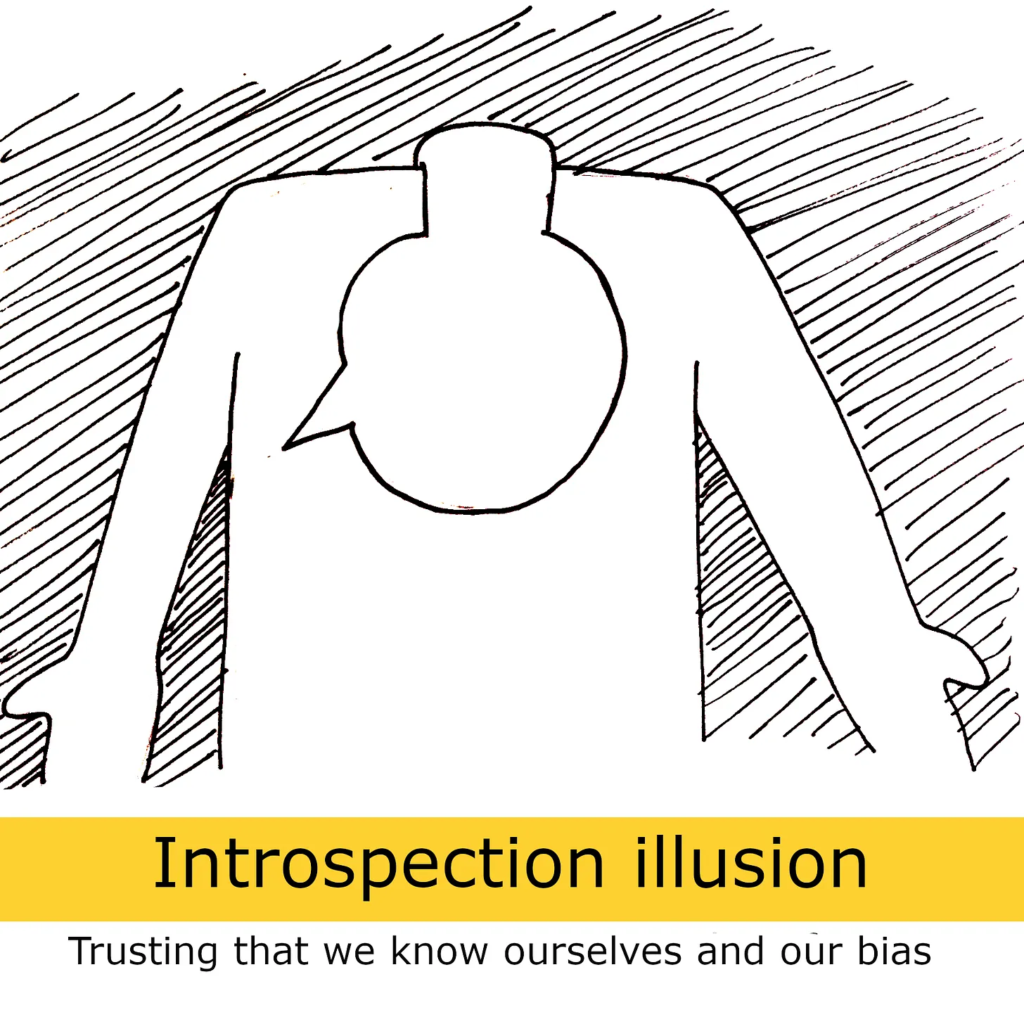
And then there is the part of the idea that probably hits hardest because it feels both humbling and a little embarrassing: we think we are acting rationally, but often what we are doing is using language after the fact to explain actions or decisions that came from somewhere deeper first. There is real science behind that concern. Psychology has long wrestled with the introspection illusion, the tendency to overestimate how directly we know the causes of our own judgments and choices. There is also the concept of confabulation, where people offer explanations that are sincere and confident but not actually well grounded in the processes that produced the behavior. In other words, yes, sometimes we are less like courtroom judges delivering clear eyed reasoning and more like press secretaries arriving late to explain a decision that has already been made.
But this is where I have to be careful not to let a sharp sentence turn into a false worldview. Because if I say that reason always comes after instinct, I have gone too far. Human beings really do deliberate. We really do change our minds. We really do inhibit impulses, reflect, revise, and grow. Executive control is not fake news. Rational thought is not just PR for our gut. The more accurate picture is that reflective thought is powerful, but it is not sovereign. It is one participant in a crowded, dynamic system. Sometimes it leads. Sometimes it follows. Sometimes it catches up after the fact and tries to take credit for authorship.
If I believe I am purely rational, I will probably become less curious about my blind spots. I will mistake my explanations for complete explanations. I will assume other people are simply being unreasonable when in reality they may be reacting from fear, history, habit, overload, shame, uncertainty, or a nervous system doing exactly what nervous systems do.
If I believe I am nothing but instinct dressed up in good vocabulary, that is not much better. Then I am off the hook. Reflection becomes theater. Growth becomes branding. Accountability gets weaker because every bad reaction can be shrugged off as biology.
Neither view works.
The better view, at least for me, is more humble and more demanding. I am one integrated brain and body with multiple interacting systems. Some are fast, emotional, automatic, and hard to put into words. Some are slower, reflective, and easier to narrate. Both are real. Both shape my life. Neither gets to claim total ownership.
And maybe that is where this starts to matter beyond self analysis.
What does any of this have to do with community?

Humans are social creatures. Pack animals, if you want to say it plainly. We live in groups, work in groups, teach in groups, lead in groups, and get hurt in groups. We also heal, learn, repair, and belong in groups. But if we want to really explore what it means to live well in community, we have to start with a more honest understanding of ourselves. We have to understand that not every reaction is fully reasoned, not every explanation is complete, and not every conflict is really about the thing being argued on the surface.
That does not excuse bad behavior. It does something harder than that. It gives us a more realistic starting point for responsiblity.
Know your patterns. Notice your body. Question your first explanation. Leave room for the possibility that the story you are telling yourself is only part of the story. And offer other people the same possibility too.
That feels like community work to me.
Not the polished kind. It’s the real kind; the messy, confusing, frustrating, rewarding and valuable kind.