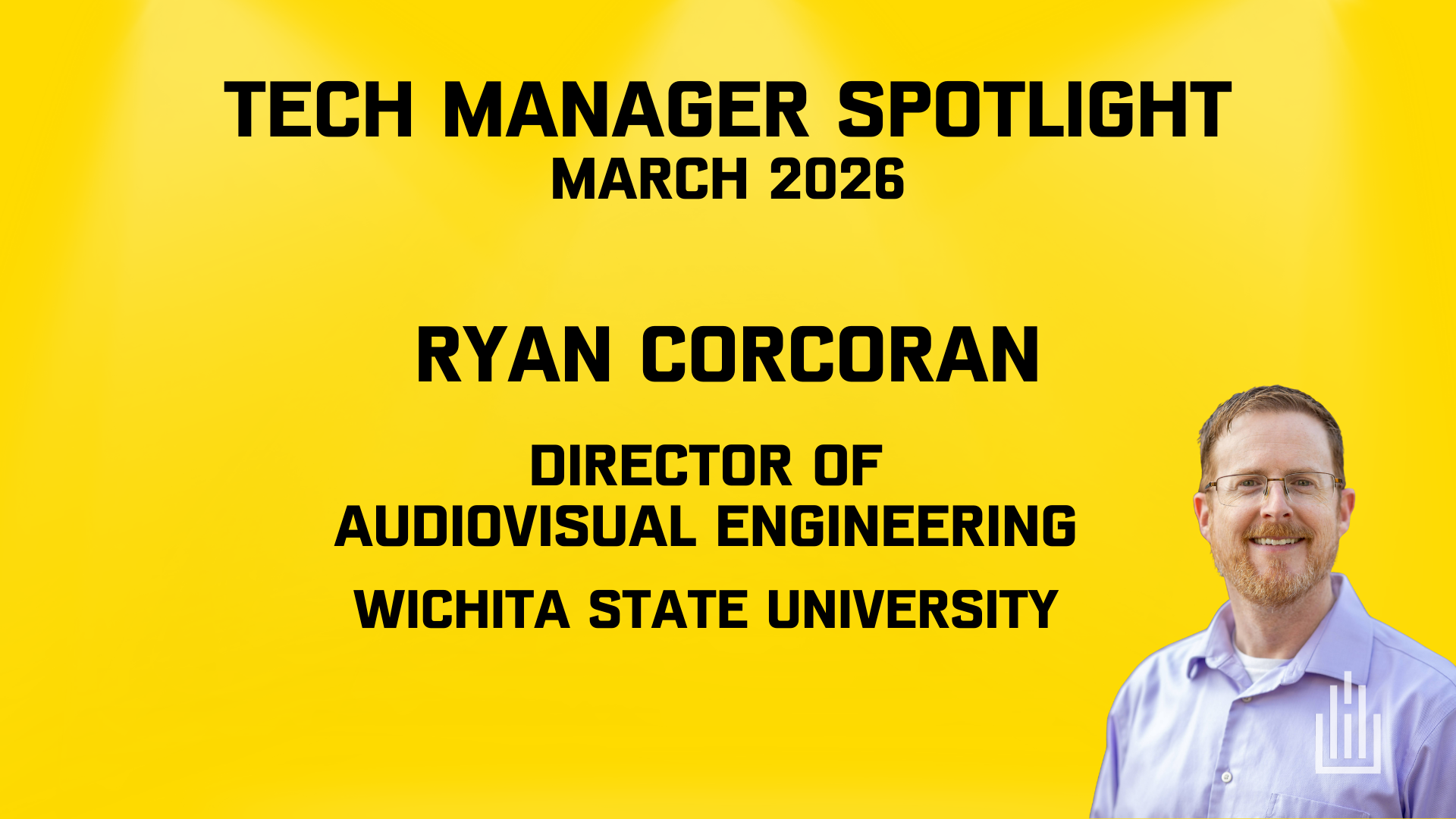
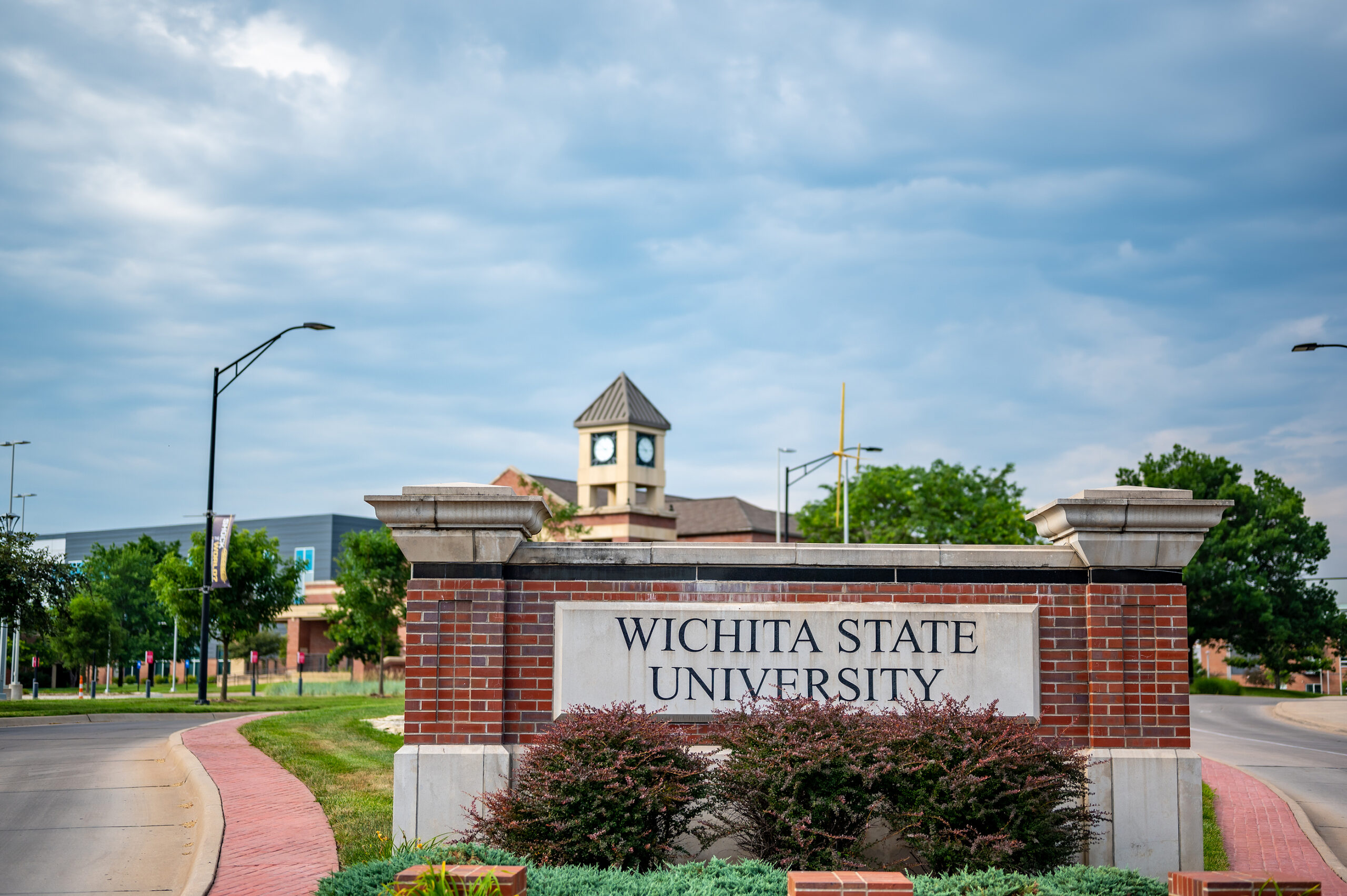
Welcome to this month’s edition of the Tech Manager Spotlight, where we highlight the professionals who bring vision, adaptability, and heart to higher‑education AV. This month, we’re excited to introduce Ryan Corcoran, the Director of Audiovisual Engineering at Wichita State University in Witchita, KS.
Ryan grew up in Kansas and received his Bachelor of Music Performance degree at Wichita State. Despite being passionate about music, he has always had a deep love for computers and AV technology, even from a young age when his family got its first computer, a Texas Instruments TI-99/4A. He built his first website using straight HTML 1.0 code around 1994 and taught himself relational databases in high school to manage his CD collection. He also learned video editing using an old VHS timecode-based dubbing system and worked his way up through iMovie into Adobe Premiere.
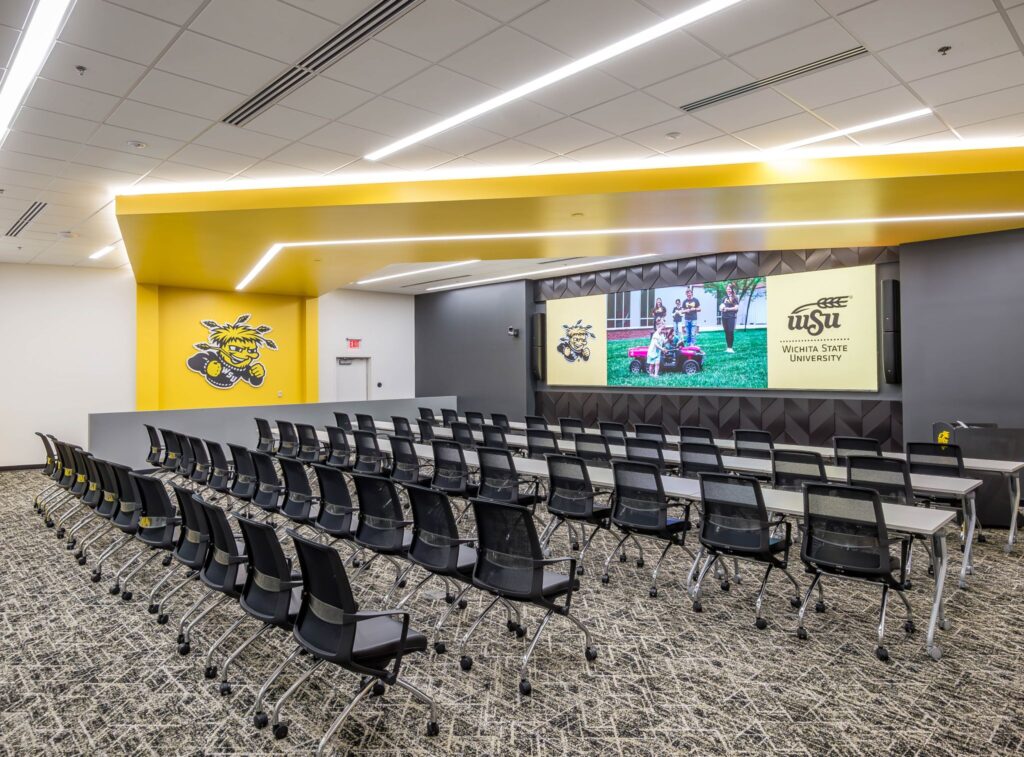
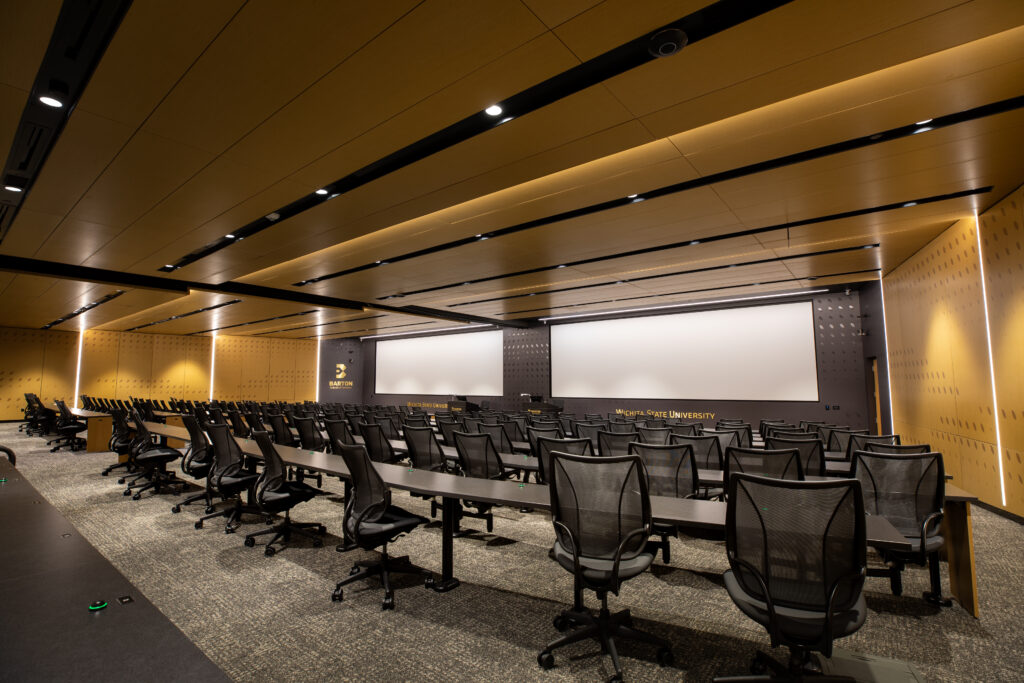
In his role at Wichita State, Ryan’s team handles audiovisual system design, procurement, installation, programming, and commissioning for new AV systems across campus, especially classrooms, conference rooms, and other meeting spaces. The team completes as much installation work as possible in-house, while also managing larger projects that require external integration firms when necessary. The goal is to standardize equipment, system design, programming, and user interface design as much as possible to reduce system downtime and improve supportability.
Ryan is currently working on the new Wichita Biomedical Campus, an eight-story, 471,000 square foot building in downtown Wichita. The project is a collaboration between Wichita State University, WSU Tech, and the University of Kansas and will house departments including Nursing, Physician Assistant programs, Physical Therapy, and more. The building is slated to open in mid-2027 and will feature over 50 learning spaces, more than 40 meeting and study rooms, and over 24 exam rooms. The AV budget is expected to be between $7 and $8 million and is the largest single project the university has ever taken on.
Have you always worked in AV? What did the path look like for you to get to where you are now?
My original career path was music education. I worked as a band director in Ohio and Kansas for five years before I realized that teaching was not one of my core competencies. I realized that I really loved technology, so I worked in the corporate world for about five years doing database and website development for an aerospace company while working on my master’s degree in educational technology. After earning that degree, I took a position at Wichita State working with faculty on educational technology and then transitioned into my current role in AV a couple of years later.
What is your morning routine?
I have always admired people with morning routines that feature study, meditation, and workouts. Unfortunately, that is not me. My morning routine usually involves waking up later than I would like, grabbing coffee and a low-carb breakfast, and heading out the door to get my son to school on time. Once I get to the office, I check email, review and update our project dashboard, and review my task list.
What does an average weekday look like for you?
Most of my days are spent working through email, doing AV design using Microsoft Visio, project management, and escalated trouble tickets. I used to do AV systems programming as well, but I now have staff who are much more talented in that area, so those skills are getting a bit rusty. I especially enjoy the days when I get to do AV design work and can focus on how signal gets from point A to point B. In recent months, I have also been more intentional about being a bigger part of AV community group meetings in HETMA and ETC.
What does your busiest day look like? What challenges does your role face, and how do you overcome those?
My busiest days are usually the ones where unexpected needs arise. Whether it is a major technical issue or a last-minute request for a design, quote, or installation, those events can disrupt the day because everything else still needs to get done. I am slowly learning not to let those moments overwhelm me and to keep my focus on the main priorities. Ongoing challenges mostly relate to budget constraints and balancing expectations. Everyone wants the impressive AV systems they see at other venues, but they are often surprised by the cost involved.
What do you enjoy doing on weekends or outside of work?
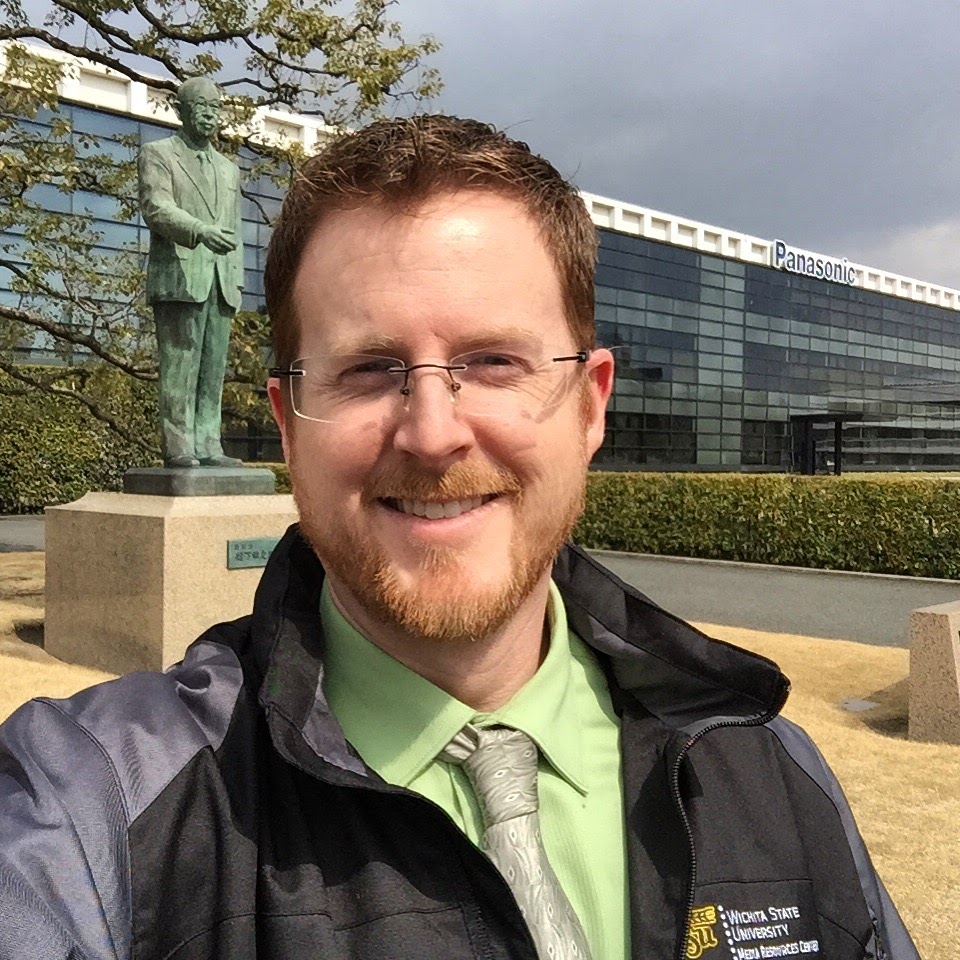
Most of my time outside of work is spent with my family. This includes taking my son to activities, helping with church projects, recently building a new video recording studio for our church’s YouTube channel, KYB Know Your Bible, or traveling and doing video editing for my wife’s YouTube channel, Geo-Logos.
What is your favorite way to unwind or recharge?
I really enjoy watching movies. I like going to see a big summer blockbuster in the theater or staying home to watch an old favorite. I also try to check items off my IMDb watchlist, although it seems to grow faster than I can work through it.
What inspired you to get involved with HETMA, AVIXA, and other higher ed organizations?
Like many people, I stumbled into AV as a career without really understanding what the field looked like. Once I realized how much I did not know, I sought out opportunities to learn from colleagues at other institutions. The ETC and HETMA annual conferences have been great opportunities to learn and connect with peers. At the same time, I did not want to limit my AV knowledge to only the higher ed space. There is a lot that we can learn from corporate, education, and religious AV environments, since we all support users in similar ways.
Where do you see your career trajectory going in the next five years?
In terms of my current role, I feel good about where I am and would be happy to still be in this position five years from now. From a career perspective, I plan to expand my knowledge and expertise on the networking side of AV. As AV over IP continues to grow, the need to communicate effectively with networking colleagues grows as well. I am working toward earning my AVIXA ANP certification.
What is your life motto, and how do you apply it to your work?
My life motto comes from something my stepfather used to say: If you always do what you have always done, you will always get what you have always gotten. With a background in engineering, my daily focus is on continuous improvement. I try to find ways to work more efficiently and strengthen the role of AV professionals when working with architects and civil or electrical engineers.
What accomplishments are you most proud of?
Earning my CTS certification was one of my proudest individual accomplishments, not because it was especially difficult or resulted in major changes, but because it helped prove to myself that I belonged in this field. Imposter syndrome is common in higher education AV, and that external validation mattered. One of my larger accomplishments at the university was migrating the campus from local, isolated AV installations to networked and fully managed systems. All general use classrooms are now remotely supported, which allows for faster resolution of issues.
How would you describe your leadership style?
Because I am self-motivated, I tend to lead with the expectation that my staff are self-motivated as well. We have a small team, and everyone needs to help each other and wear different hats. I want my staff to want to grow their skills and knowledge. As much as possible, I try to give them the tools they need to be successful and then step out of their way.
How do you foster collaboration and innovation within your department?
Collaboration is essential in our small department. I rarely make decisions without discussing them with the team first, and staff regularly share ideas, concerns, and feedback on projects and designs. Innovation is also critical because we are constantly being asked to do more with less. We often ask questions like how to support more AV enabled spaces with the same or fewer staff, or how to meet goals with less or different equipment.
How do you see the role of AV evolving in higher education?
In the past, AV in education was a nice addition to traditional lecture based teaching. In modern education, faculty rely heavily on their laptops for delivering content, collecting feedback, and supporting hybrid and distance learning. AV is now almost as critical as desks and electricity. The biggest challenge is communicating that importance and convincing leadership to prioritize AV in budgeting and design decisions.
What is a lesson you have learned the hard way in your career?
No one is going to do it for you. If you want or need something, you have to pursue it yourself. In school, we are used to being told what comes next. In your career, it is up to you how involved you become and how you choose to grow. You either put yourself out there or accept staying where you are.
What advice would you give to someone just starting out in AV or higher ed technology?
First, find a good mentor and do not be afraid to ask questions. People in higher ed and AV are usually eager to share their experience, but you need to be proactive. Second, put in the effort to study for and earn your CTS certification. You will likely learn things you did not know, and it is a good way to validate your skills among peers.
What is something people often misunderstand about your work?
Many people misunderstand AV work, especially at the corporate level, because they compare it to what they have at home, such as a TV and a soundbar. It can be difficult to explain why that does not work for a classroom. Unlike other trades like plumbing or HVAC, AV often gives people a false sense of confidence, which makes education and advocacy more challenging.
Connect with Ryan:
LinkedIn: Ryan’s LinkedIn