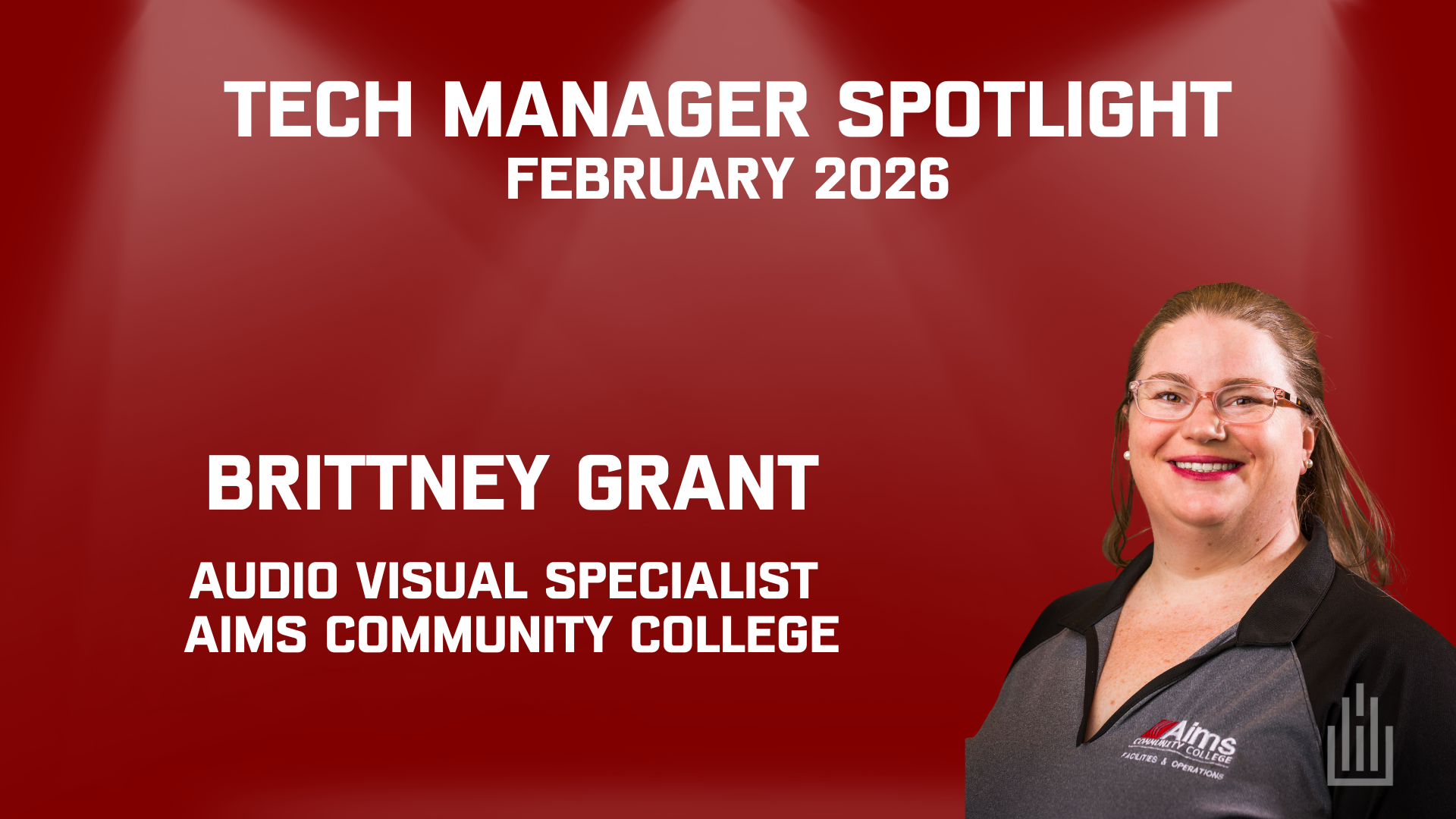
Welcome to this month’s edition of the Tech Manager Spotlight, where we highlight the professionals who bring vision, adaptability, and heart to higher‑education AV. This month, we’re excited to introduce Brittney Grant, an Audio/Visual Specialist at Aims Community College and the current HETMA Approved Program Chair. Her path into AV has been anything but conventional—and is all the more compelling because of it.
Working as one half of a two‑person AV team, Grant supports a wide range of internal and community events while maintaining the AV ecosystem of Aims’ event spaces, including the auditorium used for commencement and other major gatherings. Her background spans live events, theatre, church production, and stage management, and she still serves as an Assistant Stage Manager at her local roadhouse theatre. Over the years, she has worked backstage for international touring acts, directed countless weekly church services, and gained a deep understanding of what it takes to create technically smooth, human‑centered experiences. That blend of artistry and logistics now shapes her approach to higher‑ed technology.
Grant is currently involved in several ongoing and upcoming projects—but one in particular stands out: the Aims Workforce Innovation Center (AWIC), a future‑focused facility designed to give students, faculty, staff, community members, and industry partners access to cutting‑edge, flexible spaces. With seven distinct environments—including a maker‑space, vlog room, IDD room, VR classroom, and free‑roam VR—every room has the potential to be exactly what it was designed for… or something entirely different. She calls it “planning for the maybes or the ‘we could,’” a mindset that reflects both her creativity and her readiness to support evolving needs.
When she looks at the broader landscape of AV in higher education, Grant sees institutions falling into three major tracks: minimalist tech setups; steadily modernizing spaces where programming enables smoother operation; and the cutting‑edge implementations involving XR, VR, and AR that push learning into new dimensions. She notes that some people will always prefer familiarity—“the way it’s always been done”—while others will never find the cutting edge quite cutting‑edge enough. Navigating those extremes is part of the job, and she approaches it with realism and good humor.
Her professional philosophy has been shaped by lessons learned the hard way. One of the most impactful is understanding that she can bring her best, but she can’t—and shouldn’t—compensate for others who don’t. “I can only do what I can with the information given to me,” she reflects. It’s a principle that keeps her centered in a fast‑paced environment where expectations, events, and technology can shift without warning.
For those entering AV or higher‑ed tech, she offers a simple but meaningful piece of advice: ask for help. “There is so much knowledge in this industry,” she says. “You won’t learn it all, but someone knows—or knows someone else.” It’s advice she admits she often has to remind herself of, too. And if there’s one misconception she’d love to clear up, it’s that she isn’t IT support: “I would love to assist you with your broken computer, but the best you’re going to get from me is, ‘Did you turn it off and back on again?’” It’s a gentle reminder that while AV and IT intersect, they aren’t interchangeable roles.
1. Have you always worked in AV? What did the path look like for you to get to where you are now?
I have not always been in AV. Like many people, I got volun told—and it was probably the best thing that ever happened to me. In high school, I helped with Drama Club, took theatre classes, and started running the camera for church (basically sitting behind it to make sure the pastor didn’t walk out of frame). But after I graduated, I completely forgot that working in a theatre and being involved with tech could actually be an adult job.
I headed to college, took three semesters of classes, and then realized I had no idea what degree I wanted. I left school to find full time work and spent several years in child care and then elder care. After that, I tried my hand at quality control for a plastic manufacturing plant. Once that job ran its course, I learned—after three months—that I am definitely not a salesperson, but I did manage to get over my fear of making phone calls (haha). That was when I started working more consistently for the church and eventually got hired at the theatre where I still work today.
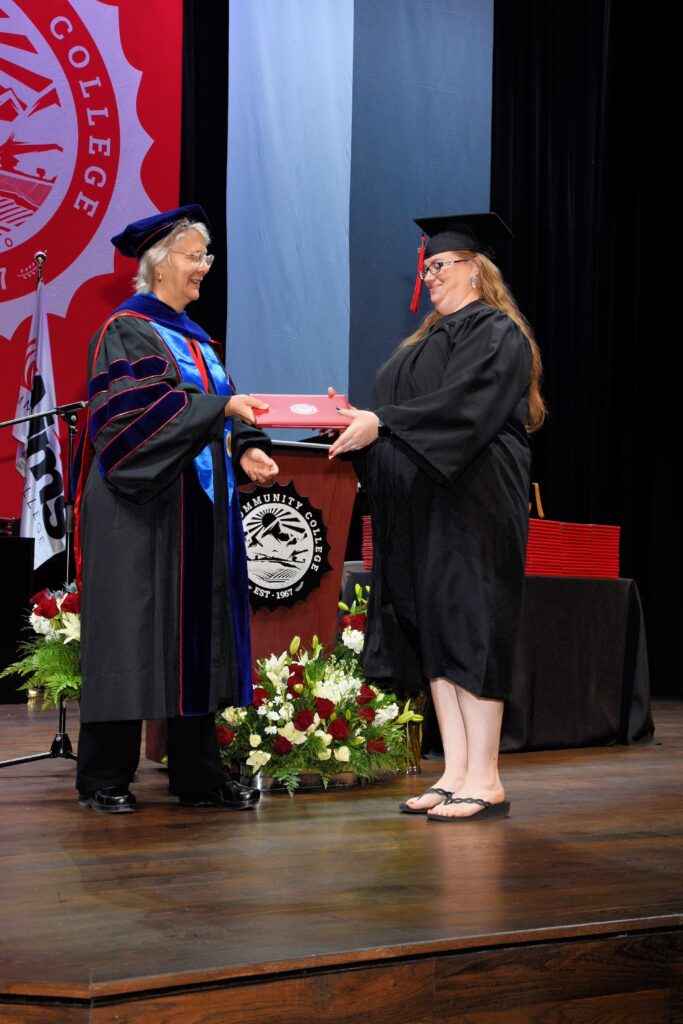
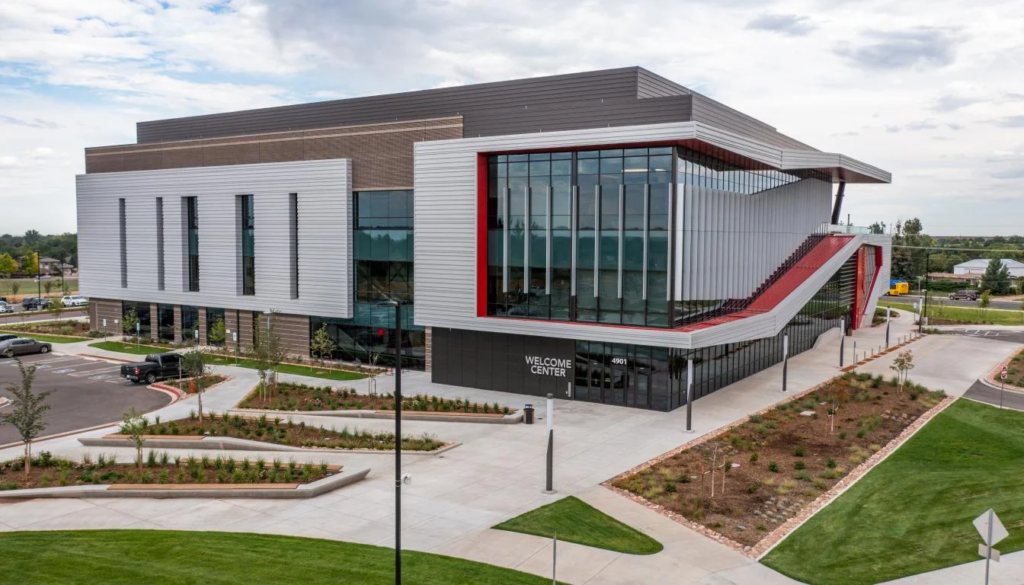
In the fall of 2020, I went back to college to finish the degree I had started quite a few years earlier. While in school, I became involved with the Student Government Association as the Vice President of Facilities and Operations (I promise the shortened version is just as long—SGA’s VP of F&O—and then you have to explain the abbreviations—HAHA). As part of that role, I attended construction meetings for our newest building on campus, the Welcome Center. Little did I know that nine months later I would be working in that very building—knowing all the little nooks and crannies—from seeing it as an empty shell, to watching the last minute details go in place, to being the first student to walk across the stage at its first commencement, to now working there every day.
2. What is your morning routine?
My routine seems to change with the seasons. Here in Colorado, we’re in a very, very, very dry December (it’s currently 12/15, 59°F, no snow on the ground, and none in the forecast before Christmas). So right now my mornings start with getting ready for the day and filling all the humidifiers in the house so the cat and I don’t static shock each other too badly. After that, I either make coffee at home or pick up a “fancy” coffee on my way into work.
3. What does an average weekday look like for you?
Get to work, check emails, head to the Welcome Center and see what is “happy” today, set up events, run events, clean up events, and—hopefully—check emails again.
4. What does your busiest day look like?
Busiest days are either Commencement days or conferences. Those are usually early mornings and late evenings, with each room in use one way or another. Thankfully, the building usually runs well enough once everything is turned on—most problems happen during the initial connections. After that, it’s a matter of checking in during breaks and making sure everything is running smoothly for the clients.
5. What do you enjoy doing on weekends? How do you spend your time outside of work? What’s your favorite way to unwind or recharge?
I am trying to get back into “fun reading.” I listen to audiobooks almost daily, but I miss being able to disappear into a physical book for a few hours like I did when I was younger. I enjoy spending time with friends and family when possible, and some of the non weekly things I love are going to shows, musicals, comedians, or museums when budget and timing allow.
To unwind or recharge, I really like watching different styles of food and cooking shows. Some of my current favorites are Last Meals on Mythical Kitchen’s YouTube channel, Somebody Feed Phil on Netflix, and anything by Anthony Bourdain (though most of his shows are rewatches for me). I also have a few comfort movies and shows that I put on when I’m overwhelmed or having a rough day. The top one is Pride and Prejudice—the 2005 version with Keira Knightley and Matthew Macfadyen. I may have watched it so many times in one week that my roommate hid it… little did she know I had a second copy. And no, I will not be taking any notes about this. Haha!
6. Comparing your career path over time, what are some of the moments, accomplishments, or projects you’re most proud of?
Recently, some of the things I am most proud of are all the small moments that just happen but have the opportunity to be so much bigger than the sum of each space. A few examples are being available and able to help a colleague change a tire, or later that week stopping by the college’s coffee cart and hearing a student talk about not understanding her credit card or car loan. I was able to take a few minutes to sit down with her and walk through each one line by line in a way that made it less confusing and less foreign.
So many of my recent moments have nothing to do with AV—just being present and available. I will always strive for perfection in my events, but the past few weeks have been a great reminder that it’s the moments between the events that make life sparkle.
7. What inspired you to get involved with HETMA, AVIXA, and other higher ed orgs?
I originally found AVIXA in March of 2023 after I was told I had professional development funds I could use if I found a conference. That afternoon, I started looking at what was out there and found InfoComm in Orlando. I signed up and booked flights. By the end of day one, I was so overwhelmed that all I could do was attend the classes I had registered for and try to walk the show floor.
After one of the sessions, I was talking to someone who mentioned he had just visited a booth for higher education tech managers and thought I should check it out. I braved the show floor to find the booth and walked up right as Troy Powers was in the middle of talking to a group, so I just listened on the edge. It sounded cool, and someone handed me a swag bag full of goodies—after which I made the fastest escape out of the building to go hide in my hotel room and regroup for the next day.
After flying home, I logged onto the website I had been given and found the HETMA community. Showing up to that first meeting was one of the best things I’ve done for myself, both personally and professionally. HETMA was the community I didn’t know I needed until I stepped in and started showing up. Sometimes it really is just that simple.
8. Where do you see your career trajectory going in the next five years?
I hope to still be in higher ed, but I am very sure I’ll be doing AV in some form or fashion. Maybe working toward a degree, maybe not.
9. What is your life motto, and how do you apply it to your daily routine?
I feel like I’m a conglomerate of different mottos, ranging from “take the cake as it’s passing” to “the answer will always be no if you don’t ask,” and “if one door closes, another one opens.” I think these play into my life more and more because it feels more natural now to step into spaces I might not have stepped into before or to ask to be involved in something I may not have thought I had the right skill set for. At this point, I can always learn new things.
Connect with Brittney Grant:
LinkedIn: Brittney’s LinkedIn