

While listening to episode 83 of the brAVe [space] podcast, a comment by Elias Puurunen stuck with me. He mentioned to Britt that his final lecture would focus on what he called “first principles.” That concept sounds similar to what I tell the players I coach, though I call it the “foundation.” No matter the phrasing you prefer, it boils down to a single truth: success requires consistently executing the basic, small stuff. That idea aligns perfectly with HETMA’s new annual theme of Homecoming.
What does it truly mean to return home when we discuss AV and IT? The answer might surprise you, because it has absolutely nothing to do with the technology itself. The answer is found within ourselves.
Over the past 18 years of my career in higher education, I have watched countless talented professionals lose themselves. They lose their “why,” slowly shifting into an uninspired routine where they are merely going through the motions. While there is nothing inherently wrong with showing up, fulfilling expectations, and going home, none of us entered this vertical just to coast until retirement.
Think back to the spark that brought you into AV, IT, or higher education. It might have been because you love solving puzzles, because you find genuine fulfillment in helping people, or because you simply enjoy tinkering with technology. If we wanted a stress-free environment or an easier path to a high paycheck, there are dozens of other careers we could have chosen.
So, how do we lose our way? It is easy to point fingers at poor leadership, administrative red tape, or the broader systemic culture of higher education. While those factors are real, the root cause is often that we are constantly asked to do too much with too little. Our teams remain small while our scope of operational responsibility continues to grow.
This reality suffocates the time required to do what we actually set out to achieve. We have limited time to deeply support our customers because the equipment demands our focus. Conversely, we have limited time to proactively maintain that equipment because users’ needs demand our focus. Ultimately, we are left with no time to innovate, tinker, and advance because we are caught in a perpetual cycle of firefighting.
Yet operating in firefighting mode does not give us permission to lose our identity. I know this is far easier said than done, as I have been down the same paths as everyone else. But even amid the chaos, I anchor myself to my core foundation: I love helping people, and I love tinkering with technology.
By keeping these principles at the center of my daily work, the firefighting shifts from an overwhelming burden to a structured practice. I refuse to rush blindly from one fire to the next just to tick a box.
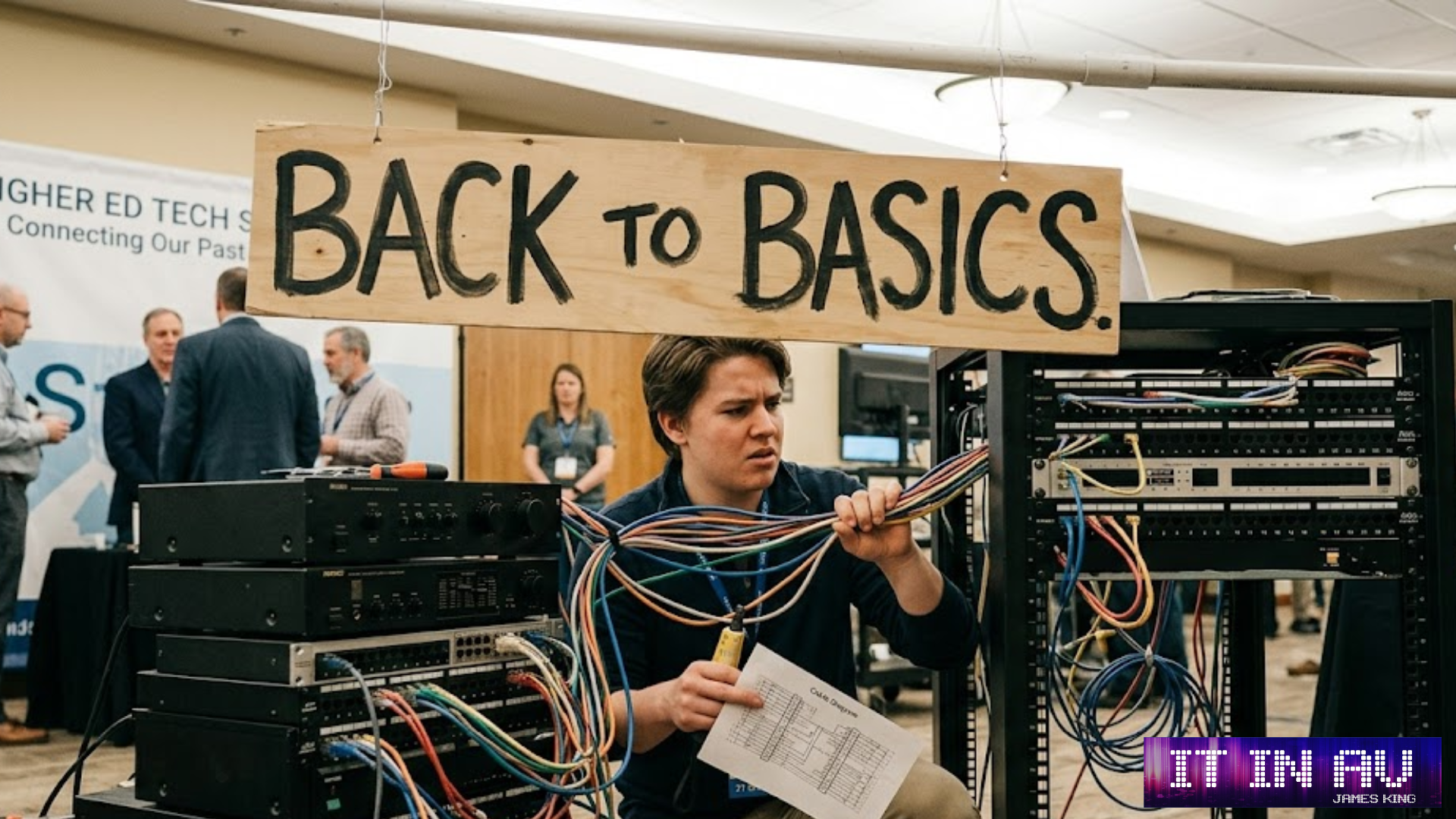
For example, when wiring infrastructure or building out a rack, I constantly think about the impact on our end-users. I prioritize how the quality of that work will affect our end-users and how it will inevitably affect me down the road. A saying I always use is:
Wire up things as if the next person coming in behind you is an insane serial killer who, if you make them mad, will hunt you down and kill you! As more often than not, it is you coming in behind yourself, so do not make yourself mad.
My challenge to you this month is to intentionally step back, breathe, and put yourself directly in the shoes of your end-users. Go sit in the student seats. Spend time in the faculty spaces.
Ask yourself honestly: Can you see the content easily? Can you hear the audio, and is it clear and intelligible? Is the rack wiring clean and safe? Are the user interface controls easy to use? Would the support you gave a customer be suitable if someone gave it to you?
If you answer no to any of these questions, then why on earth should we believe it is good enough for our end-users? Returning home to these foundational details can help make the daily firefighting feel manageable again.