
When I go to InfoComm, I have very limited time for education sessions. I always attend as much of the HETMA Higher Ed Summit as I can, but beyond that it’s tough to break away with everything happening at the booth.
Going in this year, I wasn’t sure what to expect around accessibility and inclusion. Given the current climate, I expected to see less emphasis. Instead, it was encouraging to see strong representation and a wide range of perspectives.
Accessibility Was Easy to Find
The HETMA Ed Summit had multiple sessions on accessibility and inclusion:
- The Compliance Compass: Steering Higher Ed Tech Toward Inclusive Excellence
- The Invisible Barrier: Moving from “Accommodation” to “Universal Access”
- Beyond Volume: Engineering Inclusive Audio Ecosystems
- Designing for All: Leveraging Shared Intelligence and Universal Design
- Team Building That Doesn’t Suck: Creating a Culture of Belonging for Student Staff
Outside of the HETMA Higher Ed Summit, there was also an impressive array of sessions focused on accessibility and inclusion:
- Human-Centered Design in the Age of AV: Designing Technology That Feels Human
- Essential Government Accessibility Practices for AV Professionals
- Designing AV Spaces with Americans with Disabilities Act (ADA) in Mind
- Leveraging Tech to Enable Neuroinclusive Spaces
- Future-Ready AV Teams: How to Build Purpose, Trust, and Belonging That Lasts
- Auracast™ Broadcast Audio in Practice: Designing for Inclusive and Enhanced Audio Experiences
- Beyond ADA: Designing Wayfinding for Everyone – ADA Digital Signage Check List
- Universal Design: A Holistic Approach
- Title II, AI, and the Future of Equitable Learning Spaces
- Designing Effective Blended-Modality Classrooms
From Accommodation to Universal Access
I had the opportunity to participate in the panel The Invisible Barrier: Moving from “Accommodation” to “Universal Access”, moderated by Brittney Grant, alongside Viktoria Porter, Jim Wellings, and Tom Aldridge. The conversation focused on moving away from reactive accessibility and toward systems that are inclusive by default.
One of the early themes was how institutions respond to regulation. It’s hard to take deadlines seriously when they keep shifting, as we’ve seen with WCAG timelines. That uncertainty can slow progress, even when everyone agrees change is needed.
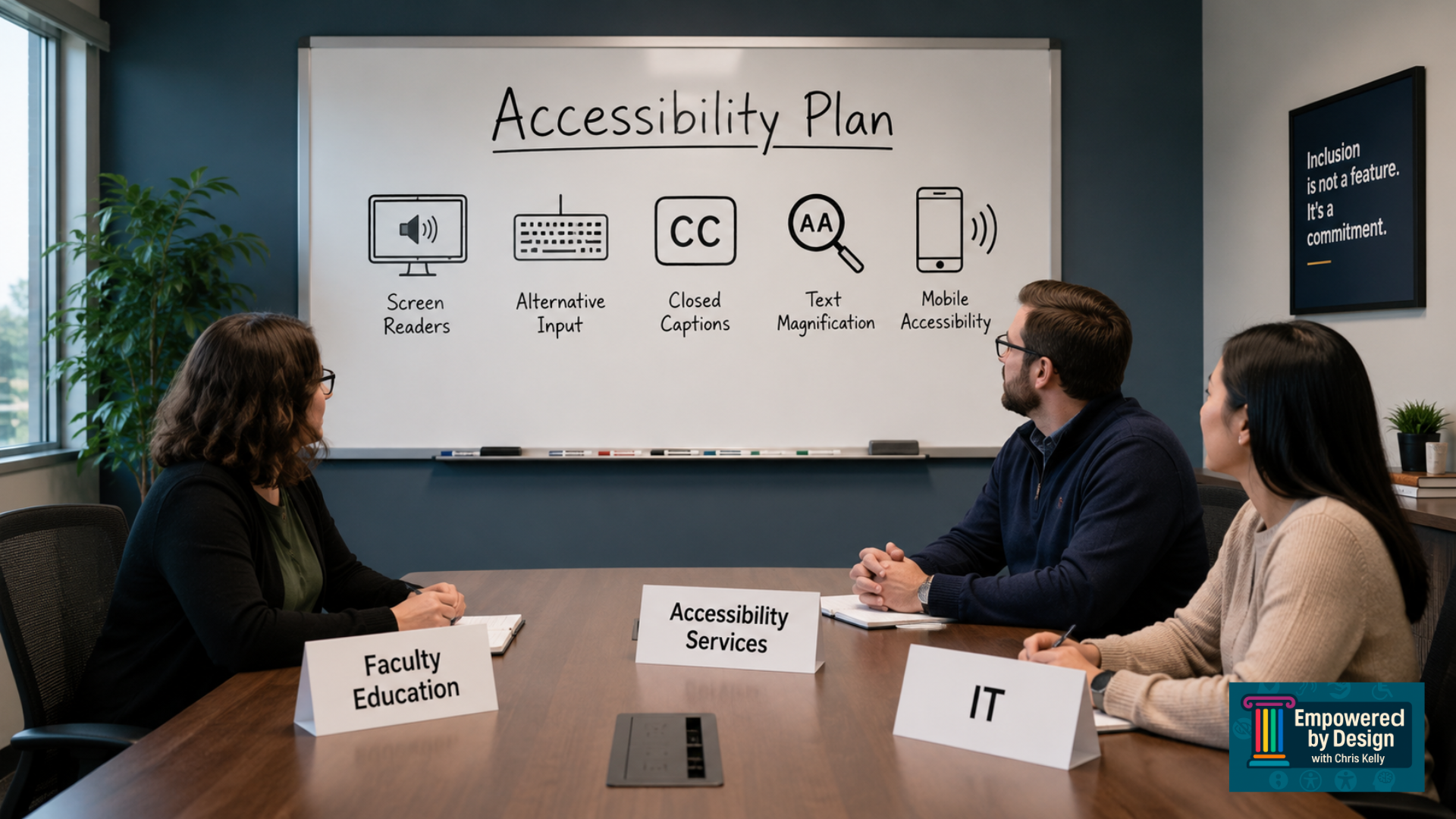
From there, we got into the practical side of design. Touch panels came up quickly. Many of us are still not designing with color blindness in mind or ensuring interfaces have enough contrast, large enough elements, or screen reader compatibility. As more panels move to HTML, that gap becomes harder to justify with WCAG on the horizon.
We also discussed new interaction models, including voice-controlled classrooms and tactile feedback in panels. These ideas push us beyond improving existing tools and into rethinking how users interact with systems altogether.
Another part of the conversation focused on accountability. Many institutions still wait until legal pressure forces change. In my own work with Iowa Vocational Rehabilitation, I’ve seen universities push back on ADA claims from students. At the same time, ADA hasn’t kept pace with the technology we’re deploying. It should be a starting point, not the goal.
More importantly, no institution should aim to be known for doing the minimum. Our students deserve better than that.
Designing for People, Not Just Compliance
Outside of the panel, Kay Sargent’s keynote on neuroinclusive design stood out. Her message was practical and direct. The number of people identifying as neurodivergent continues to grow, and our spaces should reflect that.
Small, intentional choices like zoning spaces, reducing sensory input, and being more thoughtful about lighting and sound can make a real difference. If you haven’t read Designing Neuroinclusive Workplaces, it’s worth your time.
The breakout sessions reinforced many of these same ideas. There’s a clear shift away from compliance as a checkbox and toward accessibility as a design principle.
Sessions on inclusive audio emphasized that hearing something doesn’t always mean understanding it, while others framed universal design as a proactive, shared approach rather than a retrofit. With the redesign of Flexspace, we’re hoping to make those wins easier to share across the community.
Where Things Fell Short
All of that said, it wouldn’t be honest to stop there and call InfoComm 2026 a complete success for accessibility.
For the first time, I found myself noticing physical gaps more consistently, especially on the show floor. Some booths required several inches of step-up clearance, and ramps weren’t always easy to find, even after walking around multiple sides.
It shouldn’t be a challenge to enter a booth, and level access or clearly visible ramps shouldn’t be difficult to implement. As Dustin Myers pointed out in his recent article Accessibility Doesn’t Stop at the Ramp goes beyond just getting through the door.
Inside booths, clearance and maneuverability were also inconsistent. In some areas, it was difficult to navigate at all, let alone with a mobility device, especially once crowds built up. These are the kinds of details that get overlooked in temporary builds but still have a real impact.
Even the layout of the convention plays a role. The distance between halls, particularly between West and Central, can be a real challenge. For attendees trying to move between sessions and meetings on a schedule, that distance becomes more than inconvenient. For some, it becomes a barrier.
So Where Does That Leave Us?
For me, InfoComm 2026 showed real progress in how we talk about accessibility. The conversations are more practical, more honest, and more focused on design decisions that actually impact people. There’s a lot to be proud of.
At the same time, the show floor was a reminder that awareness alone isn’t enough. Accessibility has to be built into the physical environments as much as the systems we design.
That’s really what this comes back to. Accessibility can’t just live in sessions and panels. It has to show up in the spaces we build, the systems we deploy, and the choices we make every day.
That’s what being empowered by design should mean.