






Zoom is one of those platforms that everyone in higher ed uses, but not everyone thinks about as an AV company. In this ISE 2026 conversation, Felipe Henao (Zoom Spaces Team Lead, Americas) and Frank Padikkala (Senior Technical Sales Architect, Zoom Spaces) make the case that Zoom is showing up in a much bigger way than “meetings on a laptop.” The simplest way they describe it is through partnerships, because Zoom’s presence on the show floor is less about one booth and more about being embedded across the ecosystem. Zoom’s goal is to meet institutions where they already are, including the hardware they already trust, and then raise the quality bar for what users experience in the space.
“I think the core of our presence at ISE and other shows has always been about our partnerships.”
Three key partnerships
Frank outlines three major partnership announcements that are easy to translate into higher ed conversations.
The first is a partnership with Cisco that enables Zoom on Cisco Rooms. For institutions that already have Cisco room hardware in inventory, that kind of flexibility is a practical lever. It can reduce unnecessary replacement cycles and give teams more options as departments and programs choose different platforms.
The second is Google Beam, powered by Zoom, a 3D and spatial experience that is meant to make remote presence feel more natural. It is the kind of thing that has to be experienced to truly get, but the implication is clear: higher fidelity and more realism in remote interaction is moving from novelty to now.
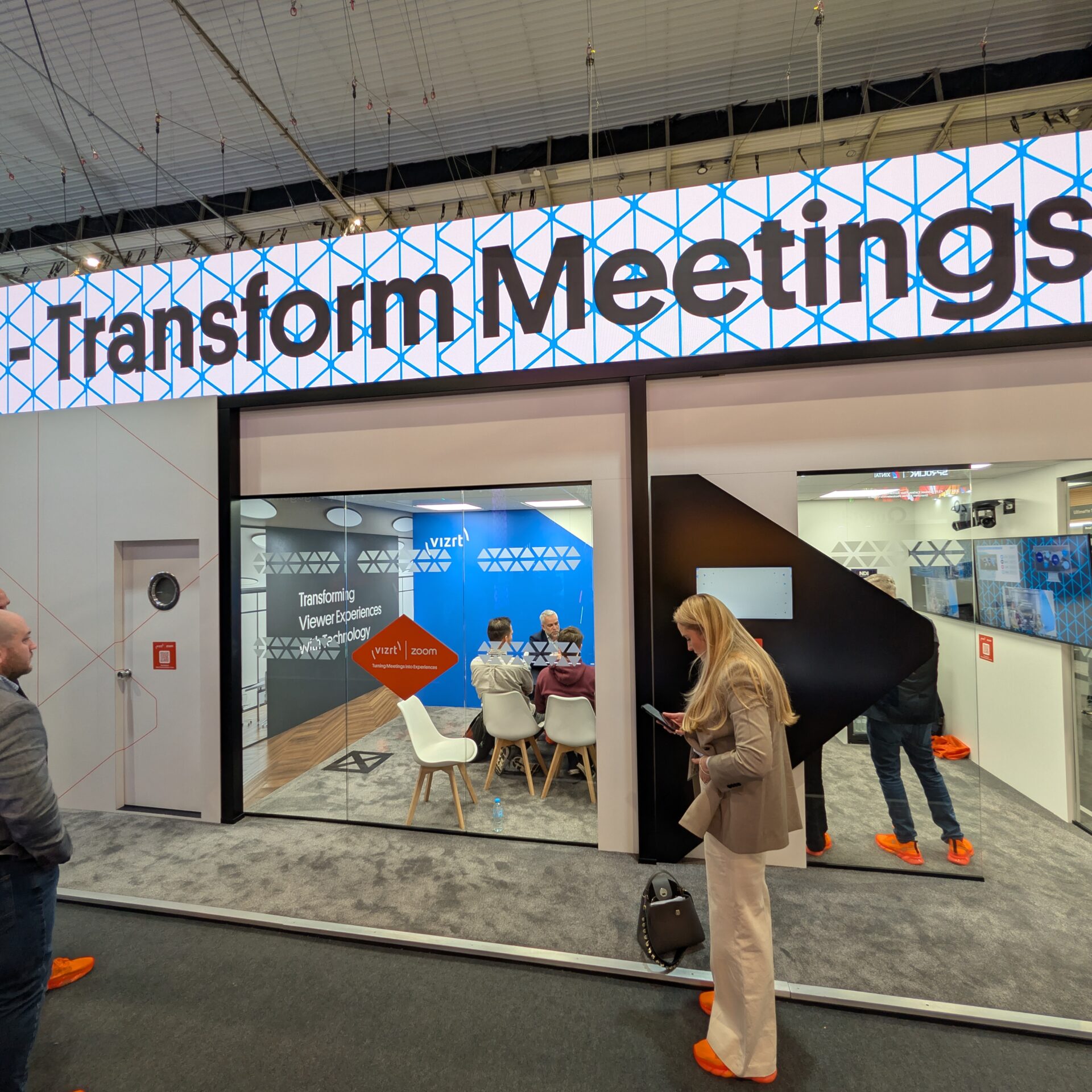
The third partnership is Vizrt. Frank calls out how Vizrt’s InteractifAI and CaptivAIte change the feel of meetings by bringing broadcast-level quality into everyday Zoom experiences. The value here is not flashy graphics for their own sake. It is shifting the baseline for what hybrid sessions can look like without requiring a room full of engineers.
“They’ve brought broadcast-level quality at the ease of traditional UC into conference spaces.”
Felipe reinforces the Vizrt point from a campus lens. He’s been involved with it directly and sees it as a way to make hybrid learning and collaboration feel less flat and more engaging, while staying accessible in cost and complexity. He also points to pilots already underway, including pilots connected to the HETMA community, with the intent to bring peer testimony into the conversation.
Zoom is “AV serious”
One of the most important parts of the interview is the moment where Zoom says the quiet part out loud. Zoom is positioning itself as an AI-first company, but it also wants to be taken seriously as an AV platform where audio and video quality matter. Frank frames it plainly: there is no AI experience worth talking about if the underlying AV is not solid.
“We’re an AI first company, but we’re very AV serious.”
They also call out a specific ISE update that hits the kinds of questions campus teams ask in large rooms: enhanced media that improves the fidelity of the streams. Frank mentions 4K outputs in large meeting rooms, and 1080p/60 content sharing as part of the push to make shared content and video look cleaner and feel more “real” in the space.
But the real higher ed angle is not the resolution. It is supportability. Frank ties audio/video quality directly to the architecture conversation: if your room takes thirty calls to troubleshoot, the solution has failed the people supporting it. In a campus environment, you do not get a long runway when a class is waiting.
“You want to be able to troubleshoot, you want to be able to resolve it, and you want to be able to do it fast.”
That is the practical lens Zoom is trying to bring to its room strategy: build in enough visibility and resilience that campus teams can keep spaces running without heroic effort.
AI in physical spaces
Felipe goes deeper on where Zoom’s AI strategy is headed for education. He describes a direction where the platform’s intelligence becomes a tool for professors, using captured lecture content over a semester to help create assessments like quizzes and midterms, and to give educators better visibility into how learning is progressing.
He also emphasizes the student side: AI models that help personalize learning journeys so students can reinforce concepts where they need it most. For higher ed, the interesting part is not only content generation. It is the potential for more individualized support when faculty are trying to serve large cohorts with widely different learning needs.
Zoom also ties this back to integrations with systems campuses already use daily, including LMS workflows. The point is to reduce friction by launching and managing experiences in the places students and instructors already live, rather than adding another disconnected toolchain.
Zoom’s message is that the platform is no longer only the meeting window. It is becoming a backbone for higher-quality collaboration, better-managed spaces, and more automated workflows that scale.
Make sure to check out all of this and more at their website and reach out to Felipe at felipe.henao@zoom.com.