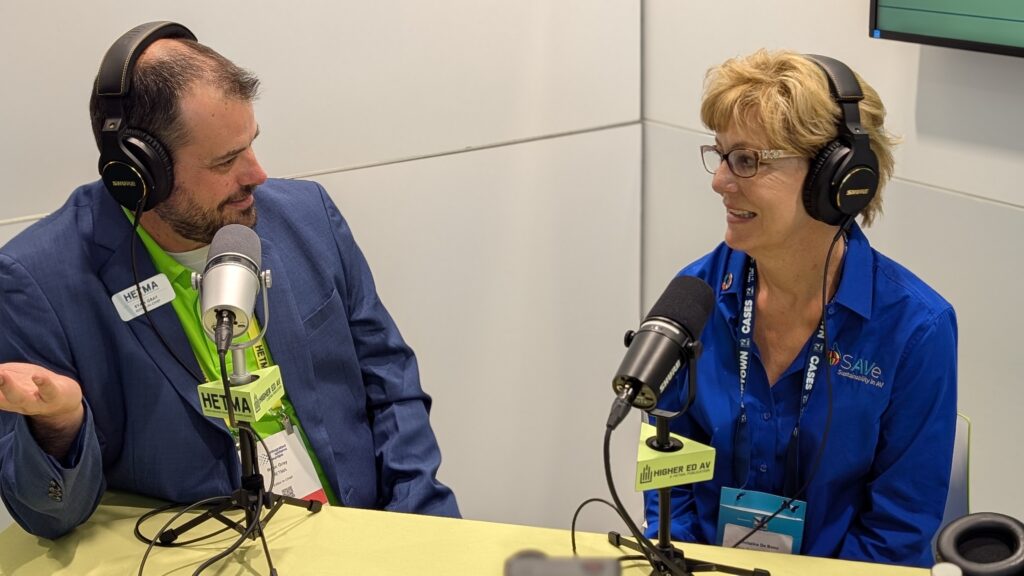
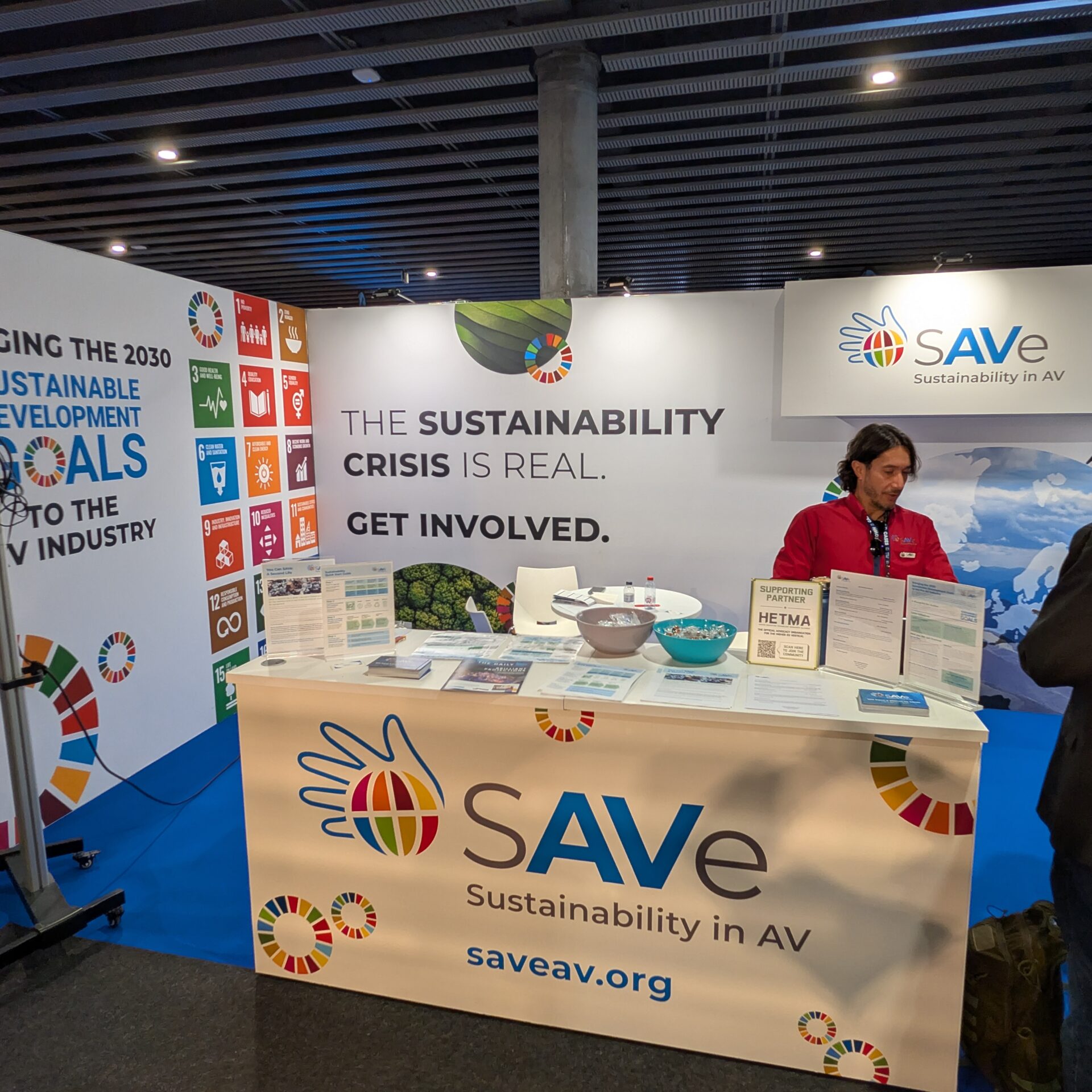







Some of the most useful conversations at ISE happen with people who are not trying to sell you a box. SAVe is one of those groups. The organization exists to move the ProAV industry toward real sustainability work, and to do it in a way that can be adopted inside day-to-day operations. In this HETMA booth conversation, Christina De Bono (Founder and President) lays out why SAVe was created, what they are building now, and why higher ed AV teams are in a uniquely strong position to lead on this inside their institutions.
“I’m the founder and president of SAVe, or Sustainability in AV, which is an all-volunteer, independent, non-profit organization with the mission of bringing stakeholders in the AV industry together to take concerted action and do our part to achieve the 2030 sustainable development goals.”
Christina’s origin story is important because it explains the “why” without turning it into a slogan. She’s spent decades in the AV industry, including running an integration business, and she has also spent time working with community organizations dealing with environmental, social, and economic issues. When she learned the UN Sustainable Development Goals (SDGs) and started asking what the AV industry was doing to align, the answer was basically “nothing,” and that gap became the spark.
“We researched, okay, what is our industry doing? What are our trade associations doing? What government programs are available to help us? And we realized that there was nothing going on, like zero.”
SAVe was formed to make that “zero” less true, by giving organizations a framework, a shared language, and concrete programs that translate sustainability from intent into action. For higher ed, that is the difference between a sustainability statement and a sustainability plan that an AV group can actually deliver.
Congress Square, Booth CS204
At ISE 2026, SAVe is set up in Congress Square at Booth CS204, a placement that fits the role they’re playing at the show: a cross-industry connector and convener rather than a product vendor. It also makes the booth a practical stop if you’re bouncing between halls and want a conversation that connects the show floor to bigger institutional goals.
What SAVe is working on right now
SAVe’s work shows up as programs. Christina highlights three that matter immediately for higher ed teams: reuse pathways, certification, and global scaling through local leaders.
SAVe a Second Life: reuse, repurpose, recycle, and partnerships that move gear where it’s needed
SAVe a Second Life is built around a simple premise: AV equipment does not become useless the day it’s decommissioned. The organization has published guidelines to help groups implement reuse, repurpose, and recycling programs, and they are building partnerships that connect AV organizations with schools and nonprofits that can use still-functional equipment but do not have the budgets to buy new.
“SAVe a Second Life, give your AV equipment a second life at the end of its first life.”
For higher ed AV teams, this lands in the real world. Campuses retire displays, cameras, switchers, control processors, and peripherals constantly. Some of that gear still has years of useful life. The question is whether the institution has a process to evaluate it, move it through reuse pathways, and document it in a way that satisfies internal controls. SAVe’s goal is to make that work easier to start and easier to repeat.
Christina also hints at deeper plans for how SAVe and HETMA will push this forward, and it sounds like the intent is to do more than just talk about it. The direction is closer to creating real pipelines between organizations that have surplus equipment and those that need it.
SAVe Certified: turning sustainability into an actionable plan
SAVe Certification is positioned as a structured way for companies and organizations, including university AV departments, to build a sustainability plan aligned with the SDGs. Christina describes it as a complete program that helps teams move from “we care” to “here’s what we’re doing, here’s how we measure it, and here’s how we improve it.”
One detail that matters for higher ed is that certification isn’t treated as “industry only.” Christina cites an example of a university AV leader participating at ISE, and she also points to a UCLA story where certification work produced a plan that the institution adopted and began implementing. That is exactly the kind of proof campus teams need when sustainability goals can feel abstract.
There’s also a recruiting angle hidden in that story that higher ed leaders will recognize: when students can connect sustainability work to AV infrastructure and careers, the pipeline into our field gets a little less accidental.
SAVe Ambassadors: scaling the mission across regions
Because the SDGs are global and the AV industry is global, SAVe built an Ambassador Program to enable local leadership across different countries and regions. Christina calls out growth to sixteen ambassadors across five continents, with multiple ambassadors present at ISE.
This matters because sustainability actions are often constrained by local systems: recycling infrastructure, procurement rules, regulations, and regional manufacturing realities. A global framework is helpful, but local leadership is what makes programs stick.
Events and where to plug in
SAVe is hosting a SAVe Certification Workshop at ISE 2026, designed as a hands-on entry point for organizations that want to build an actionable program rather than just gather ideas.
Coming again next year, SAVe has a major annual event: the SAVe Global Conference, held at UCLA. The 2026 event happens Oct 13–14, 2026 at the UCLA Luskin Conference Center. Either way, it’s a good marker for higher ed AV leaders who want deeper training, peer learning, and practical workshops rather than another vendor expo cycle.
The higher ed takeaway
If your campus is already prioritizing sustainability, AV is a place where you can make visible progress: explore programs that reduce e-waste, lifecycle planning that reduces emergency replacements, procurement decisions that take energy and longevity seriously, and operational choices that make sustainability repeatable rather than heroic.
SAVe is trying to make that work easier to start and easier to sustain.
Make sure to check out all of this and more at their website and reach out to Virginia at virginia@saveav.org.