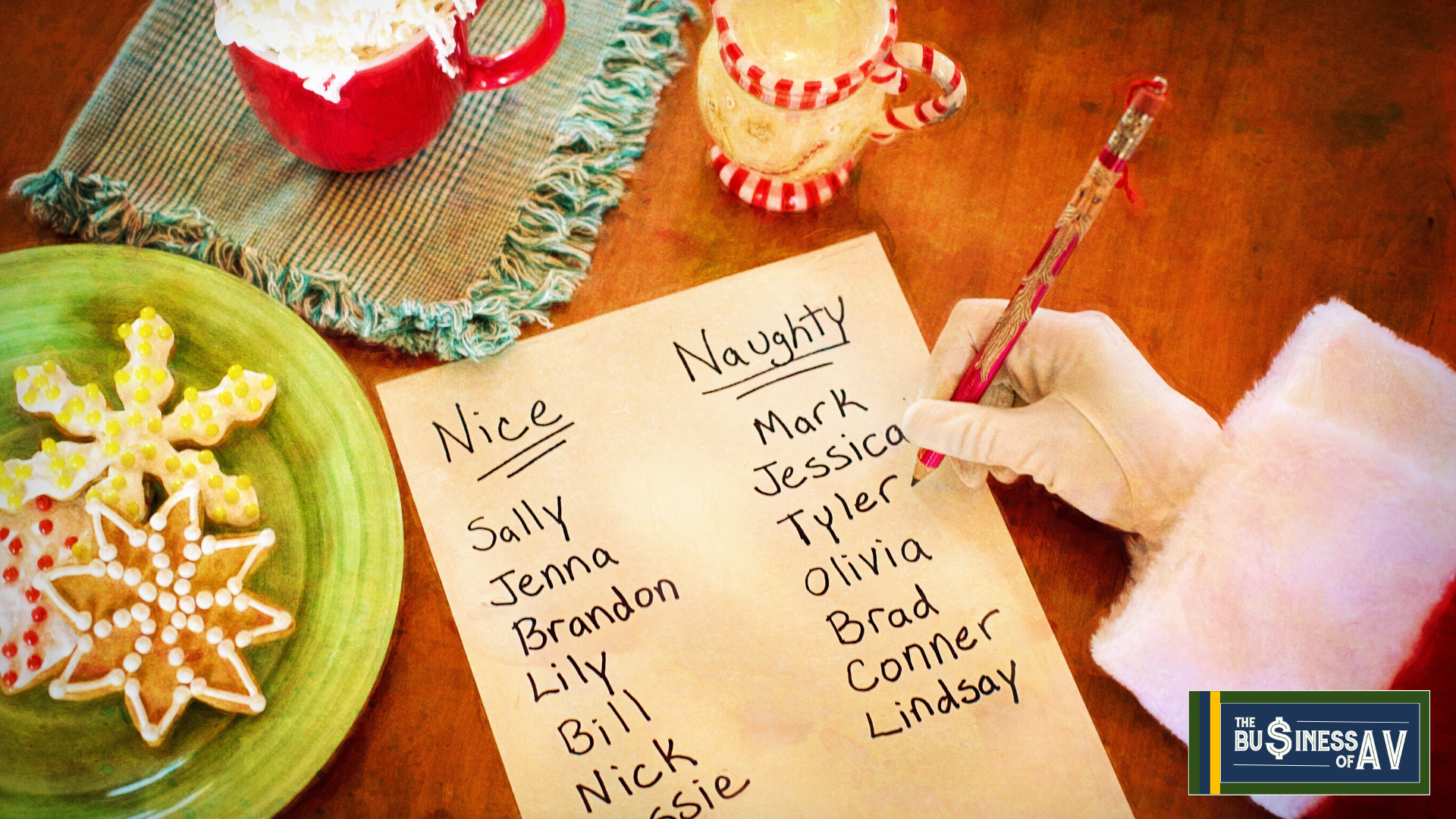


As each year comes to a close, I personally spend a lot of time reflecting. Reflecting on accomplishments, regrets, wins, and ugh’s. I spend some time going through all the Business of AV articles I’ve written in 2025 and came up with the “Naughty” and “Nice” lists based on the themes that I covered, and seemed to cover over and over again.
So, yeah… If Santa’s were to create his AV Leaders’ lists based on those themes for 2025, they might appear like these. Hopefully these come out not as a judgment tool, not as a moral scoreboard, but as a leadership lens. A way to sort what we’re going to reinforce, what we’re going to release, and what we’re going to wish for as we step into the next season with a little more intention than we had capacity for in the last one. Because, as I recently noted, the year doesn’t actually end when the calendar flips, it ends when you stop carrying it in your head.
The Nice List
At the top of the Nice List are the leaders who learned that gratitude isn’t decoration, it’s the infrastructure that forms personal well-being. They stopped treating appreciation like a “soft skill” and started seeing it as a strategic advantage. They started to view it as something that reshapes culture, elevates performance, and fuels real professional growth. These are the people who don’t just praise outcomes, they notice the invisible work that makes outcomes possible and recognize the emotional labor that keeps a team steady when the day gets chaotic. They’ve realized that calling out what’s unseen doesn’t just make people feel good, it reinforces the behaviors that reduce failure, improve consistency, and build trust across an organization.
Right behind them are the leaders who finally retired the “hero” costume. The ones who used to wear hustle like holiness by always saying yes, always staying late, always being the ones who save the day, and then woke up one day and realized the cost was showing up everywhere… Burnout, discontent, indifference, the quiet fantasy that the grass will be greener somewhere else. They’ve learned to reframe rest as a core productivity strategy and a leadership responsibility—not the absence of work, but a deliberate investment in clarity, focus, emotional stability, and long-term impact. They can feel the difference in themselves when they’re rested: more listening, less reacting; more pattern recognition, fewer panic decisions; more presence, less performance.
Then there are the ones who close the tabs before they unplug. They understand something deceptively simple… Unplugging isn’t disappearing, it’s choosing an intentional boundary that says, “I will return with a full tank.” They don’t try to wrap every loose end with a bow, but they do create both personal and public clarity because ambiguity is where burnout breeds. They write things down. They name what matters. They define what “off” and “on” looks like for the team in practice, because they model it themselves. And they know the truth that most of us avoid admitting out loud: reliability is not the same as constant accessibility.
On Santa’s Nice List too are the leaders who pay attention to their own internal soundtrack. Not the polished vision statement and elevator pitch they blurt out when asked how they’re doing, but the real one. The internal “background music” that plays under every meeting, every request, every “we need to talk,” every moment you’re trying to be steady while you’re carrying a hundred invisible weights. They recognize that background shapes experience and that what seems like “supporting noise” can subtly become the thing that defines how people receive the message. And they’ve started asking the braver questions like: “What’s been on repeat in my head lately? What story am I rehearsing so often it’s becoming truth? What mood am I bringing into rooms even when I’m not saying a word?”
There’s also a particular kind of leader who makes the Nice List that rarely gets celebrated in public, because their best work happens in the shadows. The self-emptying kind. The “kenosis” kind. Leaders who aren’t trying to accumulate credit, control, or recognition, but are actively creating room for others to emerge. They see our industry for what it is, one that is built on quiet excellence and invisible service where doing the job done right can often mean no-one even knows you were there. Kenosis gives that invisibility meaning, and it turns “thankless” into purposeful service that lifts others higher.
And finally, the Nice List includes the communities of people (yes, ours specifically) that act like an alliance rather than a club. The groups that are rooted in shared goals, peer collaboration, and collective action. It’s when we act like a “coalition of the willing” that understands voices are stronger together than apart. In an industry that can accidentally train us to operate in isolation, true alliance-minded leaders build bridges, not fences. They flip the script from transactional relationships to shared outcomes, and they make it easier for the overlooked to finally have a voice.
The Naughty List
The Naughty List isn’t full of villains. It’s full of patterns, some which are inherited, some that are self-inflicted, but most reinforced by misguided applause at the wrong moments. It’s the stuff that “temporarily” sneaks into our “normal” and then quietly sets up permanent residence.
Hustle culture lives here, but not in the obvious way. It lives here in the subtle version that praises the person who never stops, while quietly punishing the people who try to be healthy. It’s the posture that convinces us “done” is just one more sprint away, even though the end of one task simply turns into the next priority. And when rest is treated like a reward instead of a requirement, we don’t just exhaust ourselves, we erode decision-making, weaken culture, and show up physically while being somewhere else mentally.
Ambiguity is on the Naughty List too, because it’s one of the most expensive leadership habits we tolerate. When people don’t know what “off” means, what’s urgent, what can wait, who’s truly on call, and what success looks like, they don’t relax, they brace for the worst, because they know it’s coming. It’s just a matter of time. And bracing is exhausting. Closing the year well is less about finishing everything on the to-do list, and more about telling the truth to ourselves and our teams… What got done, what didn’t, what no longer matters, and what never should have been on the list in the first place?
Performative gratitude also belongs here, but not because kindness is bad, but because fake kindness is corrosive. When appreciation is used like a management tactic instead of offered as sincere recognition, people feel it immediately. True gratitude is not performance management disguised as warmth, it’s cultural investment. And nothing makes people more cynical than being “thanked” in a way that proves you didn’t actually see what they carried.
Constant accessibility is absolutely Naughty List material, even though it’s often rewarded the most in the moment. The modern world trains us to treat availability as virtue, like the quickest reply is proof of commitment. But when you never fully disconnect, you never fully recover. And when you don’t recover, you don’t just lose rest, you lose perspective, which, of course, is the very thing you need most when you’re making decisions that shape what comes next.
Then there’s the “visibility currency” trap. The world prizes titles, accolades, recognition, and the loudest voice in the room. Even the “healthiest” leaders can feel that pull to self-indulgence of praise. The danger isn’t celebrating wins, the danger is letting visibility become identity. Kenosis is the counterpunch here because it reminds us leadership isn’t accumulation, it’s distribution. The best leaders don’t cling to control, they build a stage for someone else to take the podium. Those leaders recognize that their glory truly comes through the empowerment and achievements of those they are called to steward.
And yes, one more thing lands here… I can’t leave off the habit of hiding failure. We frame success, post it, and celebrate it, but failure gets whispered about, softened with buzzwords, buried under time, or avoided entirely. The problem is that failure is one of the greatest leadership masterclasses ever designed. Failure is raw, humbling, and unwilling to let you keep the parts of yourself that success never challenges. When we hide it, we lose that important growth lesson, and even worse, we subconsciously teach our teams that honesty is unsafe.
The Wish List
If I’m writing a grown-up Santa list, the Wish List isn’t mostly about toys, tools, or budgets (even though, sure, that would be fun, and we all want those). The Wish List is about the kind of leadership environment where the work can be excellent without our people becoming collateral damage.
I called for a culture shift from hustle to healthy, not as a slogan, but as life’s operating system. One where rest is treated as a productivity strategy, where leaders see protecting recovery as part of protecting results, and where “being the hero” is replaced by building sustainable teams. I want the people who carry the most invisible responsibility to experience the rare gift of calm and clarity. One where only real priorities are actually prioritized, not just the next list of must-do tasks. And, one where boundaries that are actually honored, and a leadership layer that doesn’t make everyone guess.
I want us to get more intentional about the background music we let seep into our lives, whether intentionally or unintentionally. Because the internal soundtrack is always playing, self-doubt, fear of failure, imposter syndrome, and the feeling of not doing enough, can easily capture our mood and impact our well-being. My wish is that more leaders learn to remix their internal track (note to self!)… We must learn to name what’s looping, challenge what’s false, and choose a soundtrack that matches the story we actually want our lives and leadership to tell.
I want more kenotic leadership, which is humility with direction. Leaders who are less interested in being right all the time and more committed to being responsible all the time. Leaders who see service as strength and understand that when we pour ourselves into others through mentoring, supporting, and empowering. Only then is when expand the collective capacity of the whole.
I also want to see more bridges being built… and re-built because of trust or mistakes that may have crushed them in the past. Not forced reconciliation, not performative “we’re fine” energy, but real mending where it’s worth it. I wish for relationships rebuilt with empathy and humility. The kind of repair that starts with honesty is held together by consistency, and has enough patience baked in that trust can be poured and cured instead of demanded. Indeed, the healthiest professional ecosystems aren’t the ones where nothing ever breaks, they’re the ones where people know how to rebuild.
And I want the alliance mindset to keep spreading, formed around shared ownership and governance, open dialogue, and collective action that flips transactional relationships into shared outcomes. We’re too interconnected, and the work is too important, for us to keep acting like we’re alone in it. And that applies on both a personal and organizational level.
Stocking Stuffers
The best stocking stuffers aren’t dramatic… Save that for “the big gift.” They’re small, practical, and weirdly life-changing because they’re needed, but not necessarily at front-of-mind. Yet, we can’t live without them. So here are a few stocking stuffers based on my reflections above that don’t require a new budget or January miracle, yet are tangible actions that create a better us.
First: Do a “close the tabs” inventory that’s honest enough to feel relieving. Capture what you’re worried you’ll forget. Put names next to action items. Add dates where they belong. Name what didn’t happen because of constraints, not failure, and name what never should have been on the list. The goal isn’t perfection, it’s clarity.
Second: Set one boundary that your nervous system can trust. Pick a single “disconnect” ritual. Make it something simple, something physical, something that signals “I’m done.” It could be logging out of apps, changing your home screen, putting the laptop away in a place you don’t casually reach for, or writing an out-of-office message you actually honor. The point isn’t the ritual itself, it’s the line it draws between action and restoration.
Third: Give one piece of gratitude that is specific enough to build culture around. Don’t just say “great job.” Name the invisible behavior. Name the impact. Name the why. Reinforce the groundwork because projects don’t succeed because of a single heroic moment, they succeed because of countless uncelebrated actions.
Fourth: Do a failure debrief that doesn’t turn into shame. Ask what went wrong, but also what went right that can be built on. Model the kind of vulnerability that’s paired with accountability… The kind that says, “I got this wrong, and here’s what I learned,” because that earns more trust than pretending nothing ever goes wrong.
Fifth: If there’s a bridge that matters, take one small step toward it. Not a grand gesture. A message. A moment of ownership. A willingness to return to the ruins and begin again. Because mending isn’t magic, it’s craftsmanship.
And well, there’s my interpretation of what Santa’s AV Leaders’ list might look like based on my reflections and articles over the past year. In the end, naughty-or-nice isn’t a verdict, it’s a filter into a new way of seeing and attaining who we really want to be in 2026.
So, let’s close the tabs. Remix the soundtrack. Protect the people. Unplug on purpose. And when we walk into the next year, let’s not just bring new inspirational goals, but rather our presence that breeds purpose.