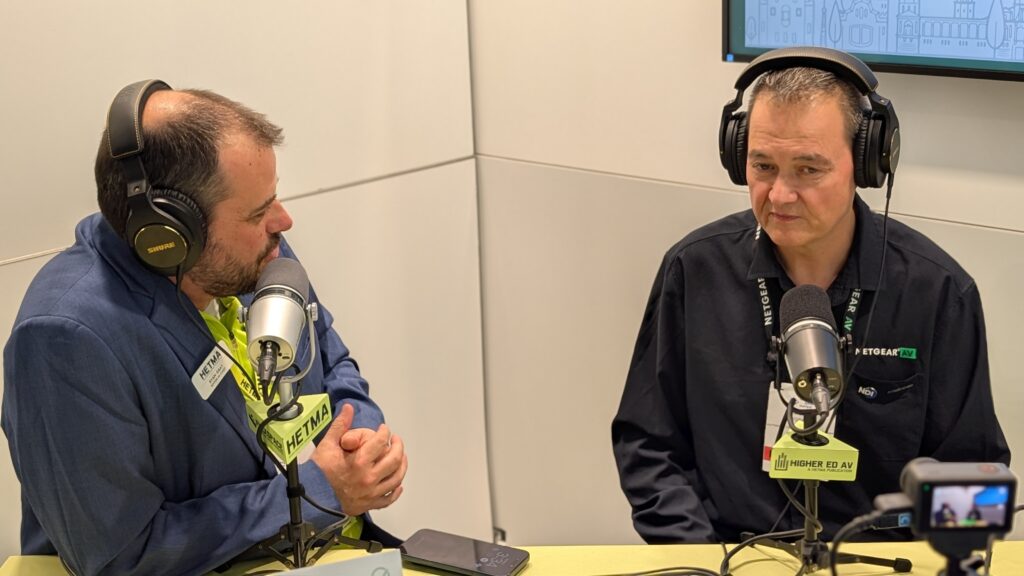







It is easy to talk about AV over IP like it is a category. It is harder to talk about it like it is infrastructure, the kind that either makes campus experiences repeatable or makes them fragile. That was the tone of this on-site conversation with Richard Jonker from NETGEAR AV. He has been with NETGEAR for almost twenty years, and he framed their story in a way that will feel familiar to a lot of higher ed teams: networking is not the flashy part, but it is the part everything else depends on.
“We come from IT, but we come in peace. And we try to help.”
Richard described NETGEAR AV as the “plumbers” of the AV over IP world, which is both funny and accurate. The work is not the shiny endpoint. The work is making it possible to deploy other people’s endpoints cleanly and consistently, at scale, across different standards and profiles.
“So we call ourselves the plumbers of the AV over IP world.”
He also connected that to a bigger higher ed goal that HETMA talks about often: the end-to-end student experience. Campuses do not run one system. They run dozens. Richard talked about a large university having somewhere between seventy and a hundred processes and services that all need to connect, exchange data, and behave reliably. That is where his argument gets blunt. HDMI and USB point-to-point thinking does not scale into cloud-managed, campus-wide workflows. IP does.
A big part of that shift is the messy middle where standards live. Richard talked about NETGEAR’s history with SDVoE and why “low latency, high quality video over a 10G Ethernet switch” matters, especially in environments where humans can actually notice delay. He gave examples ranging from performance spaces to broadcast workflows, and then broadened it out: there is not one AV over IP standard. There are many, and different profiles exist for different applications. On the ground, that means higher ed teams are asked to support more than one “right” answer, often at the same time.
Richard spent real time on openness and interoperability. Some standards are open, some are not. Some become de facto standards because they work reliably enough that the industry rallies around them anyway. For campuses, the practical takeaway is less ideological: if you want systems to interoperate, you need common ways to exchange control and management information, and you need vendors to take that seriously.
That leads into one of the more important moments in the conversation, which was really about manageability. Richard made the point that you cannot “cloud manage a USB cable,” and he is right. Higher ed support teams do not have enough hours in the day to treat every classroom connection like a custom craft project. If you want reliability, you need a network-first approach where monitoring, configuration, segmentation, and security are normal.
“Have you ever tried to cloud manage a USB cable? Right. You cannot.”
Security came up here too, and it was not theoretical. Richard described the risk in simple terms: if you open up APIs and management interfaces, you need to think through what that exposes. But he also pointed out that campuses already have security risk in their environments, even if it is just a student walking around with a compromised USB stick and plugging it into every port they can find.
Richard tied all of that back to a constraint every campus feels right now. Budgets are real. Skill gaps are real. AV spending competes with everything from energy to building security to major investments in computing for AI curriculum. The direction, in his words, is do more with less, keep it simple, and do not stand still while the industry shifts under you.
“Don’t stand there and watch the changes happening as we speak. Play an active role in it.”
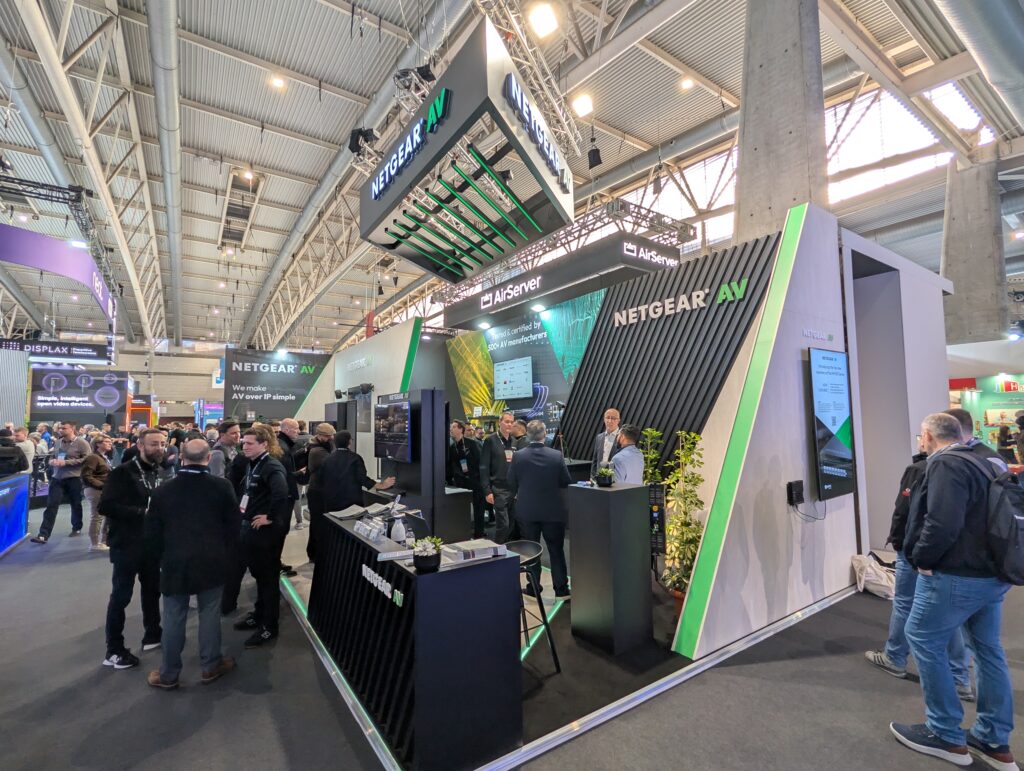
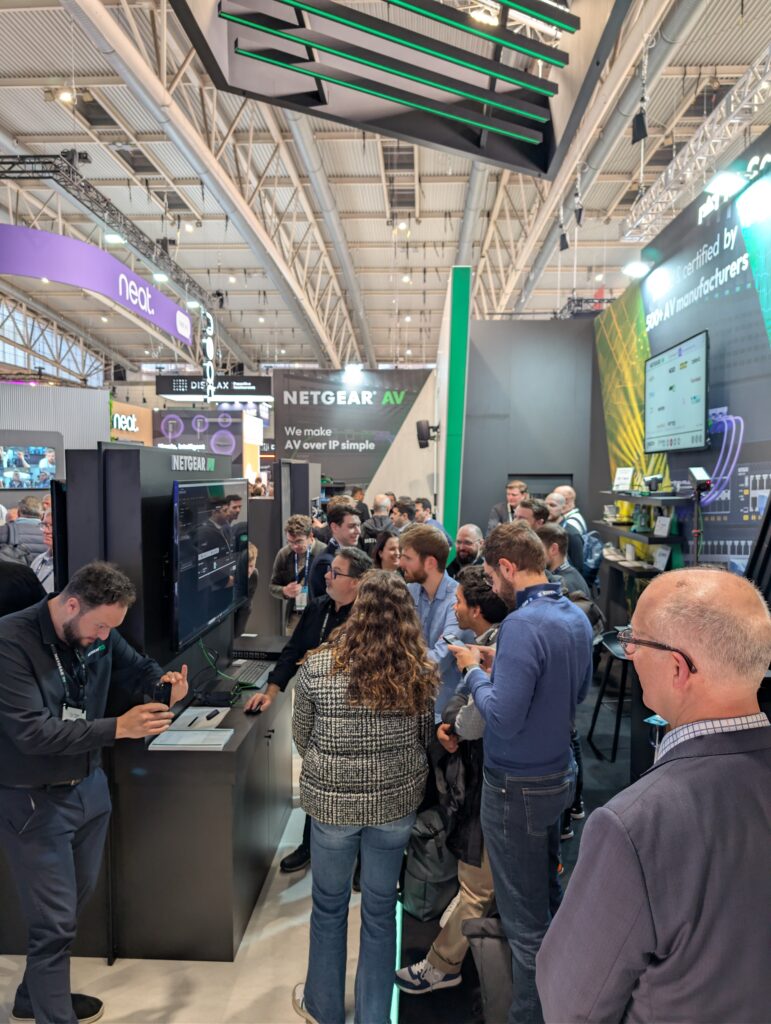
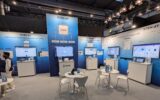
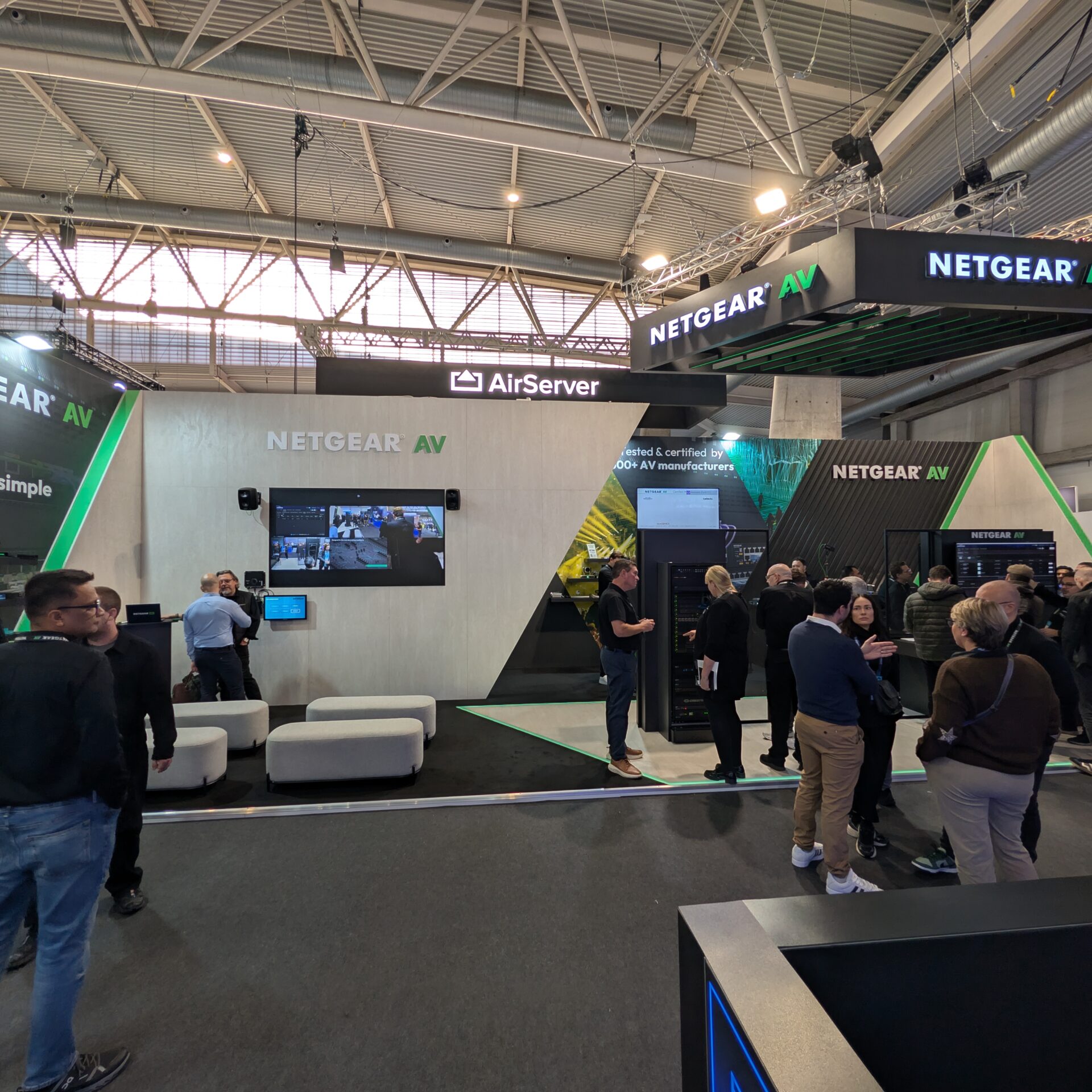
What NETGEAR AV is showing at ISE 2026
On the booth side, the message is practical: make AV networks easier to design, deploy, and operate, and make the hardware fit the realities of live environments where a loose cable can become a show-stopper.
One of the headline items is NETGEAR Engage Controller 2.4 with Offline Provisioning. It lets teams design and validate configurations before the hardware arrives, using virtual switches and access points to test settings, save templates, and then deploy quickly once the gear is on site. For higher ed, it fits how the work really happens: pre-stage what you can, reduce surprises during installs, and shorten the gap between “delivered” and “ready for real use.”
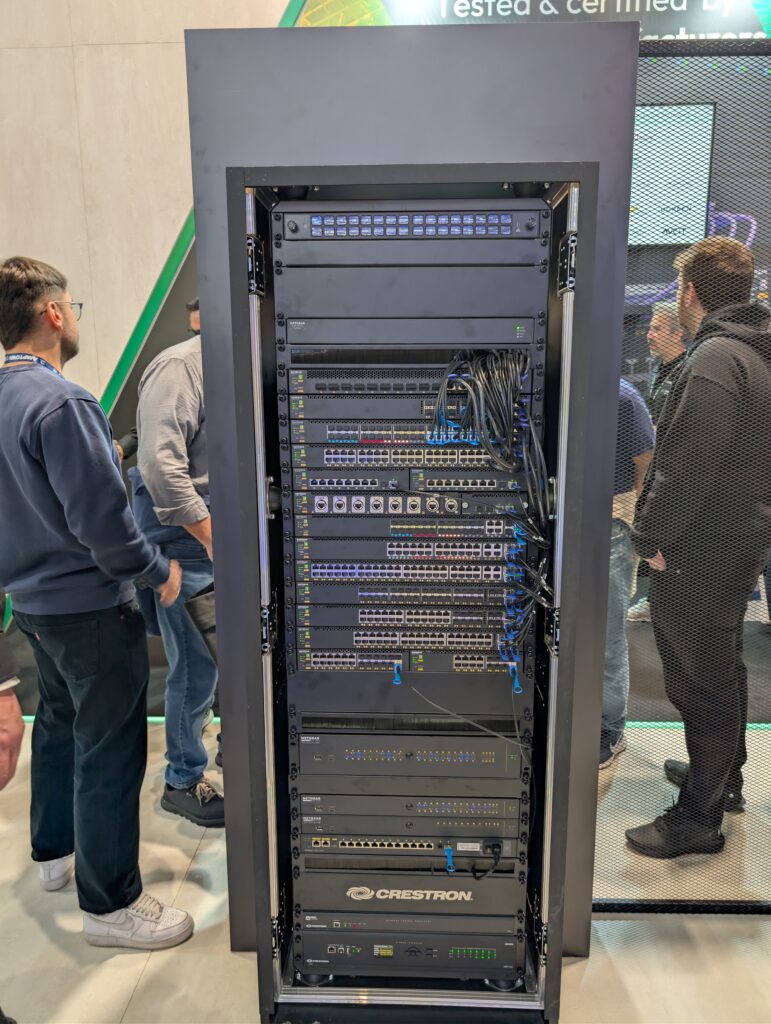
The other headline items are new additions to the M4350 managed switch portfolio, including ruggedized and high-bandwidth options that support the way AV is moving.
The M4350-16M4V (MSM4320), designed for environments where physical connections cannot be fragile. It uses locking Neutrik connector formats, including etherCON for network connections, and adds robustness for situations where vibration, movement, or a rushed load-in can otherwise cause intermittent issues. The point is not just durability for durability’s sake. The point is fewer mystery dropouts and fewer “it was fine yesterday” tickets.
The M4350-16C (CSM4316), a managed switch positioned for aggregation and core layers where high-resolution video streams converge. This is the kind of gear that shows up when you start talking about larger-scale distribution, bigger production workflows, and the reality that 4K is normal and 8K is no longer an abstract future conversation.
NETGEAR also calls out that the M4350 portfolio now spans 18 models, ranging from 1G up to 100G, which matters if your campus is trying to build a consistent standard with room to scale. In higher ed terms, the value is not that every building needs 100G. The value is that you can keep one family, one management approach, and one support posture while still meeting very different requirements across classrooms, event spaces, and broadcast-adjacent environments.
Time is money, money is tight, and ease of configuration is part of the product. NETGEAR positions professional services and design support as a way to help teams pre-plan and reduce risk, both before and after deployment. For many campuses, that is the difference between “we can adopt this” and “we do not have the staff to adopt this.”
NETGEAR AV is at Booth 2U240. Make sure to check out all of this and more at their website and reach out to Richard at richard.jonker@netgear.com.