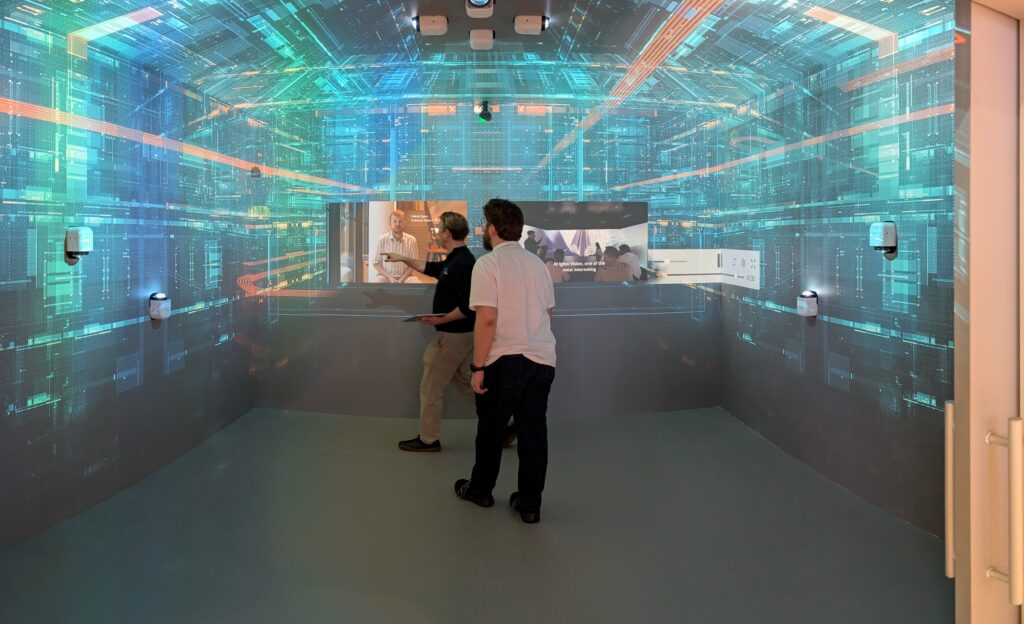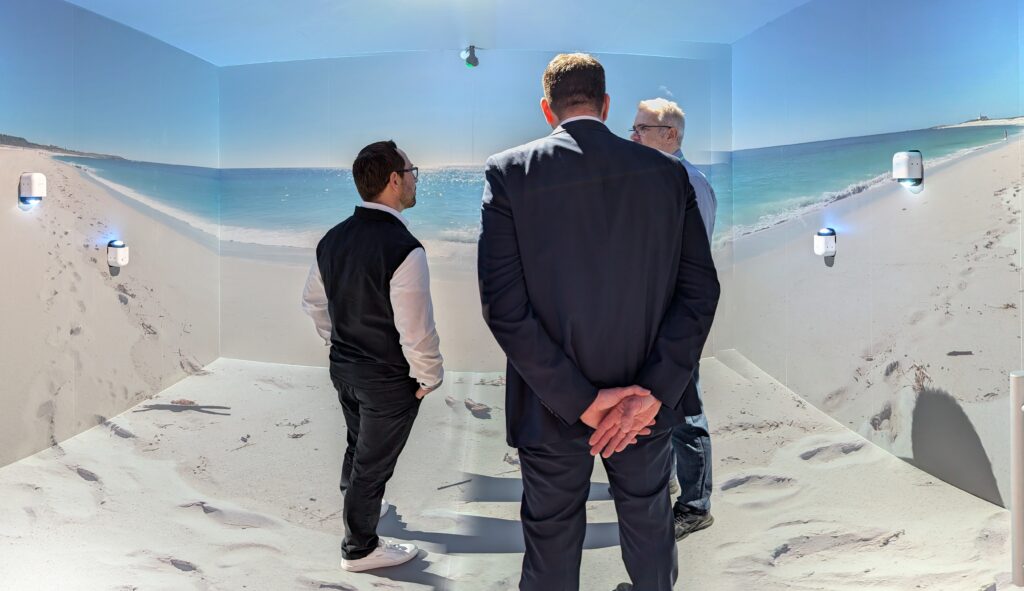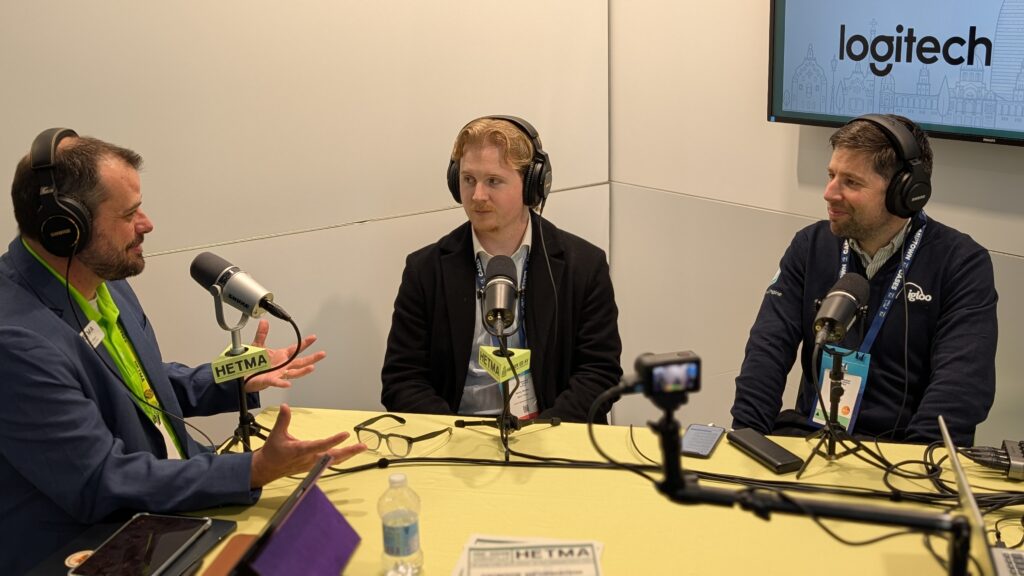







Igloo Vision is one of those technologies that is hard to explain until you have stood inside it. Henry Brown (Senior Marketing Executive) described it in the simplest way that tends to land for first-time visitors: you get the feeling of VR, but without putting anyone in a headset. You walk into a 3D space that wraps around the group, and the room becomes the interface.
“It’s a VR headset but without the headset.”
Headsets have a place, but many faculty and staff are trying to create shared experiences where people can talk, collaborate, and react to the same content together. Igloo’s approach keeps the barrier low. No device checkouts, no fitting and cleaning routines, no one student disappearing behind goggles while the rest of the room waits.
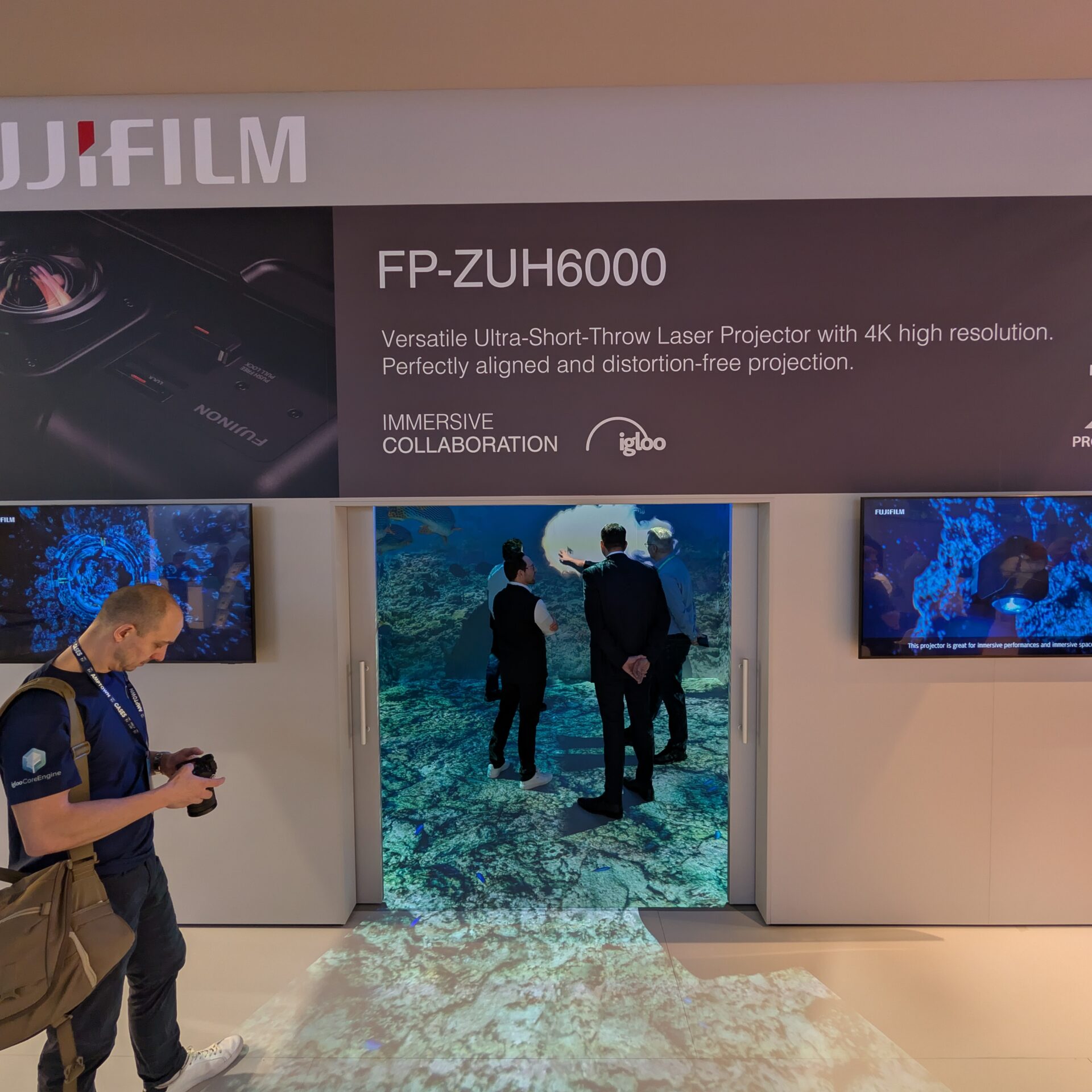
At ISE 2026, Igloo Vision is showing this on the Fujifilm stand, 5B100, using Fujifilm projection to bring an immersive room to life. The experience is meant to be engaging and immediate. Walk in, understand it fast, and then start thinking about use cases rather than specs.
Theo Penty (Sales Director, EMEA) framed the bigger idea as “shared immersion.” The goal is to create spaces that faculty and students actually want to use, and then make it possible to move from one scenario to another without turning the room into a one-purpose exhibit. Transport students to environments that are too dangerous, too expensive, or too time-consuming to visit in real life. Put them inside spatial content that is hard to understand on a flat display. Build the kind of context that makes training feel real.
That is where the conversation naturally moved to software, because the hardware is only half the story. The challenge is making them usable by everyday instructors without a technician hiding behind the curtain.
“Other immersive installations might require kind of a man behind the curtain making it all happen and that’s not the case with Igloo.”
Igloo’s core platform is Igloo Core Engine, and this year’s headline is Igloo Core Engine 2.0, a major update focused on making immersive rooms easier to operate and faster to teach with. The emphasis is not “more complexity.” Its fewer steps between walking into the room and running the lesson.
A big part of that is interface and workflow. Igloo Core Engine 2.0 brings a refreshed UI and Control Panel, plus tools designed to reduce setup time in the moment. The Launchpad is built for starting sessions quickly. Session Collections help keep lessons organized so an instructor is not hunting through folders while a class watches. AI asset generation is positioned as a way to build and curate content faster, especially for programs that want to iterate quickly or tailor content to specific lessons.
The other key point is consistency across different room designs. Igloo systems can be cylindrical, partially immersive, or fully immersive, including more ambitious builds that incorporate floor and even ceiling projection. The software layer is what makes that variety practical for campuses that want multiple immersive spaces in different departments. Theo described the campus reality clearly: one system in a medical faculty for training, another in architecture for design walkthroughs, another in a library or innovation hub for broad cross-curriculum use. The staff should not have to learn a new tool for each room. One software environment should run the same content in a predictable way across different geometries and scales.
Architecture and engineering are obvious fits because spatial content benefits immediately from being “inside” the model. Medical and first responder training also shows up quickly, because context changes behavior. A simulated emergency room on a flat screen is not the same as being surrounded by the sights and sounds of the environment while you are running a scenario. And then there is the “innovation hub” category where the use case is not one department, but the question: what do you struggle to teach, and what becomes teachable when you can place people inside the content?
Theo described the sweet spot as any situation where it is important to understand a 3D world or spatial context, and where the real-world experience is too costly or too risky to replicate routinely. That includes design reviews with tools like Revit, Navisworks, and Autodesk workflows, where walking through a model often reveals issues that are easy to miss on a 2D monitor.
From a higher ed AV perspective, the real differentiator is not the spectacle. It is the usability layer. An immersive room only becomes campus infrastructure when instructors can run it confidently, content can be loaded and formatted correctly, and the room can pivot from one discipline to another without a rebuild.
“You get your content in, the software formats it correctly, it displays well in your space and you can get straight to the benefits of immersive content.”
If you are at ISE 2026, 5B100 is worth time because it is experiential. Go in with one real question: what on your campus is hard to teach because it is too expensive, too dangerous, or too abstract to experience directly? Then ask how Igloo Core Engine 2.0 reduces the friction between “we have an immersive room” and “faculty actually use it weekly.”
Make sure to check out all of this and more at their website and reach out to Henry at henry.brown@igloovision.com.