
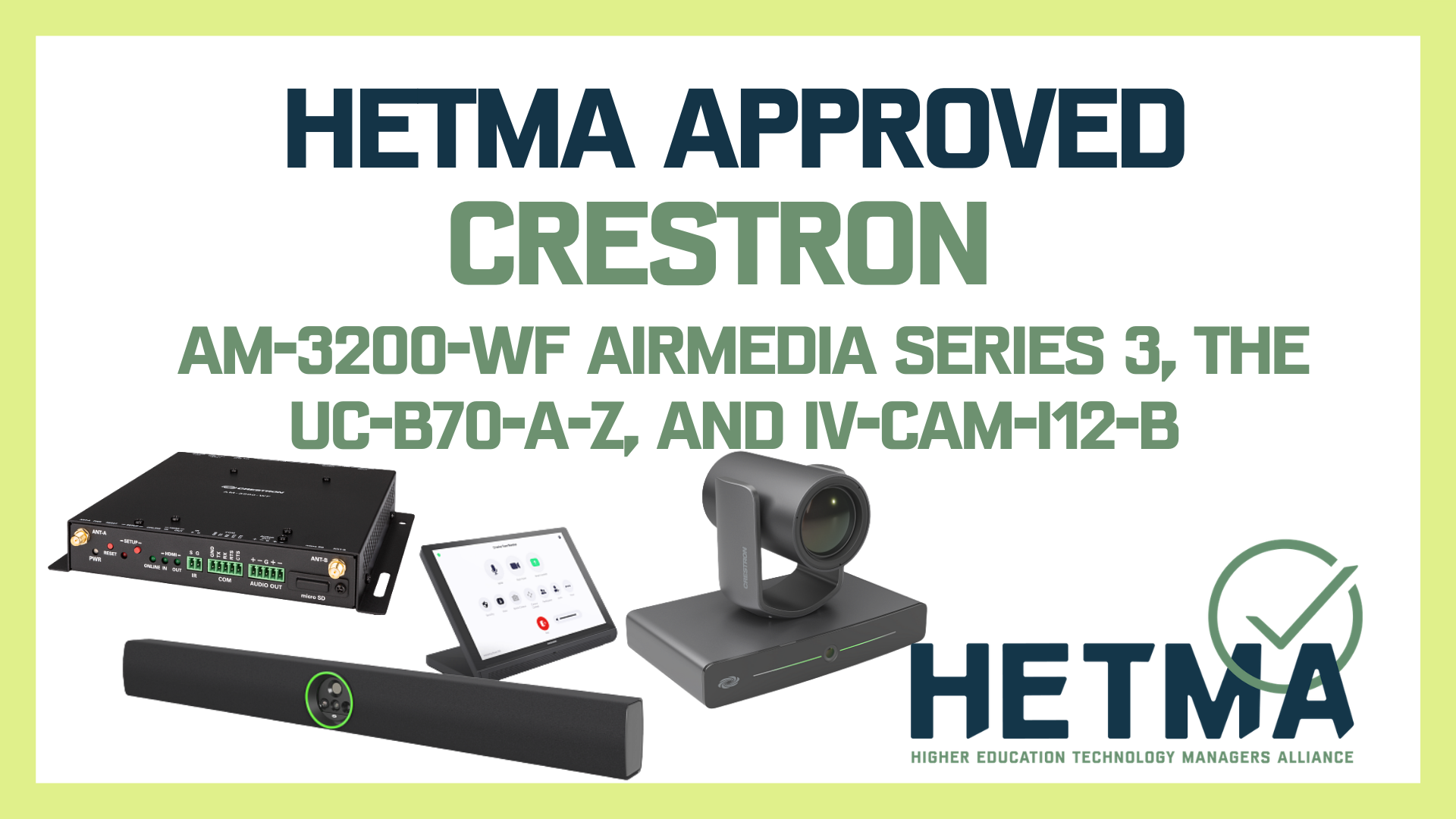

Crestron has officially entered the Higher Education Technology Managers Alliance Approved program with three products evaluated specifically in higher education environments: the AM-3200-WF AirMedia Series 3 wireless presentation system, the UC-B70-A-Z Zoom Rooms video bar system, and the IV-CAM-I12-B intelligent PTZ camera.
The approvals mark Crestron’s first devices to earn HETMA Approved status, a designation based on independent evaluations conducted by higher education technologists who deploy products in real campus environments.
The HETMA Approved program focuses on practical, real-world validation rather than manufacturer-driven certification. Devices are installed and tested in active classrooms, meeting spaces, and hybrid learning environments, allowing evaluators to assess how well technology performs under the conditions institutions face every day.
AirMedia Series 3 Improves Wireless Presentation Experience
The AM-3200-WF AirMedia Series 3 wireless presentation system is designed to simplify screen sharing while maintaining enterprise-level network security and management capabilities.
Evaluators deployed the device in classrooms and conference rooms, connecting it to campus networks using PoE+ and validating wireless sharing across Windows, macOS, iOS, and Android devices. AirPlay and Miracast connectivity were tested alongside the system’s wired HDMI input option.
One of the most notable improvements evaluators identified was the addition of Bluetooth discovery, which streamlines user connections. Previous wireless presentation systems often required client applications, introducing friction for instructors and guests. In testing, the updated AirMedia platform allowed users to connect more quickly and consistently without additional software installation.
Wireless presentation remained stable during high-resolution presentations, and evaluators noted that the system managed bandwidth effectively across both wired and wireless networks.
For campus IT teams, the system’s dual network interface capability stood out as a particularly valuable feature. This allows institutions to separate guest traffic from enterprise networks, a common requirement in higher education security models.
While wireless reliability was strong overall, evaluators noted that many institutions will still want to maintain a clearly labeled wired presentation option in instructional spaces where absolute reliability is critical.
All-in-One Zoom Rooms Solution for Hybrid Collaboration
The UC-B70-A-Z Zoom Rooms Video Bar System provides a simplified approach to hybrid meeting and collaboration spaces by combining camera, microphones, speakers, and compute hardware into a single appliance paired with a touch controller.
Installed in conference rooms and hybrid collaboration spaces, the system was used for daily Zoom meetings and content sharing throughout the evaluation process.
Evaluators highlighted the system’s audio performance as one of its strongest attributes. Microphone pickup and echo cancellation were effective across the room, allowing participants to speak naturally without needing to raise their voices.
Video performance was well suited for small- to medium-sized rooms, with automatic framing adapting as participants entered or left the meeting space. Dual HDMI outputs also supported multi-display configurations common in higher-education conference rooms.
Evaluators reported reliable day-to-day operation and noted that the all-in-one architecture simplifies deployment compared with systems that require separate compute hardware.
Institutions deploying the system within segmented enterprise networks may need to coordinate network access for the touch controller during installation, a common consideration for enterprise collaboration appliances.
Intelligent PTZ Camera for Lecture Capture and Hybrid Learning
The third product evaluated, the IV-CAM-I12-B Intelligent PTZ Camera, is designed for lecture capture, distance learning, and hybrid classroom environments where presenter tracking and high-quality video are essential.
Evaluators deployed the camera in distance-learning classrooms and Zoom Room environments, testing both USB and SDI connectivity alongside automatic tracking features and manual presets.
Image quality was consistently praised during testing. Evaluators noted accurate color reproduction, smooth PTZ motion, and reliable focus performance, all of which are important for capturing lectures and classroom presentations.
The camera’s support for both USB and SDI outputs was also recognized as a practical advantage for higher education deployments. Many institutions operate mixed infrastructure environments where USB connectivity is needed for conferencing systems while SDI enables longer cable runs and integration into production or lecture capture workflows.
Presenter tracking performed well in typical lecture scenarios where instructors move naturally across the front of a classroom. Evaluators noted that more complex room layouts may require additional cameras to fully capture audience participation.
Security and Network Integration
Network security and enterprise management capabilities were also evaluated across all three devices.
The AirMedia platform supports WPA2-Enterprise authentication, 802.1X network security, VLAN segmentation, and dual-NIC configurations for isolating traffic between guest and institutional networks.
The Zoom Rooms video bar system follows Crestron’s enterprise device security model while integrating with Zoom’s secure authentication and management platform.
The intelligent PTZ camera supports secure firmware updates, HTTPS-based administration, and centralized monitoring through Crestron’s cloud management tools, providing institutions with the visibility and lifecycle management capabilities expected in enterprise AV deployments.
Crestron’s Entry into the HETMA Approved Program
With these approvals, Crestron becomes one of the many manufacturers participating in the HETMA Approved initiative, a program designed to strengthen collaboration between technology vendors and higher education institutions.
By relying on evaluations conducted by campus technologists rather than internal testing alone, the program provides institutions with transparent insights into how technology performs in real academic environments. As hybrid learning, flexible classrooms, and collaborative meeting spaces continue to evolve, the addition of Crestron’s AirMedia platform, Zoom Rooms solution, and intelligent PTZ camera to the HETMA Approved ecosystem represents another step toward helping colleges and universities identify solutions that align with the operational realities of modern campus technology environments.