
One of the things I enjoy most about working in higher education AV is helping new technicians develop their skills. Audio can seem intimidating when you’re first getting started. There are countless terms, technologies, and opinions, and everyone seems to have a different way of doing things.
The good news is that great audio is not about memorizing every specification or owning the most expensive equipment. More often than not, it comes down to understanding a few fundamental concepts and applying them consistently.
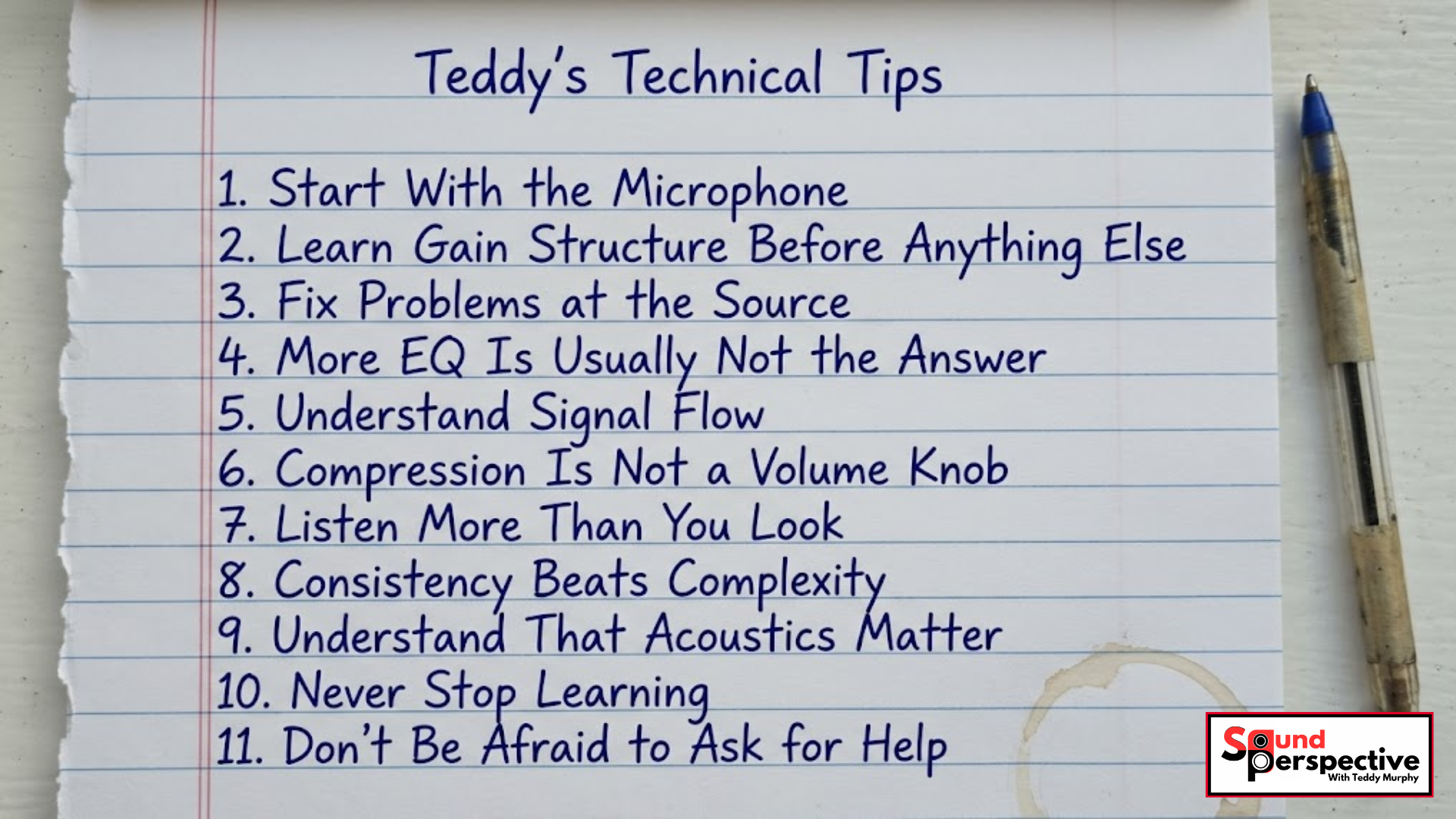
These are eleven lessons I wish someone had taught me much earlier in my career.
1. Start With the Microphone
Many new technicians immediately focus on DSP settings, loudspeakers, or equalization when troubleshooting audio issues. The microphone should always be your starting point.
A poorly placed microphone cannot be fixed with processing. If a presenter is too far away, speaking off-axis, or using the wrong microphone for the application, no amount of DSP magic will create great audio. The best audio systems begin with capturing the source correctly.
2. Learn Gain Structure Before Anything Else
If there is one concept that separates good audio technicians from great ones, it is gain structure.
Every device in an audio chain should receive and pass signal at the proper level. Too little gain creates noise and a poor signal-to-noise ratio. Too much gain introduces distortion and instability.
Many audio problems that appear complicated are actually gain structure problems.
Before touching EQ, compression, or advanced DSP tools, verify your gain structure.
3. Fix Problems at the Source
One of the most common mistakes in audio is trying to solve every issue with DSP. If a room has excessive background noise, address the noise source. If feedback occurs, evaluate microphone placement and loudspeaker coverage. If speech intelligibility is poor, examine room acoustics. DSP should enhance a well-designed system, not compensate for a poorly designed one.
4. More EQ Is Usually Not the Answer
New technicians often believe every channel requires extensive equalization. Most microphones sound surprisingly good when used properly. Every filter changes the natural character of the source. Before adding EQ, ask yourself whether the problem actually exists. Many experienced engineers spend more time removing unnecessary filters than adding them.
5. Understand Signal Flow
If you can follow a signal from the microphone all the way to the loudspeaker, you can solve most audio problems.
When troubleshooting, always ask yourself one question:
Where is the last place I know the signal exists?
Following the signal path step by step is far more effective than randomly changing settings and hoping something works.
6. Compression Is Not a Volume Knob
Compression is one of the most misunderstood tools in audio.
Its purpose is to reduce dynamic range, not make everything louder.
Used correctly, compression can improve intelligibility and protect against sudden level spikes. Used incorrectly, it can make a system sound lifeless, fatiguing, and unnatural.
For those just getting started, a good rule of thumb is to be conservative. For speech applications, I often recommend starting with a ratio between 2:1 and 4:1. Set your threshold so that normal speech occasionally triggers gain reduction, but not so low that the compressor is constantly working. An attack time between 10 and 30 milliseconds and a release time between 100 and 300 milliseconds will provide a good starting point for most voice applications.
Watch your gain reduction meter. If you are consistently seeing more than 6 dB of gain reduction during normal speech, you may be compressing too aggressively. The goal is to gently control peaks and improve consistency, not completely flatten the dynamics of the speaker.
One of the biggest mistakes new technicians make is using compression to compensate for poor gain structure. If your levels are inconsistent because your input gain is incorrect, fix the gain structure first. Compression should be the finishing touch, not the foundation of the design.
Start with conservative settings and remember that subtlety usually wins.
7. Listen More Than You Look
Modern DSP platforms provide incredible visual feedback. Meters, analyzers, and dashboards can tell us a lot. But audio is ultimately experienced with our ears. Do not become so focused on what the software is showing that you forget to listen to the room. The audience does not see your meters. They hear your system.
8. Consistency Beats Complexity
Some of the best audio systems I have encountered were not the most sophisticated. They were the most predictable. Consistent microphone choices, DSP design, user interfaces, and operating procedures make systems easier to support and easier to use. Complexity should only be added when it solves a real problem.
9. Understand That Acoustics Matter
Many technicians spend thousands of dollars trying to overcome room problems with technology. A poor room will always make audio more difficult. Hard surfaces, excessive reverberation, poor loudspeaker placement, and environmental noise can limit even the best equipment. Before blaming the technology, evaluate the space.
One of the most common challenges in higher education is dealing with highly reverberant spaces. Large classrooms, auditoriums, active learning spaces, and multipurpose rooms are often filled with concrete, drywall, glass, and other reflective surfaces. Every hard surface becomes an opportunity for sound to bounce around the room, reducing speech intelligibility and making systems harder to tune.
While there is no DSP setting that can completely fix poor acoustics, there are several things that can help.
Start by focusing on microphone placement. The closer a microphone is to the source, the greater the ratio of direct sound to reflected sound. A properly placed microphone will almost always outperform a poorly placed microphone running through layers of processing.
Loudspeaker placement is equally important. Many newer technicians focus on making a room louder when they should be focusing on making it more intelligible. Proper coverage allows listeners to hear more direct sound and less reflected sound. In larger spaces, additional delayed fill speakers can often improve intelligibility more effectively than simply increasing the level of the main loudspeakers.
For ceiling microphone deployments, pay close attention to coverage patterns and mounting locations. Ceiling microphones placed too far from the talker may capture as much room reflection as direct speech, making the system sound distant and difficult to understand.
In spaces where physical improvements are possible, even small acoustic treatments can make a noticeable difference. Acoustic wall panels, ceiling clouds, curtains, carpeted areas, and upholstered furniture can all help reduce reflections and improve speech clarity. You do not always need a complete acoustic renovation to achieve meaningful results.
If treatment options are limited, consider adjusting user expectations. A room designed primarily for visual collaboration may never perform like a dedicated lecture hall from an audio perspective. Understanding the limitations of the space is an important part of system design.
Most importantly, remember that acoustics cannot be solved solely with DSP. Equalizers, noise reduction, and other processing tools may help mitigate symptoms, but they rarely address the root cause. The best audio systems work with the room instead of constantly fighting against it.
10. Never Stop Learning
Audio is one of those disciplines where the more you learn, the more you realize there is still more to learn. Every installation, troubleshooting session, and mistake teaches something valuable. The technicians who become exceptional are not necessarily the smartest people in the room. They are the ones who remain curious and continue refining their craft.
11. Don’t Be Afraid to Ask for Help
One of the biggest mistakes I see from newer technicians is believing they need to have all the answers.
You don’t.
Every experienced AV professional was once the person trying to figure out why there was no audio, where the signal disappeared, or why a DSP file wasn’t behaving the way it should. Nobody starts this career knowing everything. The good news is that the AV industry is filled with people who are willing to help. If you are struggling with a design, troubleshooting a difficult problem, or simply trying to understand a concept, reach out. Ask questions. Learn from people who have already made the mistakes you’re trying to avoid.
One of the greatest resources available to higher education AV professionals today is the community itself. Organizations and communities such as Higher Education Technology Managers Alliance (HETMA) are full of experienced practitioners who are willing to share knowledge, review designs, discuss troubleshooting approaches, and mentor the next generation of technicians.
I can confidently say that some of the most valuable lessons I’ve learned throughout my career did not come from a manufacturer training class or a certification program. They came from conversations with other AV professionals who had encountered the same challenges before me.
There is no award for struggling alone. The fastest way to grow in this industry is to remain curious, stay humble, and never be afraid to ask questions.
Final Thoughts
Audio can feel overwhelming when you first enter the industry, but the fundamentals have not changed. Capture the source correctly. Build proper gain structure. Understand signal flow. Keep your systems simple. Trust your ears.
Master those concepts and you will solve more problems than any plugin, DSP block, or software update ever could.
The technology will continue to evolve. Good audio principles will not.