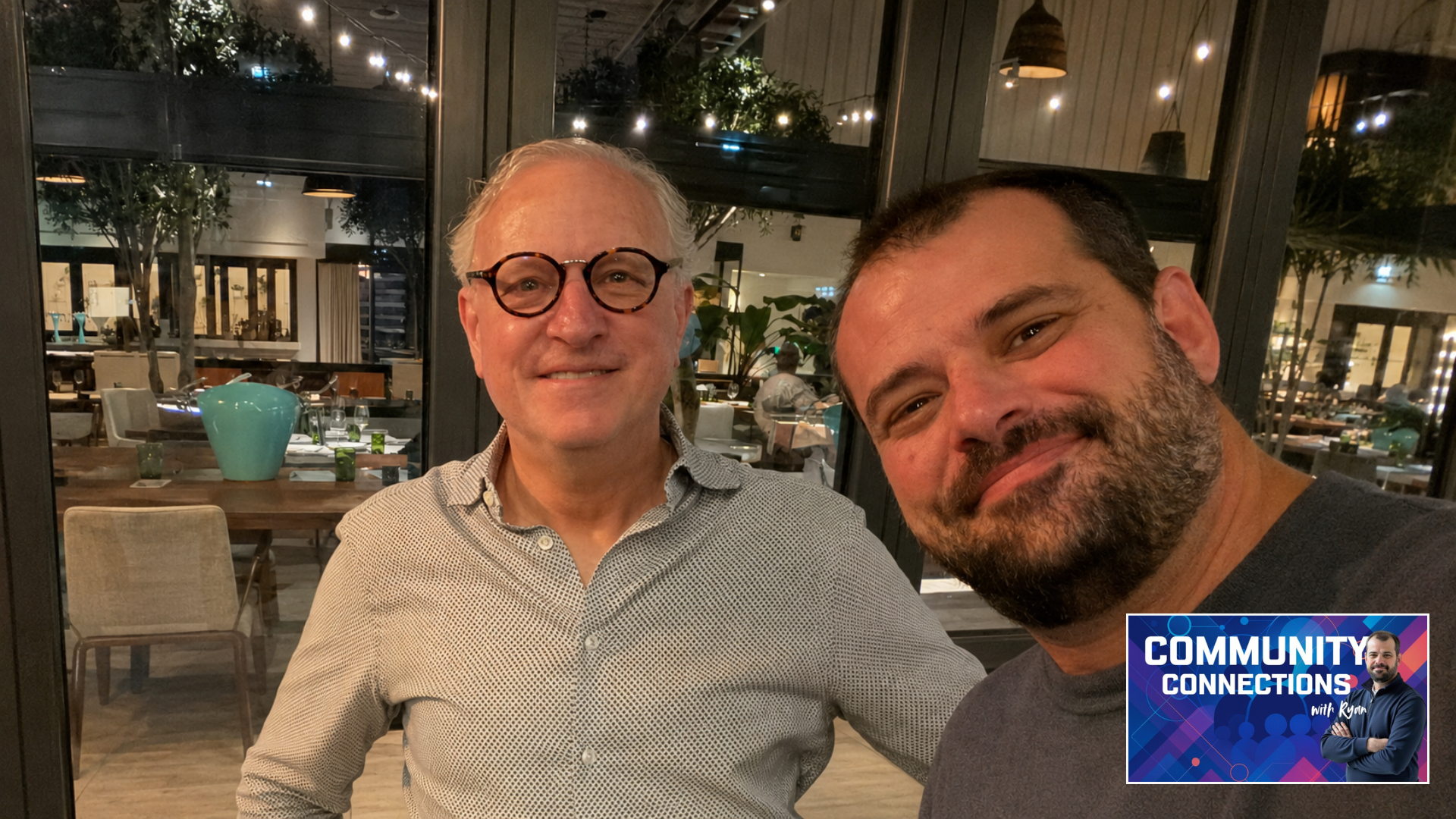


I’ve been trying to write about Richard Pierce for several days now.
The difficulty isn’t that I don’t know what to say. It’s that I have come to understand that I only know my version of Richard Pierce. That probably sounds obvious, but I don’t think we acknowledge it very often. We really only know our experience with another person but we might think that our experience shows us the whole.
My friend Richard died last week.
I knew Richard for seven years. I knew him as a colleague, later as someone who reported to me, but from day one I knew him as a friend. Those relationships gave me access to one version of Richard, but they didn’t give me access to all of him. There were decades before I met him. There were friendships that long predated mine. There were struggles he never shared with me, and there were probably parts of himself that nobody ever fully knew.
He was born in Bermuda, he spent his childhood moving around the world before his family eventually settled in Dallas, a place he always considered home. That global upbringing seemed to leave him with an enduring curiosity about people, ideas, and cultures, one that burned as hot as ever when I first met him. He earned a doctorate in education and a master’s degree in educational technology, and over the course of his career built expertise that crossed instructional design, educational technology, faculty development, assessment, online learning, research compliance, and academic innovation.
Before joining Yavapai College, Richard spent many years at Shenandoah University, where his work rarely fit neatly into a single job description. He moved comfortably between technology and teaching, between administration and research, helping faculty rethink how they taught while also contributing to institutional leadership, assessment, and the oversight of human subjects research as chair of the Institutional Review Board. By the time he arrived at Yavapai College, he had already spent decades exploring how technology could make education more engaging and more human, not because he was fascinated by technology itself, but because he never lost sight of the people it was meant to serve.
One of my foundational memories of Richard happened on a the day of an annual convocation. It was the start of a new year, the whole institution was gathered, there was a ton going on and a lot on my mind. We were walking through the student rec area and he said baited me into a game of ping pong. Thats not where my mind was and I thought I didn’t have time for it but I wanted to make sure he felt I was valuing him so I obliged. That was the day I first learned that he was a paddle shark. Master of ping pong, tennis and pickle ball.
That memory has stayed with me, because it captured something I would see over and over again. Richard never seemed to believe that being serious about your work required being serious all the time. He had an unusual ability to recognize when another person needed to step away for twenty minutes, laugh a little, and then come back better than they left.
I watched him make decisions that confused me only to see them make sense later. Richard seemed unusually comfortable deciding what mattered most and giving his attention to it, even if the people around him didn’t always understand why. Eventually, I stopped assuming my instincts were better than his. More often than not, he was seeing the long term impact of something while the rest of us were still looking at the immediate task.
I don’t mean that he was always right. I mean that he had developed a way of thinking that I learned to respect and value.
During a time of transition in our department a few years back were discussing different organizational possibilities, Richard kept saying some version of, “Just tell me where you need me.” He meant it. He wasn’t lobbying for a title or trying to shape the organization around himself. He genuinely wanted to contribute wherever he could be useful.
I think Richard did his best work when he had room to follow his curiosity. He was at his best when he could connect ideas, experiment with technology, rethink how students learn, and build something that hadn’t existed before. Structure never seemed to motivate him nearly as much as possibility did.
I was reminded of that only recently. A highly respected faculty member inherited one of Richard’s courses while he was away on medical leave. After working through it, she reached out because she wanted to nominate him for one of our highest faculty recognitions. (remember, he’s full time staff, adjunct faculty) She talked about the thoughtful use of technology, but even more than that, she talked about how intentionally the course invited students to participate. It wasn’t simply well organized. It was engaging in a way that reflected how Richard thought about teaching and learning.
Richard wasn’t there to explain any of it. His work explained him.
Richard talked often about friends. Not networking contacts or former coworkers, but genuine friendships he had developed over a lifetime. I remember him traveling more than once to spend time with friends who were seriously ill. What stood out wasn’t simply that he made those trips. It was that he managed to make them joyful. He seemed determined that illness wouldn’t become the defining feature of the time they had together.
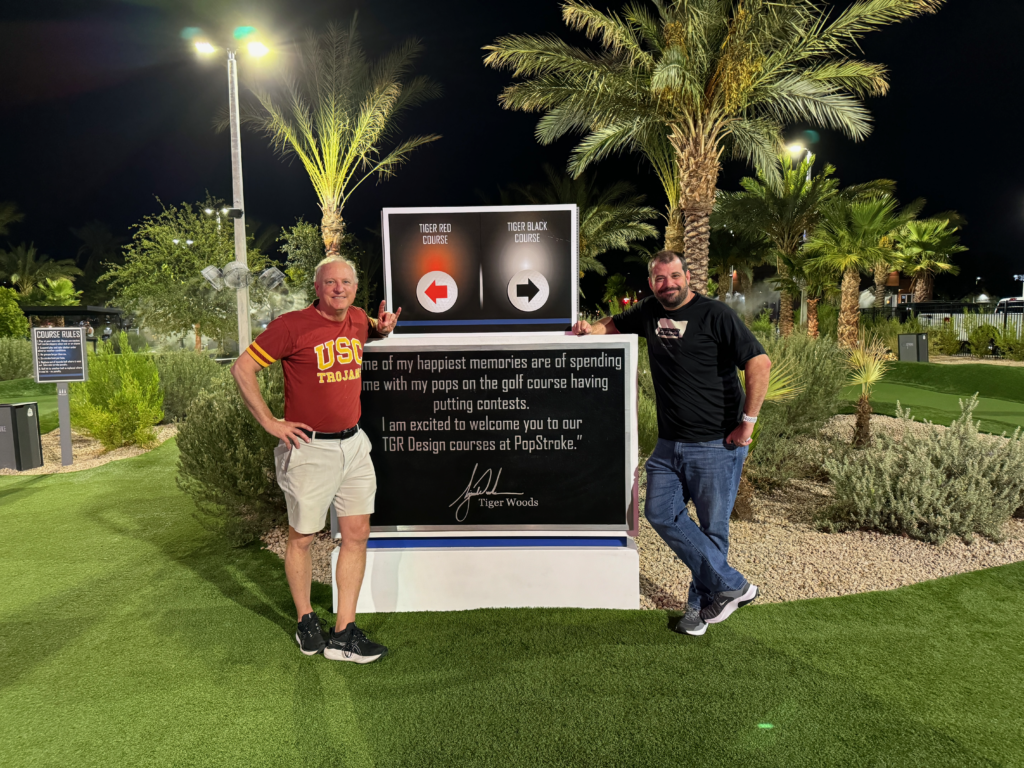
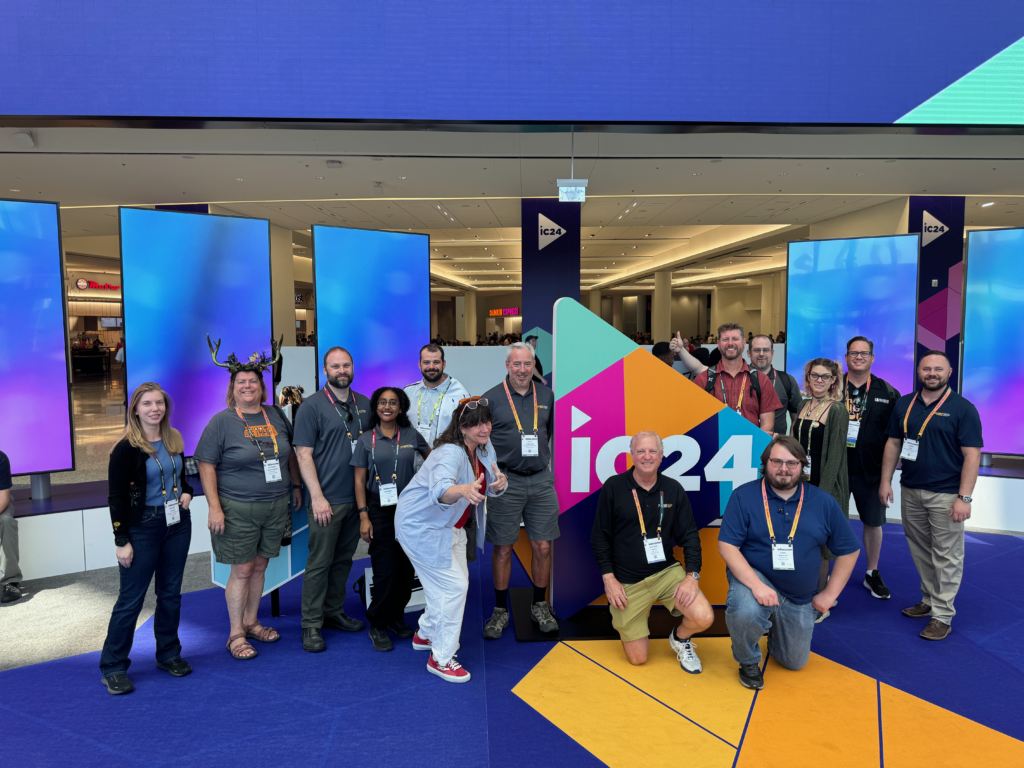
One of my favorite memories happened during a conference in Phoenix when his daughter joined him for part of the trip. One evening we crashed the Tiger Woods mini golf facility, laughed far more than any of us probably expected to, and at one point I recorded a short video of Richard and his daughter dancing just because there was fun and music in the air. I still have it on my phone.
There are parts of this story that I still don’t know how to think about.
During the months before Richard went on medical leave, I was buried in our Center for Learning and Innovation project. It consumed all of my time. Richard and I talked about that. He didn’t need direction and I told him I was there if he needed me but that I was going to go quiet for a while and we’d pick up a more normal cadence of communication when the project was complete.
I knew he’d be ok with that. Or at least he would make sure I felt ok about that decision.
The incident that sent Richard out on leave happened quickly. None of the conversations we had before then carried the feeling that they might be our last. Looking back, I regret that. Not because I think I made some terrible mistake, but because I took for granted something that almost all of us take for granted. I assumed there would be more ordinary Tuesdays.
There’s another part of this that has stayed with me.
When Richard went on medical leave, the communication boundaries, that I know exist for good reason, also created distance. As his supervisor, I understood exactly why those boundaries existed. At the same time, they felt strangely impersonal. My CIO and I have talked about this frequently over the past few months. Both of us were left with the feeling that well intentioned rules can sometimes separate people from each other at exactly the moment when being human seems more important than being institutional. I don’t know what the answer is. I only know that it has been difficult to reconcile.
I’ve also caught myself wondering how much of what I’m going back and re-living is actually memory and how much is grief doing what grief does.
We know that human memory is objectively unreliable. I’ve come to think human memory might actually be beautifully unreliable. It isn’t a flaw so much as a condition of being human. We don’t remember people as they were. We remember them as we experienced them. Those aren’t the same thing.
That’s especially true after someone passes away. The temptation is to smooth away disagreements, uncertainty, and complexity until all that’s left is admiration. I don’t think Richard needs that from me. We disagreed at times. We had conversations about work that weren’t always easy. If I thought he was making a mistake, I could tell him. If he thought I was making one, he could tell me. There was never much need for pretending with Richard, and I think that’s one of the reasons I respected him so much.
I am sad that we won’t smile together again. I have a cigar that he gave me that I was saving to light up with him.
I am broken for his wife and daughter, they do not deserve this.
The thing is this. Richard was one of the good ones, seriously one of the best of us. It’s an injustice that someone whose hallmark was how he lifted others up is gone while so many who drag others down remain. I’ve come to the point that I have to acknowledge that my real emotion is anger, and accept that anger is a reasonable response to injustice.
Richard had more to do.
More students to teach.
More ideas to chase.
More friendships to deepen.
More years with Becky and Sage.
More laughs, more wisdom, more smiles, more life.
That’s probably the part I’ve struggled with the most. We often say someone “left a legacy,” and Richard certainly has. But that phrase quietly assumes the work was finished.
He wasn’t done but he didn’t get that choice. None of us really get that choice.
One thing that I’ve said over and over in the past few days is this… I’ve never seen anyone live life with the understanding that it is finite more than Dr. Richard Pierce. That’s a hard quality to quantify but it was written all over him.
This is not a platitude, I consider it an honor that he would have called me a friend. Now, can I follow his example and truly learn to live my life with the knowledge that it is finite.