
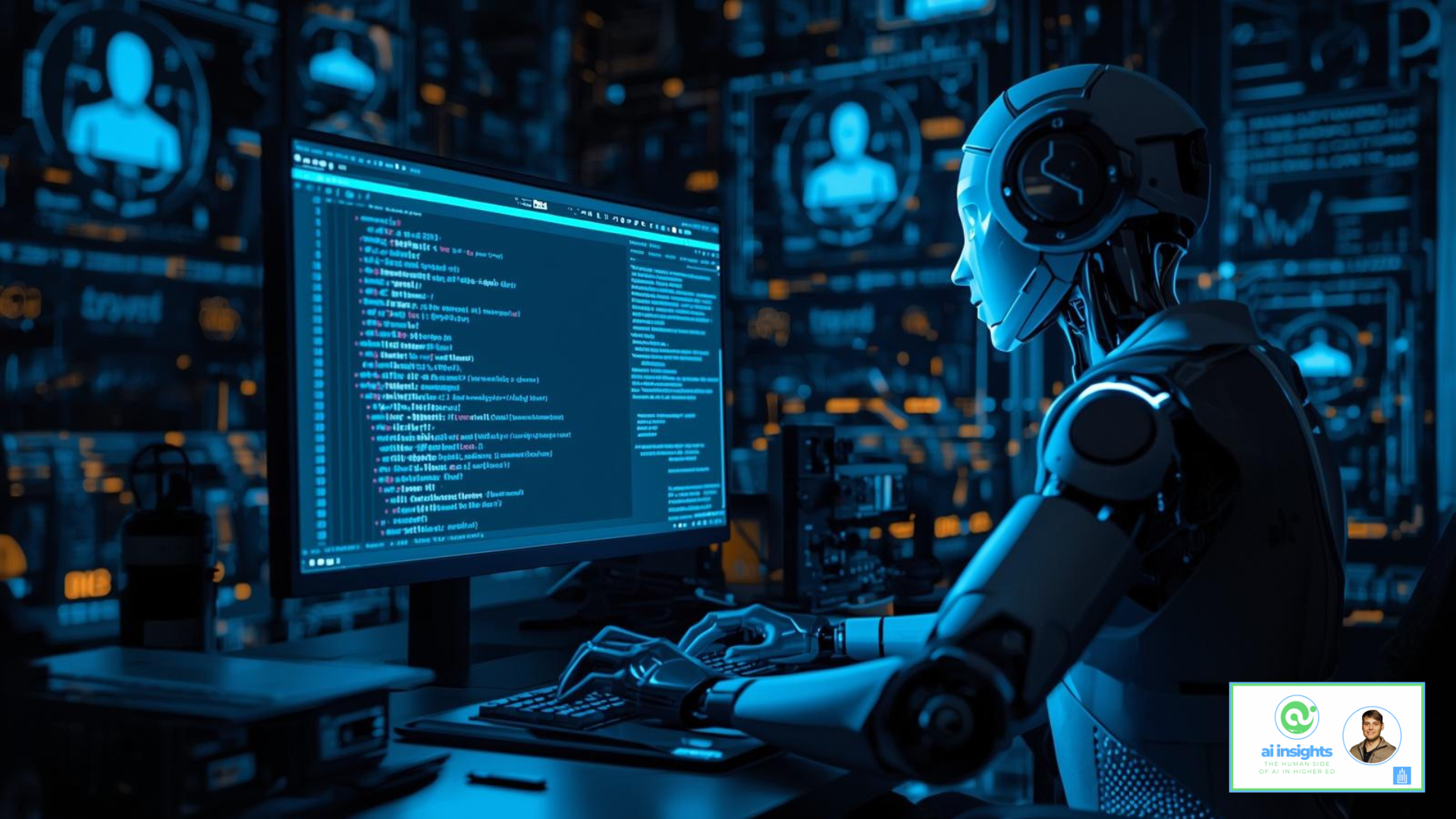


Claude Code and OpenClaw are framed as emerging tools that make programming accessible and can run locally. These tools facilitate “vibe coding,” the ability to code at a proficient level with novice skills. Unlike the popular web-based AI apps, Claude and OpenClaw require knowledge of terminal commands. There are examples of folks using these tools to develop their own websites and other resources.
The ability for people to become self-sufficient with programming brings fear to job sectors that have long been considered desirable. But what does this mean for higher education? For some roles, such as instructional designers, these tools create both opportunity and unease. They may assist with:
- Generating LMS course structures from syllabi or learning outcomes
- Producing HTML, CSS, or LMS‑friendly templates for modules and pages
- Drafting assignment instructions, rubrics, and discussion prompts in structured formats
- Translating learning objectives into machine‑readable course shells
While a Command Prompt interface can be a barrier to entry for some, a polished UI could enable less tech-savvy faculty to develop their own course shells with minimal guidance.
- Generating LMS module structures
- Providing accessible headings and semantic markup
- Iterating rapidly without waiting on support staff
These tools can empower those who normally do not have a web or programming background to develop quality content. On paper, this is a win. Accessibility work is often under‑resourced, inconsistent, and pushed downstream. Automating parts of that process could improve equity at scale. No one wants to add rote work to their everyday workload. With Title II deadlines rapidly approaching, it is no surprise people will offload these tasks to machines.
There are a variety of use cases for OpenClaw. An automatic ticketing system that searches knowledge bases appears ideal for Tier 1 items, such as instructions on how to turn on AV systems. These systems can even clear out an email inbox and respond to clients with acknowledgments and troubleshooting information before a technician responds.
Of course, that begs the question: are your customers reaching out for assistance or for human support? Some people simply want face‑to‑face help to build self‑sufficiency. Are these automation tools replacing the countless how‑to videos and paper‑based training materials we create in hopes of being proactive? Time will tell.
The end of humanity will be no more emails…
While code is important, programming matters just as much. Recently, a security staff member at Meta lost access to their email and was unable to prevent OpenClaw from accessing it. This is not an isolated incident, and there are other examples that make it clear boundaries need to be established when implementing new technologies.
The big takeaway is that these tools are getting easier to work with. I am currently running a version of OpenClaw on an old Raspberry Pi for experimentation. You can get a free API key from Google to use their Gemini model. Of course, more snappy setups recommend using Mac Minis and API services as outlined below. These introduce different costs based on need.
API Key Cost Comparison (2026)
| Provider | Model / Tier | Input Cost (per 1M tokens) | Output Cost (per 1M tokens) | Notes |
| OpenAI | GPT‑5 Turbo | $5.00 | $15.00 | Best for balanced cost and speed |
| GPT‑4.5 Turbo | $3.00 | $9.00 | Lower cost, slightly less capable | |
| Anthropic | Claude 3.5 Sonnet | $3.25 | $15.00 | Strong reasoning, higher output cost |
| Claude 3.5 Haiku | $1.25 | $5.00 | Fast, budget-friendly | |
| OpenClaw | Standard API Tier | $2.00 | $4.00 | Includes basic analytics |
| Pro API Tier | $4.00 | $8.00 | Priority processing and advanced features |
Note: If your workload is input‑heavy (e.g., large document ingestion), OpenClaw’s Standard tier or Claude Haiku can be the most cost‑efficient. For output‑heavy tasks (e.g., long text generation), OpenAI’s GPT 4.5 Turbo often provides better value.
This video is funny but fairly realistic in the steps it takes. Warning: nerdy programmer humor.
You can also go all-in and invest in a $5,000 Dell appliance to handle data‑intensive workloads. For now, I will stick with the Pi and the free API key and see where it takes me. I see clear benefits in having students and faculty experiment with lean technologies to operate powerful tools. With resources becoming limited in higher education, these tools continue to empower technology managers to provide services at scale.