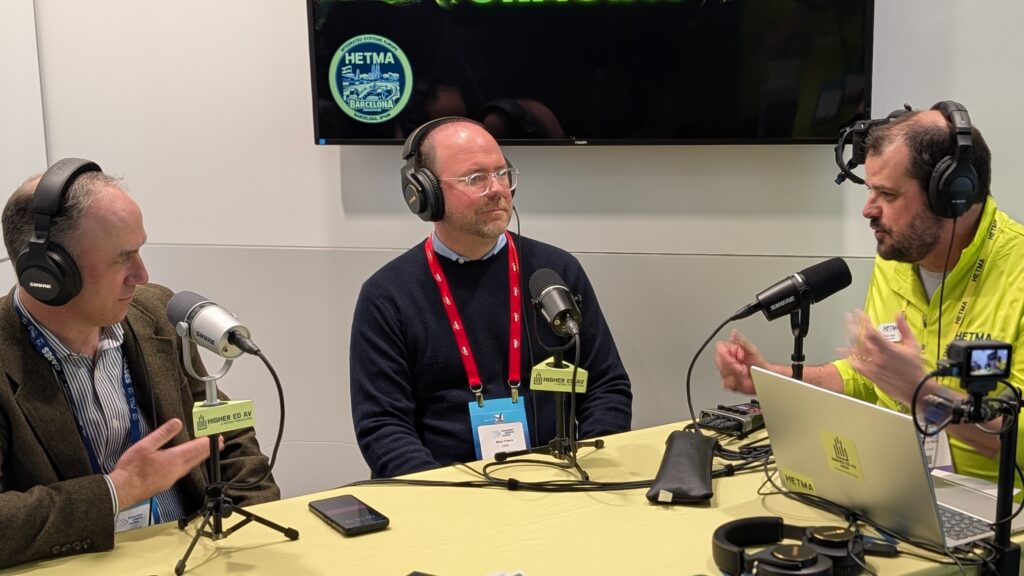
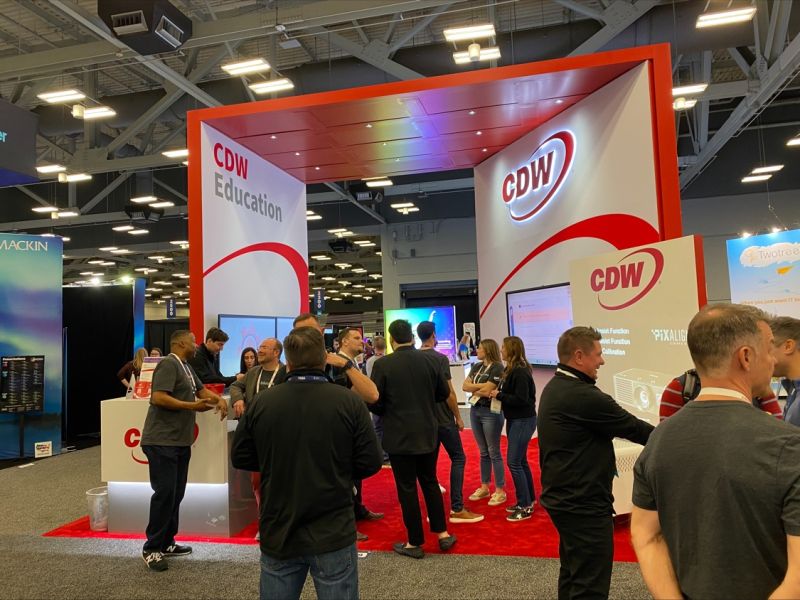







Most ISE conversations start with a booth and a product list. CDW shows up at the show in a different posture. They are here to see what is changing across the AV, UC, and classroom technology ecosystem, and to translate that into decisions campuses can live with for years. In the HETMA booth, we sat down with two CDW voices who sit on different sides of that work: Mike Peters, Director of CDW’s Education Presales team in the U.S., and Tim Russell, Chief Technologist for the Modern Workspace at CDW in the UK.
The simplest version of why they are here is also the most honest: they cannot help customers make good decisions if they are not seeing the market in motion. They talked about staying current with partners across the AV spectrum, spotting what is emerging, and separating “eye candy” from what will actually deliver value. That is not just a vendor relations exercise. In higher ed, a technology choice is rarely isolated. It touches network design, security, room standards, support models, procurement timelines, and user expectations. If the decision is wrong, it becomes operational debt.
Tim also said something that will feel familiar to anyone who gets reduced to a purchasing channel. CDW is often seen as the place you buy things. He called it “shipping tin,” and then he immediately reframed it as a much broader lifecycle relationship that is meant to save campuses time.
“Customers see us as shipping tin, and we do a lot more than that.”
During the discussion, the work was described as a full arc: technology sourcing and selection, professional services to architect and implement, and managed services to operate and support what gets deployed. That matters because higher ed does not just need gear. It needs systems that can be stood up, stabilized, and sustained through staffing changes, academic calendar pressure, and the ongoing reality of “we do not have enough people for the number of rooms we support.”
Mike framed that end-to-end role in practical terms. CDW can help design complex solutions, deliver the hardware, install it, and handle decommissioning. The point was not “we do everything.” The point was that the handoffs between stages are where projects often slow down, and where the user experience can drift away from the original intent. If the organization helping you source the technology can also help you design, deploy, and run it, you reduce the number of seams.
Tim took a different angle that landed in a very higher ed way: specs do not matter until they map to experience. Speeds and feeds are not the story. The story is what it results in for teaching, learning, and campus life. He pointed out a competitive reality that is sometimes uncomfortable to name. Students want to be on the campus that feels connected and modern. They want the Wi-Fi to work. They want rooms that behave predictably. They want spaces that feel intentional, and it does not always have to be expensive, but it does have to be designed well.
Mike tied this all to a North Star: the work has to serve students. You can stack up features all day. If the room is hard to use, or teaching becomes a troubleshooting session, it is not a successful solution. They also leaned into something that gets overlooked until you are living it: global consistency. CDW’s higher education practice spans the U.S., Canada, and the UK, and they described delivering the same “look and feel” across main and satellite locations around the world. For institutions with international campuses, global programs, or a distributed footprint, the pain is not just shipping, it is tax laws, logistics, local rules, and the operational friction of trying to deliver the same standard in different places with different constraints. CDW’s pitch is that they can reduce that friction by bringing continuity in design, procurement terms, implementation approach, and support posture.
Tim put it as a repeatability argument. If you have seen it once and it works, the goal is to replicate it without reinventing the wheel every time you cross a border. That is not glamorous work, but it is the work that keeps international expansion from turning into a series of one-off surprises.
There was also an interesting tension in how Mike and Tim described their ISE role. On one hand, they have to spend time with the major partners they already do big business with. On the other hand, Tim’s job is to look five years out. He talked about seeking out what is emerging, what is going to disappear, what will be swallowed by consolidation, and what will actually make a difference for customers. He mentioned having NDA conversations with suppliers about what is coming, and while he cannot share details, he can connect patterns and advise customers on direction. That is a useful distinction. Higher ed teams rarely need secret roadmaps. They need help making directionally correct decisions that will still make sense when the next refresh cycle arrives.
The most practical advice they offered, especially for a community like HETMA that is building more global connection, was also simple. Know who you are. Do not try to be everything to everyone. Be honest about what you do well, and build partnerships for the rest. That is true for vendors, integrators, and campus teams. When people pretend they can do everything, the failures show up later, and they show up in the classroom.
If you take one operational takeaway from CDW’s presence at ISE, it is this: treat technology decisions as experience decisions. A campus can buy any box. The harder work is joining the dots between AV, UC, network, security, services, and support so the outcome is consistent and usable. That is the work CDW is trying to be known for, and it is why they are walking the show floor instead of selling one fixed demo.
Make sure to check out all of this and more at their website and reach out to Mike at mikpet@cdw.com.