


A higher ed AV leader from Belgium makes the case for curiosity, privacy-first hybrid design, and why education has to unite if we want to shape the industry instead of just adapting to it.
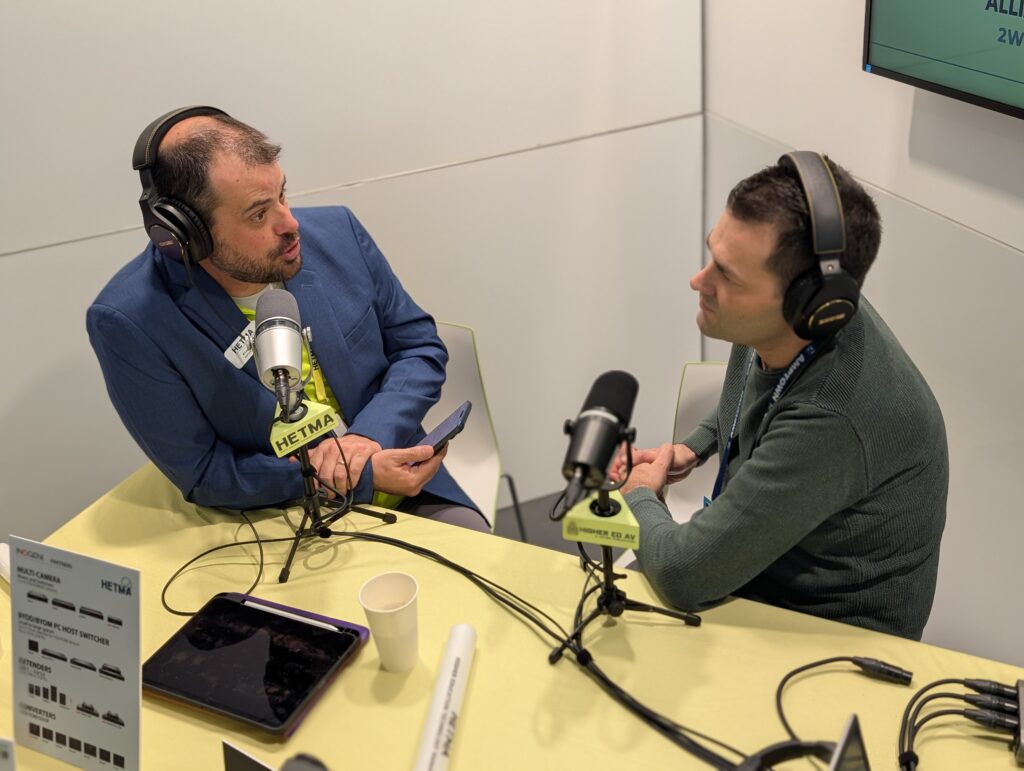
Tom Segers and I recorded two conversations on the show floor at ISE 2026, and I walked away with the same kind of mental note I get when I meet a certain type of higher ed AV leader, the ones who are not trying to be impressive, they are trying to be useful. Tom moves fast, but not in the flashy way. More like the way you move when you are responsible for a lot, you know exactly what breaks, you know how long it takes to get from one campus to another, and you do not have the luxury of being wrong very often.
The first operational detail that matters is scale. Tom works for Thomas More University of Applied Sciences in Belgium, across seven campuses in the province of Antwerp, supported by a team of three AV experts. If you have ever done the mental math of rooms, users, travel time, lifecycle replacement, and the ticket queue you cannot see yet, you know what that means. It means you plan. It means you standardize. It means you build systems that reduce chaos. It also means you have to be intentional about staying curious, because curiosity is usually the first thing that gets sacrificed when the calendar gets tight.
Tom says something early that sets the tone for who he is, and I believed him instantly because you can hear the grin in it. This is not a job title for him, it is a genuine interest that turned into responsibility.
really don’t know because in fact this is my hobby. My hobby became my work. think if I do something else, I won’t be happy. Because this is my playground. I love it to play with cameras and audio and monitors and for now, LED screens. No, I love this. I don’t want to do anything else.
That line can sound like a cute origin story until you listen to what he does to protect it. I asked him the question I ask because I feel it in my own life, how do you keep AV fun when the job tries to turn into meetings and inbox management. His answer is painfully honest and then immediately practical. He does not romanticize the grind. He just names it, then chooses a strategy anyway.
That’s a very difficult one because in the end everything ends up in meetings. I only can confirm that. ⁓ I saved some space in my agenda. This is for testing, this is for playing around, playing around. I don’t think it’s the right word, testing out new technology, can this be good for the education?
That is not just a time management tip. That is a leadership posture. Tom is building his own internal research and development lane inside an environment that could easily consume him with reactive work. And what he uses that lane for is the question education needs people asking more often, can this actually be good for education.
That question, asked seriously, is part of why he is at ISE in the first place. Tom is not walking the floor to be sold to. He is there to talk to the people who can actually change a product, because his team has real gaps to solve.
⁓ Especially talking to the R &D part of the firms. I think it’s not right that I go into ⁓ much of details but for example ⁓ We need, for example, solutions for big meeting rooms. And we don’t have them at this moment. There is a gap in technology for that kind of rooms. And now we are talking to all of the partners that have solutions for that. OK, do you have a solution for this? Do you have a solution for that? And we probably need this, or we probably need that. Do you?
I love that because it is the opposite of hype culture. It is not, tell me what is new. It is, here is what we need, here is what is missing, and here is the conversation we are going to have until somebody builds the right thing.
That is also why his connection to HETMA matters. Tom is not chasing association for the sake of association. He is chasing the leverage that comes from shared voice. He talked about an initiative they started in the Flemish speaking part of Belgium, and he described it as successful, but incomplete because the infrastructure was missing.
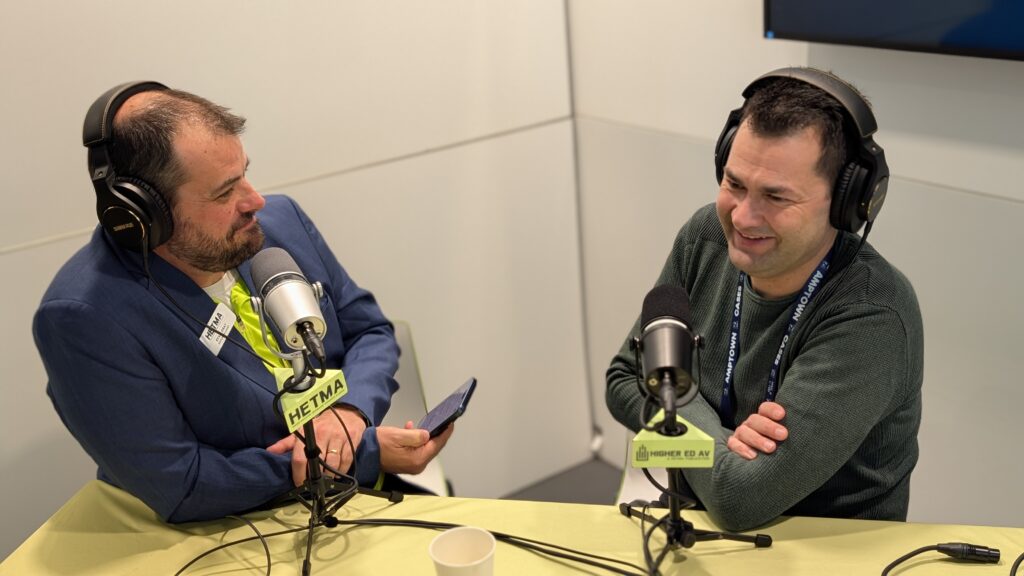
Okay, maybe that’s what we need because we just started it. Initiative within the Flemish speaking part of Belgium. And it was quite a success. But we missed a professional tool of initiative to connect to each other.
Then he says the sentence that explains so much about why higher ed often ends up adapting corporate products instead of shaping them.
Yeah, and also we are too small to make an impact on the industry. every product, most of the time it’s commercial, it’s for a business market, but not for the education market. And if we want to make an impact to them, we need this kind of initiatives.
That is not pessimism. That is strategy. If education shows up fragmented, we do not get to be surprised when product development treats our needs as edge cases. If education shows up connected, we start to influence the roadmaps we spend our money on.
There is another layer to this that is easy to gloss over if you only think about community in terms of social connection. For Tom, connection also has a real world language component, because Belgium itself is multilingual. I asked him to explain the Flemish piece because I knew listeners in the U.S. would not automatically understand it, and he gave a quick, useful overview.
to give a background of Belgium, you have in fact Belgium has three official languages, which is Dutch for the Flemish speaking part. ⁓ You have also the Wallonia, it’s French speaking part. You also have a German, no German, Dutch, Dutch is my language. and yeah, for Flanders. It’s easier to communicate of course in our Dutch language. But also I think everybody is capable of speaking English. It’s not a problem at all. So no, I don’t think we have any kind of problems to get involved into a ⁓ wider European initiative.
That matters because it points to something bigger than language. It points to intent. If you want a broader European higher ed AV community, you can build it. If you want a global higher ed AV community, you can build it. The infrastructure is there. You just have to decide it matters enough to do the work.
The most important part of Tom’s perspective, though, is not international connection for its own sake. It is his insistence that education environments are not just corporate environments with different furniture. When we started talking about the connected classroom trend and the way vendors have shifted since the pandemic, he drew a line that should be a requirement in every classroom design conversation.
since Corona, changed a lot. Yeah, because they, for example, we’re looking right now, connected classroom, it’s a new hype, it’s a new trend. And I think they see money into it. Yeah. So, and that makes the very big difference because it’s not only being done in the classroom itself, a hybrid classroom or a connected classroom, it’s just the new. ⁓ the new thing and you need it and but you have a meeting room but the meeting room is not a classroom. Right. And it’s very important and especially in Europe where we have a lot of privacy rules and something like that and they didn’t know that because it’s very obviously that in a meeting everybody you can see everybody but in Europe it’s not being done that a student is being filmed. Being captured just to show him. everybody in the meeting. So if it’s a student you are supposed not to be seen by the other students and that sounds a little bit strange but it’s our privacy rules so we have to take order to that.
That is not an abstract idea. It creates immediate design constraints, and Tom gets concrete about how they respond. Their strategy is not a camera that hunts for faces. Their strategy is teacher focused capture and audio led participation, which is a completely different posture than what a lot of corporate hybrid rooms assume.
strategies. For example the ⁓ cameras are most of the time only to the teacher and it’s also being when it is being captured or recorded only the the active speaking ⁓ the actual the active speaker is being captured right and not the students in the classroom but if they are asking questions from at home everybody can hear it and also if somebody in the classroom is asking questions you will hear it yeah but you will not see the person yeah and that’s most of the time the strategy that we are now
Once you design that way, audio stops being a supporting character and becomes the foundation of the experience. Tom says it as plainly as it can be said.
Yeah, indeed. that’s audio part is the most important thing and it’s also the most costly part of a hybrid room. It’s the audio. Everything stands false with the audio.
If you are reading this and thinking, yes, but budgets still fight us on that, you are not wrong. Which is why I also appreciated how Tom talks about budgets. He does not pretend he controls the entire national funding picture, but he does describe the structure he understands, and then he immediately moves into what he does about it in his own lane, lifecycle planning and reserves for failure.
In Belgium, don’t know if it’s a written law or something like that, but there is some kind of a rule that you can pay 80 % of your budget. You got a budget per year from the government and 80 % can go to your employees and 20 % you need for your buildings and for all of the… funds and something like that and that 20 % is being divided between the services between the faculties and something like that but I really don’t know how it is it’s above my head that they make that kind of a decision but for example for Thomas More because I know for the other institutions that are so around here everybody has a different kind of… For example, in Thomas Marr, I have a working budget yearly and I have to support everything with that. And we make plans, for example, how long does a projector last, how long does an audio system will work, and something like that. And also you have your reserve for if something really… happens and lecture hall is going down yet.
That is what seasoned operators sound like. Not, we will always get what we want. More like, we will plan the lifecycle, we will build reserves, and we will be ready when the room fails at the worst possible time.
Then Tom does what the best technologists always do, he tells a story that makes all of this real. He starts talking about LED walls, because that is what he is currently learning, and he describes it as one big learning curve. If you have ever watched someone assume LED is just a display swap, you will enjoy how quickly his story kills that illusion.
it’s ⁓ one big learning curve. ⁓ You start with it, okay it’s easy. No, it’s not easy. You have to take consideration of the video processor. You have to make consideration is it 1080p, is it 4k, is it ⁓ how much current or how much… For example when you put it on it’s a very high amount of voltage. You need other electric gear before you build it. For example the fuse. I don’t know the type anymore. You have different types in it. C, type D, type E or something like that. I don’t know. It’s not my kind of stuff. So we put it on, hop, bang, the electricity fell off. what the f**k is that? And yeah, it’s not easy. And also we scaled up with the LED wall from 1080p to 4K. And then came the inputs. We have a bring your own device policy. But you can’t every bring your own device. Kenny handle for most of the teachers we are learning them use the duplicate mode in Windows. Yeah, but now use the extent mode. Yeah, that doesn’t make it easy because you have to. just your manuals. For example, if you’re doing it with an ExtendView in PowerPoint, it’s different when you use the duplicate modes in consideration of the Extend mode. And we have to play a video into it with the YouTube link and it’s played on the other screen, not on the LED wall. You have a lot of problems, so it’s a whole new way of thinking. look at, okay, how can we create content that’s best for that kind of solutions? Because if you have a 4K video or LED wall, never put 1080p on.
That is the whole job in one story. Technology decisions that look clean in a plan set become messy when they hit buildings, power, cabling, user habits, and teaching workflows. Tom is not just installing gear. He is rebuilding faculty mental models. And he is doing it in a context where his team is small, time is limited, and the expectation is still that everything should just work.
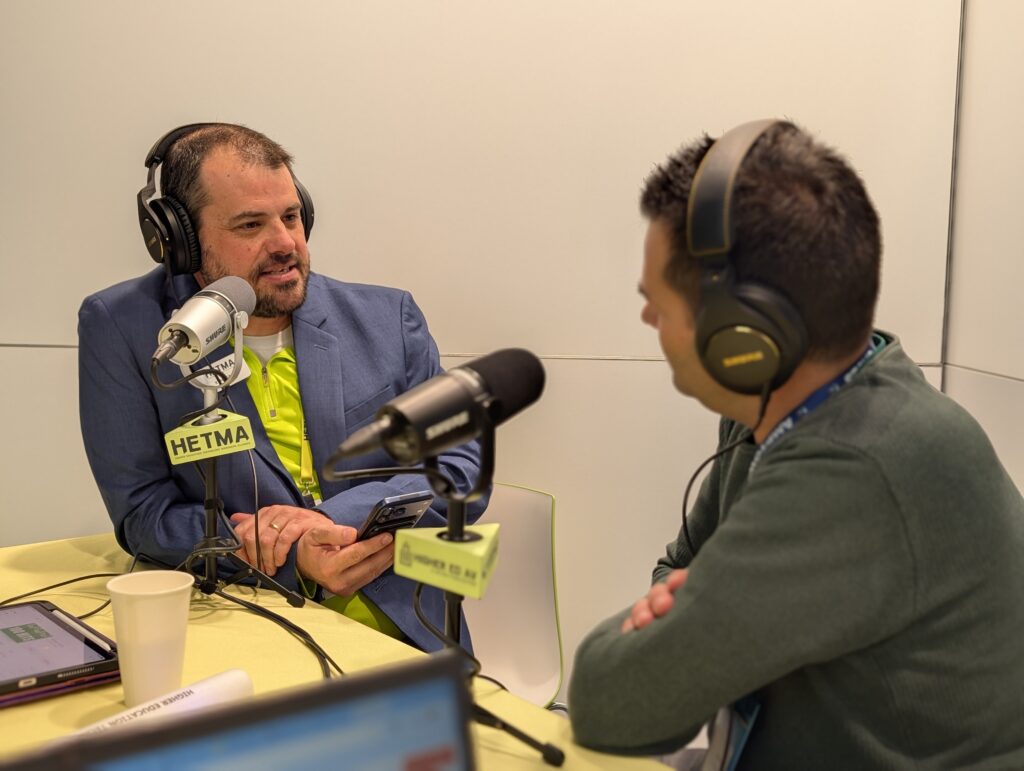
At the end of the second conversation, I asked him the sign off question, the drop the mic line. His answer is so perfectly AV that I laughed, and then I immediately felt the sting of it, because it is true. It also contains a warning we do not talk about enough.
No news is good news in our business. So if we don’t hear anything, probably everything is working very fine. I love it. And sometimes there’s also a pain in the ass because you don’t get feedback. Yeah. you, for example, some things, for some people, a solution isn’t working very good. And when get rid of it and then you get a lot of response. Where is my solution? Where is the solution? What did you do with it? ⁓ you didn’t know that you were using it. You never gave feedback. Right. So no
No news can mean everything is fine. No news can also mean you have no visibility into what matters until it disappears. That is the invisible cost of being good at the job, and it is also why community is not optional. If you want to get better, if you want to keep education from being treated like an edge case, if you want to influence the market instead of just adapting to it, you need feedback loops that actually exist.
So what do I want you to take from Tom Segers if you never listen to the episodes.
I want you to meet him as someone who protects curiosity on purpose, because he knows curiosity is how education stays honest about what works. I want you to see his insistence that a meeting room is not a classroom, not as a cultural footnote, but as a design requirement that changes the entire hybrid conversation. And I want you to notice the throughline that runs underneath everything he says, education is too small to influence the industry as isolated campuses, which means connection is not just nice, it is leverage.
If you want to connect with Tom, he suggests going through the HETMA Community and sending a personal chat.
https://www.linkedin.com/in/tom-segers-19b89676