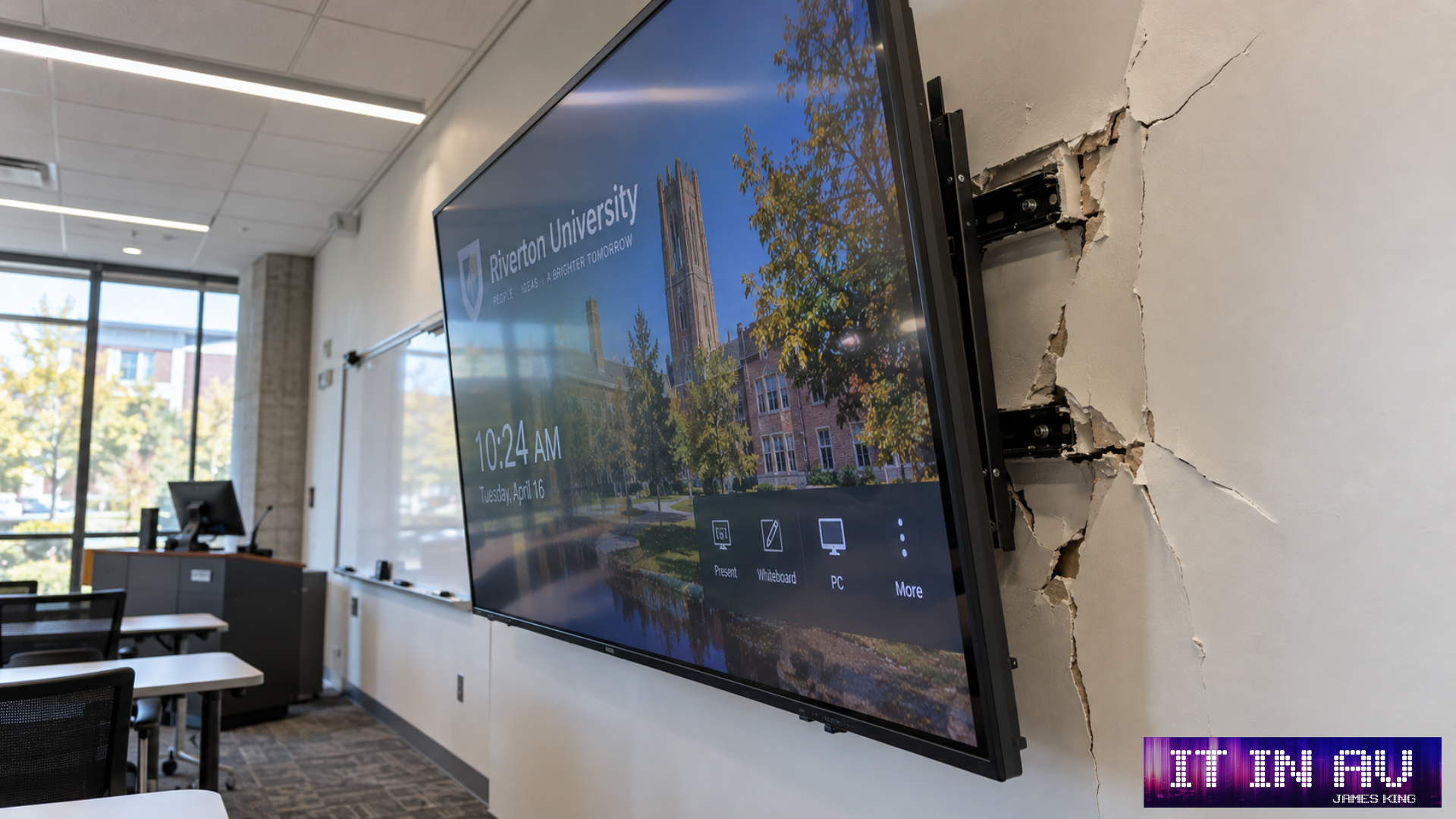



Walk into one of your classrooms. Take a seat. Not at the podium and not standing near the rack or tapping through a control panel but sitting the way a student sits. Sit in the back corner and look at the sight lines. Sit off to the side where displays skew slightly and audio arrives just late enough to be distracting. Sit in the front row where necks crane upward, captions drift out of view, and lighting feels harsher than expected.
That experience matters.
Higher education spaces are often evaluated from the standpoint of whether they technically function. The projector turns on. The microphones work. The room meets a checklist of requirements. But accessibility, and more importantly inclusion, often reveals itself in the moments that feel tiring rather than broken. Something works, but only if you already know how it is supposed to work. Something is usable, but mentally or physically exhausting over time.
When was the last time you actually sat in your classrooms and experienced them the way others do?
That question opens the door to a larger one. What type of university do you work for?
Universities Waiting for a Lawsuit
Some universities operate as if accessibility is a risk calculation rather than a responsibility. They know there are gaps. They know some requests are being deferred or denied. But the hope is that nothing escalates far enough to force change. The cost of doing nothing is seen as acceptable until it becomes legally inconvenient.
This approach has played out repeatedly in higher education.
An unfortunate example is Arizona State University’s Kindle pilot program, where the university distributed Amazon Kindle DX devices to students without ensuring the technology was accessible to all users. A blind student, along with the National Federation of the Blind and the American Council of the Blind, challenged the decision, arguing that the devices could not be independently operated using assistive technologies. The case resulted in a federal settlement that made clear that universities cannot deploy instructional technologies that exclude students, even in pilot programs or experimental settings. [archive.ada.gov]
What makes cases like this instructive is not just the outcome, but the mindset behind them. The technology worked for most users. Alternatives existed. No harm was intended. And yet, the harm was real, and the institution was willing to take it to court.
Universities that operate this way place the burden on students and faculty to prove they deserve access. Every accommodation becomes a negotiation. Every request becomes a test of persistence. Even when institutions eventually comply, the damage to trust and experience has already been done.
This is a losing situation for everyone involved, including the institution itself. Don’t be this type of higher ed institution.
Universities Focused on ADA Compliance
Many universities genuinely want to do better and focus their efforts on meeting ADA requirements. They invest in compliance reviews, audits, and checklists. They make sure new buildings and classrooms meet published standards. This is necessary work, and it is absolutely better than ignoring accessibility altogether.
Recent updates to ADA and similar regulations have made this baseline clearer than ever. Public universities are now explicitly required to ensure that digital content, learning platforms, and instructional materials conform to WCAG 2.1 Level AA standards, including accurate captions, accessible documents, and compatibility with assistive technologies. Physical spaces must still meet long‑standing requirements for wheelchair clearance, accessible seating, and equitable access to instructional areas.
Compliance matters. It protects institutions, and it establishes a minimum level of access.
The problem arises when compliance becomes the finish line rather than the foundation. When accessibility is treated as a legal threshold to clear, the resulting experience often feels transactional. The space technically works. The mandate is met. But the environment still assumes a narrow range of users and abilities.
Few universities aspire to be known as places that do the bare legal minimum. Yet when ADA compliance is the primary goal, that is often the message that is unintentionally sent.
Striving for Universal Design
Universities that embrace Universal Design for Learning start from a different place entirely. UDL does not assume we have all the answers. It assumes we never will.
Designing for UDL is about approach and purpose rather than perfection. It requires admitting that no single designer, technologist, faculty member, or administrator can anticipate every way a classroom might fail someone. That humility is not a weakness. It is the reason UDL works.
When institutions design with UDL in mind, they stay curious. They observe how spaces are actually used. They listen to feedback. They share ideas across roles and departments. Accessibility becomes something that evolves through collaboration rather than enforcement.
This is also where sitting in the classroom matters most. When designers and support teams experience spaces the way students and instructors do, they start to notice barriers that never appear in documentation. Displays that favor certain seating positions. Audio that assumes perfect hearing. Furniture that technically meets standards but limits real choice. Controls that require confidence, reach, vision, or prior experience.
UDL invites us to imagine options instead of defaults. Touch panels that incorporate tactile cues for users with vision challenges. Voice control that allows someone to operate a room without needing to physically reach a panel. Height‑adjustable desks and tables that support a wide range of bodies, teaching styles, and daily needs.
Most people learn about these ideas not from manuals, but from one another. UDL creates space for that exchange. It allows accessibility to grow through shared knowledge instead of isolated solutions.
Most importantly, it reduces the need for people to ask for special treatment just to participate fully. Students and faculty already carry enough cognitive load. They should not have to advocate for basic access on top of everything else.
Designing for UDL says something simple and powerful. We thought about you before you walked into the room. This is a powerful stance for a university to take and for students and staff to experience.
Why This Reflection Matters
When universities take the time to sit, observe, listen, and learn together, accessibility stops being abstract. It becomes personal. It becomes practical. And it becomes clear that the goal was never perfection.
The goal is effort, humility, and shared responsibility.
So as you think about accessibility on your campus, ask yourself one final question. What type of university do you work for?