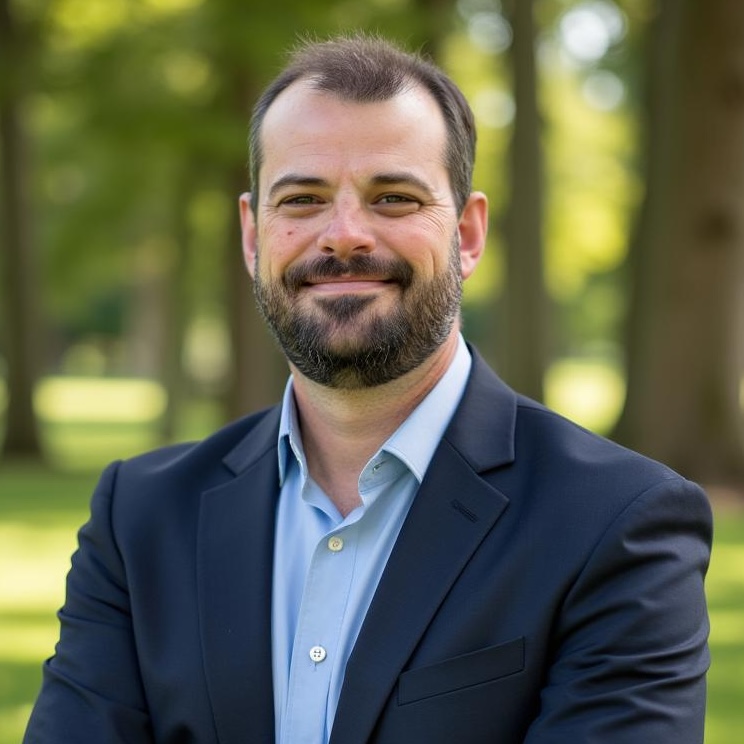




Thomas Eastlack and I recorded two in person conversations for the AVIT Amplifier podcast, and I walked away with the same feeling I get after meeting a certain kind of higher ed colleague. Not the flashy kind. Not the kind who needs to prove they belong. The one who makes the room calmer just by being in it. On paper, Thomas has moved fast at Yavapai College, from student worker to full time technician to lead analyst for HRIT. In the chair across from me, what stood out was not speed. It was a service posture that feels practiced, tested, and uniquely his own.
Here is the first operational detail that matters, because it shaped the whole vibe. We have a brand new podcast studio upstairs in the building, and it is not ready yet. I said it out loud during the intro, partly as explanation and partly because it was funny in the way higher ed is funny, where something can be brand new and still unavailable because reality has not caught up to the ribbon cutting dream.
And because it was not usable yet, we were doing the very higher ed thing of making stuff work anyway.
If you watched the video, you saw the setup was a little shotgun, with a whiteboard behind us, not a polished studio look, more like two coworkers stealing time to talk in the middle of a real day. In the middle of the start, I got pulled away. Big surprise on that right? I had a guest sitting there who literally had to stand and wait while it was, Ryan, just a second, Ryan I need you for a minute, Ryan need you. Thomas just stayed steady through it. No irritation. No performative patience. Just a calm willingness to let the day be the day.
“This is a weird one because literally upstairs in this building, we have a brand new podcast studio, but it’s not ready yet, so we can’t use it.”
I am starting there because it frames why Thomas is worth amplifying for people who do not listen to the podcast. The messiness is the point. Thomas does not need ideal conditions to show up as himself. And what he brings to a community is not just technical competency, it is a way of carrying service that does not make other people feel small.
When I asked him what HRIT actually means in his context, Thomas described a shift a lot of us recognize. His previous role was more reactive. People call, they need something fixed, he fixes it. In HRIT, the expectation is more proactive, looking at systems and processes, identifying solutions, thinking forward. Then he got concrete in a way that mattered. HR used to do communications through email, and now they adopted a ticketing system.
That ticketing system, in Thomas’s words, allows for more automation and routing, and it also keeps people accountable, both the users and the people in HR. Even if you never touch HR systems, you can feel the cultural shift baked into that sentence. Email based support lives in inboxes and memory. Ticket based support lives in shared visibility and traceability. It forces clarity. It exposes patterns. It creates a record. It also makes it harder for a request to disappear quietly, which is where accountability starts to mean something.
“we adopted this ticketing system that allows for a lot more automation and routing and stuff like that. And it also keeps people accountable, both the users and the people in HR.”
If you want two more specifics from his current work, he mentioned being tasked with getting the new website updated and ready to go, and he described the reality of websites like someone who has lived through the churn. Iteration after iteration, people chiming in with change this, change that, until it becomes obvious you are going to have to meet in the middle and accept something as launchable. That is not glamorous work, but it is real work, and it is where service posture matters, because the difference between a smooth launch and a never ending revision loop is often how someone understands human behavior, not how someone writes code.
He also mentioned that the YC website has a chatbot, and he got admin access to the back door of it, then started learning how to train it. That detail matters because it shows the kind of “bring us into the 21st century” expectation he said his supervisor has for HRIT. Thomas is not only maintaining. He is being asked to modernize, to design new pathways for support, and to do it in a way that builds trust instead of friction.
One thing he said kinda got to the core of who Thomas is because it is the simplest explanation for why some service teams feel safe and others feel exhausting. He acknowledges that help desk work can be repetitive, and he acknowledges he has had the same call over and over and over. But he holds onto one reframe that keeps him from turning repetition into contempt.
“This might be their first time dealing with it.”
That sentence is not sentimental. It is operational. It changes tone. It changes patience. It changes whether the person asking for help walks away feeling supported or feeling stupid. Thomas also said he never wants to talk above people or use technology speak in a way they won’t understand. Again, not soft. Functional. If the person cannot follow you, the work is not done.
When he described how he approaches a support conversation, he gave a question that, honestly, should be printed and taped above all our desks.
“what are you trying to accomplish? And then we kind of work backwards from there.”
That question is the opposite of gatekeeping. It signals partnership. It also shows that Thomas’s service mindset is oriented toward outcomes, not toward proving expertise. He cares about where the person is trying to go. The tech is the road, not the destination.
This is also why his HRIT context is so interesting. HR is a department many employees approach with caution, sometimes fear. Thomas talked about his boss wanting HR to be a place where people feel good to come to, and he named the perception that people avoid HR because they are afraid they are going to get in trouble. In that environment, service posture is not a nice extra. It is culture work. Making support feel safe is part of making the institution healthier.
One of the things thats fun about interviewing someone you really kinda already know is getting to hear them articulate out loud something I’ve intuitively understood for a long time. Thomas talked about how gratitude fuels him. He described it as gas in his tank. He also wondered out loud whether that can be selfish, whether chasing that feeling blurs the line between serving others and feeding your own need to be needed. I know that tension. A lot of you reading this know it too. The fact that he is willing to name the tension, while still choosing service, is part of what makes him trustworthy.
Thomas also offered one of the clearest metaphors I have heard for why helpers burn out. He described finding a fountain pouring out with life, and then bringing cups to people slumped on the sidewalk. At first it is beautiful. They drink, they are grateful, everyone is happy. Then he keeps doing it, and it wears him down, but the people he is helping don’t stand up to get their own cup. They rely on him to keep filling theirs, and he can end up exhausted sitting right next to them.
He does not respond to that realization by becoming cynical. He responds by evolving his care into something more sustainable, something that builds capacity rather than dependency.
“I would much rather show the person, hey, look what I found and have my cup overflow into theirs than having to constantly fill theirs up.”
That kinda sounds like mentorship, kinda sounds like leadership doesn’t it… That line is what a healthy service organization has to learn if it wants its best people to stay whole.
There was another quote he shared from a mentor that was an example of a healthy and productive boundary, especially in a field that quietly rewards over functioning.
“within all this, don’t lose yourself in who you are. Because that’s a big reason why you’re here.”
If you have ever been the person who closes 75 percent of the tickets, who takes the late call, who absorbs the stress of other people’s urgency, you already know why that line matters. Thomas even described a season where he was closing something like 75 to 80 percent of the tickets, and he wanted it, he gobbled them up, he wanted more. The work was rewarding. The gratitude was fuel. The pace felt like purpose. And yet, that is exactly the pattern that can quietly consume the person doing it if there are no boundaries, no overflow, no capacity building, no guardrails.
The last thing I will say about Thomas is that what he wants from community is not shallow. When asked what he wishes people would ask him, he said he wants to be asked how he is feeling, but not as small talk, actually consider it. He also acknowledged why people do not ask. It can be emotionally draining, because you have to be ready for the answer. That is an unusually honest preference for a workplace conversation, and it tells me something about what Thomas values. He values substance. He values people being seen.
And that brings me to the line he chose as his sign off. It is awkward in the best way, because it sounds like a real person trying to hand something real to another person, not a polished slogan.
“How about… if you think nobody cares you’re wrong”
If you do not listen to the podcast, I want you to still be able to meet Thomas through this profile. Not as a collection of quotes, but as a person who brings something valuable to a community that runs on service. He believes there is good in the world. He practices empathy like it is part of the job, because it is. He modernizes systems, like moving HR support from email to a ticketing platform with automation, routing, and accountability. He builds the infrastructure that may not win awards but provides real value, like websites and chatbots, while still keeping his eye on the human experience of asking for help. And he is learning, in real time, how to care deeply without losing himself in who he is.
That is what he offers the rest of us. Steadiness. Clarity. A service posture that is both warm and disciplined. And a reminder that the best kind of support is not the kind that makes people dependent, but the kind that helps them stand up and find the fountain for themselves.
Everyone should connect with Thomas on LinkedIn: https://www.linkedin.com/in/thomas-eastlack/
And if you want to hear him in his own words give these episodes a shot: