There is a hard truth in higher ed AV that we do not talk about enough. Most of the people using our systems are going to use them wrong.
Not because they are careless. Not because they do not care. But because they are focused on teaching, presenting, or running an event. They are not thinking about signal flow, DSP behavior, or how your control system was programmed. They are thinking about delivering content.
And yet, we continue to design systems as if every user is going to follow the intended workflow perfectly. They will not. So the real question becomes whether we are designing systems for how they should be used or how they will actually be used.
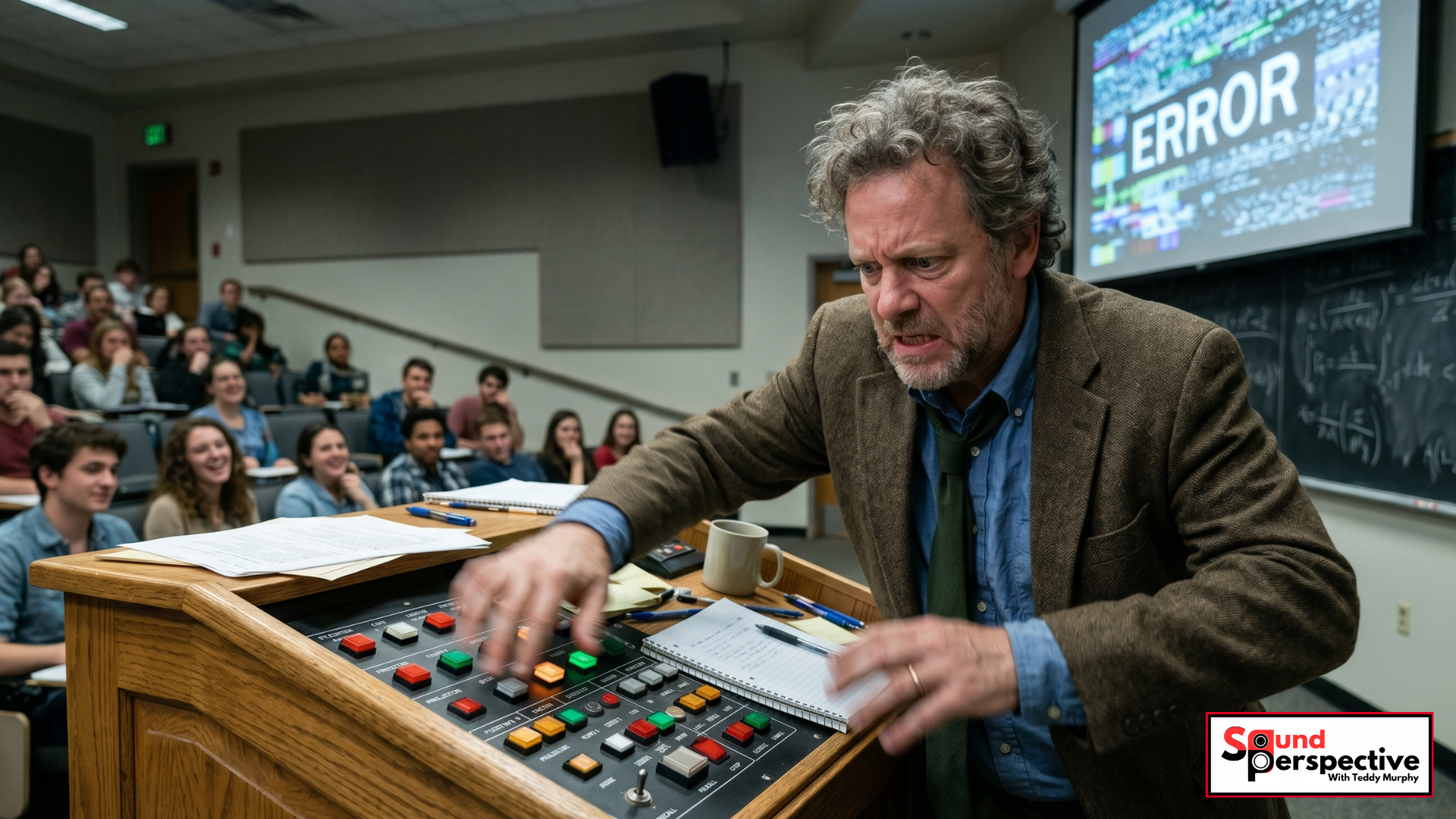
If you have spent any time supporting classrooms or events, you have seen this play out. Displays get turned off using the wrong control, which breaks the logic of the room. Laptops get unplugged in the middle of a session because something seemed slow. Microphones get muted and no one knows why the audio disappeared. Someone presses the wrong input, panics, and starts pressing everything else.
This is not misuse in the traditional sense. This is normal operation.
Designing around ideal behavior is a losing approach. Designing around predictable behavior is where reliable systems come from.
One of the biggest mistakes we make is confusing flexibility with usability. We like giving users options. Multiple inputs, multiple routing paths, advanced control pages. In some spaces, that is necessary. In most higher ed environments, it creates more problems than it solves.
Every additional option introduces a decision. Every decision introduces a point of failure.
A well-designed system should focus on what the room needs to do most of the time. Start the system. Select a source. Adjust volume. That should cover the majority of use cases. If a user has to think about how the system works, the design is already too complex.
Another reality is that if a system can be broken, it eventually will be. This is not a criticism of users. It is simply the result of giving people access to controls that can create conflicting states. If someone can turn off a display in a way that disrupts the control logic, it will happen. If someone can select an input that is not active, they will. If audio can be routed in a way that creates silence or feedback, it will occur at the worst possible time.
Good system design removes these possibilities. Unused inputs are eliminated. Critical functions are automated. Control interfaces are simplified to only what is necessary. The goal is not to limit users. The goal is to protect them from the system.
This is also where a little bit of smart DSP work can save you from a lot of bad days.
If you know someone is eventually going to push volume too far, design for it. A properly set limiter on your outputs can prevent clipping and protect both your speakers and your ears. Set your threshold just below the point where your system starts to distort, and you create a ceiling that users cannot exceed no matter how hard they try.
On the input side, light compression can go a long way in managing inconsistent microphone technique. Not everyone is going to speak at a consistent level or even stand in the same place. A gentle ratio with a reasonable threshold can help smooth that out without making the system feel unnatural. It is not about making it sound perfect. It is about keeping it usable.
Control systems can help here as well. Not every volume control needs to expose the full range of the DSP. If your system is properly tuned at a certain operating level, there is no reason to give users access to everything above it. Scaling your volume control so that the top of the slider represents a safe maximum instead of the absolute maximum can eliminate a lot of problems before they happen.
These are small decisions, but they make a big difference. They allow the system to absorb bad inputs without falling apart.
Training is often presented as the solution to these problems. While training has value, it is not a fix. People forget. Adjunct faculty may never attend. New users enter spaces throughout the semester. Even well-trained users will make different decisions when they are under pressure.
If a system only works correctly when someone remembers how to use it, then it is not a reliable system.
The most effective systems require little to no training for basic operation. They are intuitive enough that users can walk in, start the system, and be successful without thinking about it.
Consistency across rooms is one of the most powerful tools we have, and it is often overlooked. When every space behaves differently, users are forced to relearn the system every time they walk into a new room. When every space behaves the same way, users develop confidence.
Consistent startup behavior, consistent interface layouts, consistent microphone performance, and consistent input selection all contribute to a predictable experience. That predictability reduces support calls and improves outcomes for both faculty and students.
We do not operate in controlled environments. We operate in rooms that are used all day, every day, by people with different levels of experience and different priorities. Systems need to account for that reality. They should recover from incorrect actions. They should default to states that are functional. They should guide users back to where they need to be without requiring intervention.
The goal is not to build systems that work perfectly when used correctly. The goal is to build systems that continue to work even when they are not.
At the end of the day, users are not interacting with your system based on how it was designed. They are interacting with it based on habit, time pressure, and whatever worked the last time they were in the room.
Strong AV design acknowledges that. It anticipates mistakes. It reduces complexity. It creates an environment where technology supports the user instead of becoming another obstacle.
The best compliment you can get is not that the system is powerful or feature rich. It is that no one had to think about it at all.