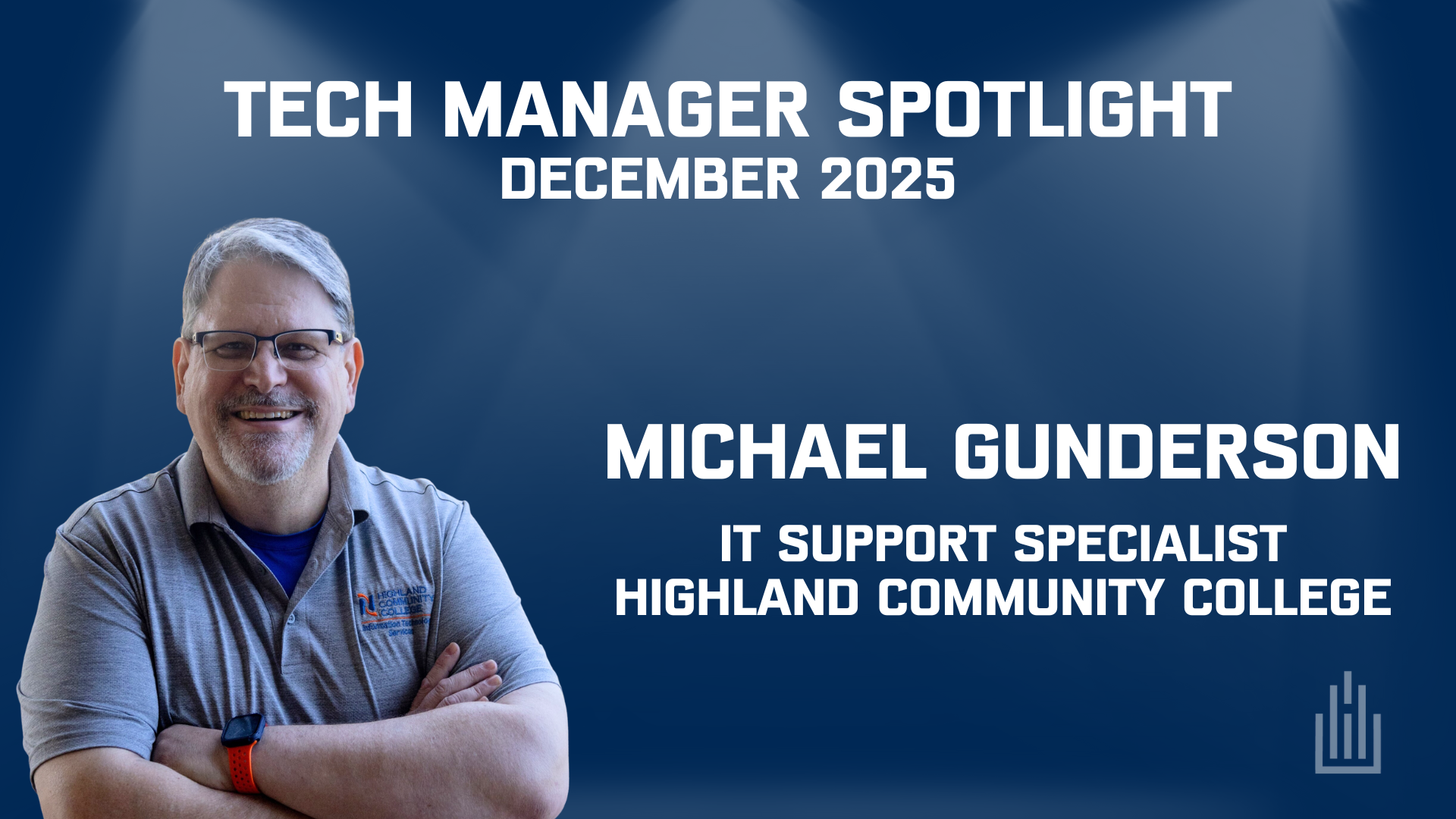

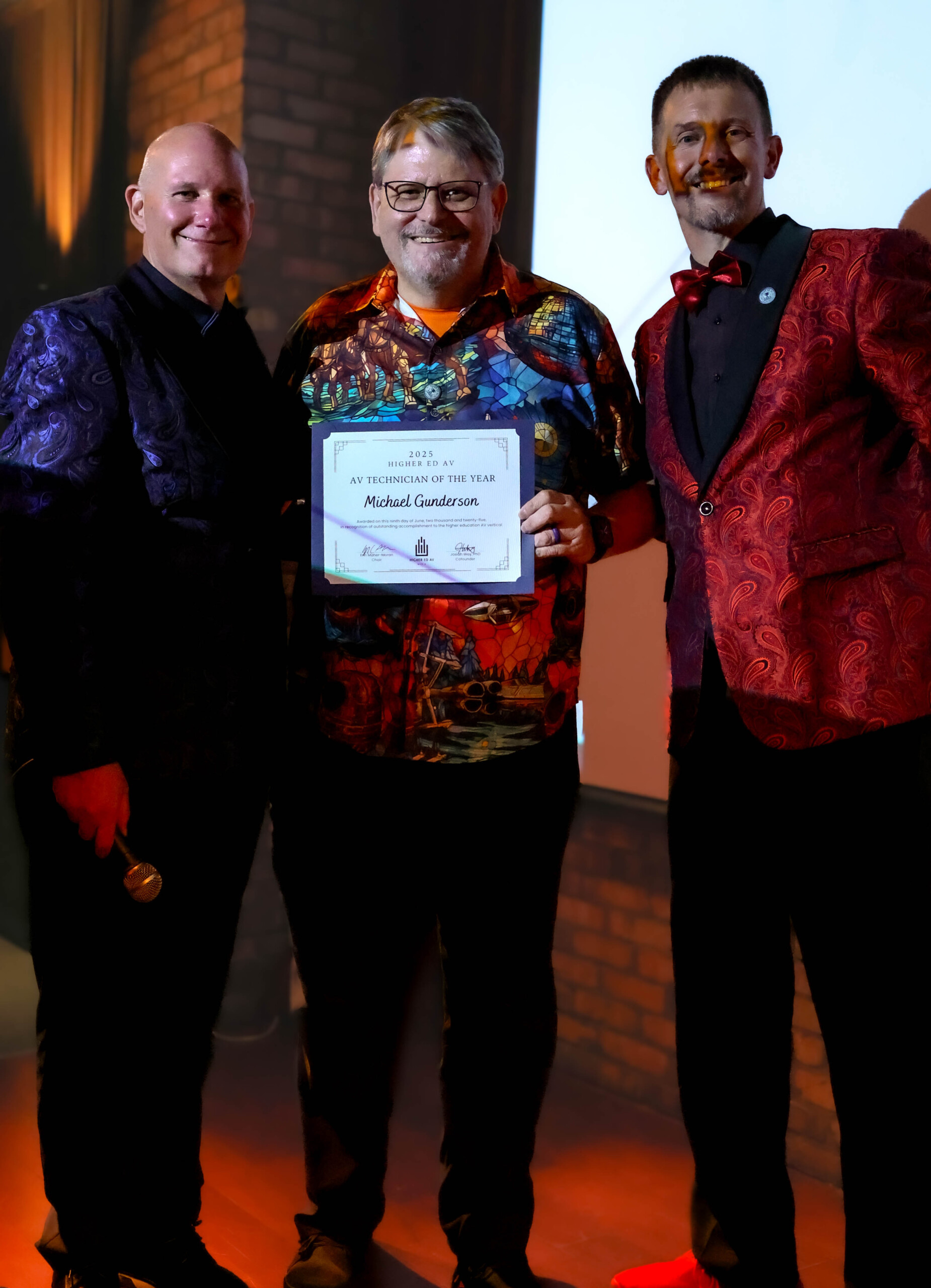
Welcome to this month’s edition of the Tech Manager Spotlight. Michael Gunderson is an IT Support Specialist and the sole AV professional at Highland Community College in Freeport, Illinois. His responsibilities span a wide range of tasks, including managing more than 50 classrooms equipped with full presentation systems, eight smaller huddle spaces and conference rooms with various display setups, and one large conference room that combines four spaces into a single 300-seat theater-style room. Any display or projector on campus falls under his oversight, including the digital signage system. In addition to AV duties, Mike also serves as the primary furniture buyer for the campus.
Mike believes in working with people rather than having them work for him. He prioritizes regular communication with ITS colleagues and is known for quick wit, a sarcastic sense of humor, and a positive attitude that helps influence and motivate others. Even on challenging days, he maintains a positive outward demeanor. He strongly believes that teams that talk, laugh, and have fun together collaborate more effectively and achieve better results.

Looking toward the future, Mike envisions AV moving toward fully AV-over-IP networked devices. He anticipates that AV-over-IP technology will continue to improve in efficiency and reliability, potentially reaching a point where it could integrate with regular campus network traffic. As LED wall prices decrease, he expects institutions to begin replacing projection systems in large and medium-sized rooms. To prepare for this shift, Mike emphasizes the importance of AV professionals honing networking skills to effectively collaborate with campus network security teams and communicate at their level when integrating more devices into the campus infrastructure.
Mike has learned to thoughtfully consider every commitment. A guiding principle he follows is: “If you never say no, your yes means nothing.” This philosophy reminds him that saying “yes” should always carry weight and intention.
Reflecting on his career, Mike notes that he once learned from “the old-timers” and now realizes he has become one himself. His advice to those starting out in any field is to listen to experienced professionals and learn from their insights. He also stresses the importance of taking detailed notes during discussions about technology changes in any space.
Mike recalls a pre-COVID project involving a science lab refresh, where a faculty member requested PTZ cameras and microphones. After the project was completed post-COVID, a misunderstanding arose when someone who missed the planning meeting objected to a camera installation, escalating the issue to the faculty union. What helped resolve the situation was Mike’s meticulous documentation—notes from his “AV bible” that included the original request, meeting date, and attendees. Sharing those notes and clarifying that the camera was only connected to the local PC quickly deescalated the conflict.
His key takeaway: always document needs analysis meetings thoroughly and keep those records for future reference. Mike’s final piece of advice is simple—make work fun. Life is too short not to enjoy what you do.
Have you always worked in AV? What did the path look like for you to get to where you are now?
My background is in video production, and prior to coming to Highland, I ran MRG Video Productions for over 20 years—12 of those years full-time. In my capacity as a wedding and event videographer and live video productions, I was able to see how facilities of various types used video and audio in their space. Some of them were very poor and outdated. To give back to my community, I started voluntarily offering my experience in the form as a consultant to help improve AV systems. In 2007 when the economy started a slight downturn, a part-time position was advertised at HCC as “Audio/Visual Technical Assistant”. In November 2007, I started my journey at HCC. Due to and unfortunate health issue, the lead of the AV department retired in 2010, making way for me to transfer into the full-time position. Over the past 18 years, I have grown my skillset and the technologies on campus.
What is your morning routine?
My normal routine is not what the average persons’ is. Living with a rare chronic illness throws a monkey wrench into any semblance of normalcy. When I wake up, there is usually a golden-doodle wanting snuggles. Next it is off for my morning pill regimen with my first dose of caffeine via SodaStream, and then get ready for work. During my get ready time, I check my phone for any overnight urgent messages and/or alerts. My commute is 30 minutes, so that is my time to prepare my brain for work. What I listen to in the car varies from day to day. Some days I spend that commute time catching up on the latest podcasts. Other days, my car is filled with the sounds of 80s hair metal from XM radio. Having a car with a H&K premium audio system is eventually going to catch up with me. (-8
What does an average weekday look like for you?
My weekday probably is like a lot of others. First fire up my office gear check emails, voice mails, zoom chat messages, service desk tickets and our conference center event calendar. Boring, right? I usually try logging into the HETMA community on my desktop during that time too. The rest of my average day is anything but average. Every single day is unique. Some days are spent planning upgrades, working on furniture projects, updating classroom confiigurations, installing new components, collaborating with faculty and staff, ad working with the community in our conference center. I wear many hats. Being an undiagnosed ADHD kid from the 70s and 80s has its advantages for me—I pivot well!
What are the challenges your role faces, and how do you overcome those?
When there are large events in our conference center, it can be very busy if service desk tickets or help desk calls come in. To mitigate issues during large events, I can be found logged into my PC and working in a secondary workspace outside our largest conference room. If calls come into our help desk, I may have to travel to one of 8 buildings on our 140 acre campus, to address the issue. Being the sole AV person, almost all classroom calls are forwarded to me, and require my attention. Since my classrooms are mostly standardized from building to building, I can talk folks through most issues. A good majority of my calls are from the computer not being turned on, or the input on the button panel is not selected appropriately. Since GVE and our Aruba switches in the classrooms both monitor uptime, I can proactively fix issues without anyone knowing I worked in the room.
Like many others in similar positions to mine, there are days when I am out of my office more than I am in it–meetings, troubleshooting user problems, etc.
What do you enjoy doing on weekends? How do you spend your time outside of work?
If I have a busy week at work, it usually takes the weekend for me to recharge–where I am a homebody. For 34 great years, my wife and I have become a great team together, and we do tend to do everything together—especially with our dog, Millie Rose. I do get a huge amount of joy sharing Millie with our community. She is a certified therapy dog and a part of the SSM Health Monroe Clinic Hospice Pet Program. At least twice a month we share her love with others so they can have a better day.
Comparing your career path over time, what are some of the moments, accomplishments, or projects that you’re most proud of?
When I started at HCC in 2007, we had 12 rooms with permanently installed presentation systems. The institution was 100% contractor dependent for any/all installations—all of which were VGA based. In my first 10 years, I installed projectors and equipment in all the remaining spaces, replaced every workstation on campus, and added document cameras and presentation switchers to those spaces. I’ve had a hands-on role in 5 rounds of projector replacements, a campus wide digital room update, and a complete conversion of all standard learning spaces into HyFlex* and Hyflex Plus** (*simple solutions with high-end web cameras, ** PTZ cameras and built in room mics). Now that every space has presentation switchers, laser projectors, and control systems, it is getting more difficult to replace/update those spaces in large numbers by myself. By relying on our preferred vendor/partner and their installers, I can manage large implementations in limited/short timelines. After almost 18 years at HCC, I have become more contractor dependent than I ever thought I would.
In my AV role, I am very proud of the current classroom designs and the consistent up-time of those spaces. For the past ten years I have been working on increasing the functionality and flexibility of classrooms and conference rooms, all while maintaining consistent and simple user experiences. Even when I work with external contractors, we are installing my designs and leveraging their installation experience and manpower. This summer, we installed 5 rooms as part of site improvements in 7 working days—one of which is a large multi projection lecture hall utilizing AV over IP.
Since I am also the furniture buyer, I have had a lot of projects that come to mind. Over the past 10 years, I have been the lead person on renovating soft seating in several buildings, redesigning our cafeteria from square institutional tables to a new modern space with various types of seating (and outlets galore), a campus wide student desk replacement project, a complete renovation and redesign of our testing center (and this summer relocating it to a new location/building). Most of these projects were identified as spaces needing attention by our Learning Spaces Committee.
What inspired you to get involved with HETMA, AVIXA, and other higher-ed orgs?
In 2011, took a CTS-prep class and passed my CTS exam. I was interested in how to better communicate with our partners. Since then, I have been able to work more effectively with our facilities, architects and the HCC faculty and staff! Just being able to create an appropriate needs analysis with campus stakeholders has been the game-changer for me. HETMA appealed to me because us small community college people rarely had a voice with manufacturers and integrators. Now, Mike at Highland Community College has almost as much of a voice as someone at a major university.
Where do you see your career trajectory going in the next five years? Where do you envision yourself?
Most likely, in five to seven years, I will be passing my skill-set and day to day job to someone else while preparing for retirement. Hey HETMA Board, is there a place in the organization for retired technology managers? Can I still be a part of the HigherEd community when that happens?
Tell us about a project you are currently working on now?
I just finished a complete renovation of our eSports room. I redesigned the room functionality by adding a second matrix switcher (thanks to WyreStorm and HETMA Approved program). I topped it all off with two Extron multi window processors and 12-inch touch panel. Our coaches worked with me the whole way and helped to create the touch panel GUI to make it function best for them, and it became my priority to tailor the logic and functionality the way they needed it. It is an amazing room now, and the team and coaches are using it with huge success.
Today, I am updating two large classrooms with Mic arrays, PTZ cameras, Inogeni switchers and new projectors. This is a project where the cables will be pulled over time and products installed during the course of this semester. By doing the labor in-house (with the help of an amazing student worker), we are saving over $30K in implementation fees.
What is your life motto and how do you apply it to your daily routine?
I had to think long and hard about my life motto. In my personal life (fighting an autoimmune disease) my life motto is “You never know how strong you are until strong is the only thing you have.” In my professional life, I refer to a quote from Jeremy Gutsche from a keynote he gave at a UBTech conference: “Complacency will be the architecture of your downfall!” Over the years, I have watched people become complacent in their jobs and careers, and in almost every circumstance, their career and/or personal life has been negatively impacted.
Connect with Michael Gunderson:
LinkedIn: https://www.linkedin.com/in/michael-gunderson-cts/